

Key takeaways
- Buying for the best day, not the average day. Count how many truly clear, high-sun days your area gets before paying for a model that depends on them.
- Oversizing or undersizing capacity. A solo tube cooker cannot feed a family, and a bulky box oven is a chore to haul for a single serving.
- Ignoring storage and weight. A cooker that is awkward to carry or store tends to stay in the garage.
- Skipping a thermometer. Looking done is not the same as being safe, especially for chicken and reheated leftovers.
- Expecting stovetop speed. Slow dishes like dried beans take hours even in strong sun, so plan the meal around the cooker and start early.
- Treating a hybrid as a pure solar tool. If your goal is cooking with zero electricity, the electric backup on a hybrid adds cost you may never use.
The best solar cooker for most people is the GoSun Sport, a vacuum-tube cooker that reaches oven-like temperatures in sunshine and cooks a small meal in well under an hour. If you want to bake bread, roast, or cook for a family, the All American Sun Oven is the better fit because it takes standard pots and pans. For a single serving or a backpack, the GoSun Go is the lightest option. Every solar cooker depends on direct sun, so match the design to your climate and the amount of food you cook.
Our top picks


As an Amazon Associate we earn from qualifying purchases at no extra cost to you.
Quick comparison of the best solar cookers
| Pick | Best for | Type | Key specs (per maker, approximate) | Price range |
|---|---|---|---|---|
| GoSun Sport | Best overall | Evacuated tube with reflectors | Up to about 550 F; small meal for 1 to 3 people | Mid-range |
| All American Sun Oven | Best for families and baking | Box oven with reflectors | Roughly 350 to 400 F; fits standard pots and bakeware | Premium |
| GoSun Go | Best ultralight and solo | Evacuated tube | About 0.9 L capacity; 1 to 2 servings | Budget to mid-range |
| GoSun Fusion | Best hybrid (sun or electric) | Tube plus electric backup | About 14 lb; around 3 L capacity | Premium |
| Sunflair Portable Solar Oven | Best low-cost folding oven | Reflective folding oven | Lightweight and foldable; best for slower cooking | Budget |
Figures are drawn from manufacturer descriptions and published reviews, and vary by model year. Confirm the specs of the exact version before buying.
Best overall: GoSun Sport
The Sport traps heat inside a double-walled evacuated glass tube, with folding reflectors focusing sunlight onto it. Maker materials and reviewers describe internal temperatures as high as about 550 degrees Fahrenheit, and a typical meal cooks in roughly 20 to 40 minutes in strong sun. Because the tube is insulated like a thermos, it works in cooler air and can cook in cold but sunny weather.
The trade-off is capacity. The tube holds on the order of a pound or two of food, so it suits one to three people rather than a big family dinner. It also needs fairly clear sun and periodic repositioning.
Best for families and baking: All American Sun Oven
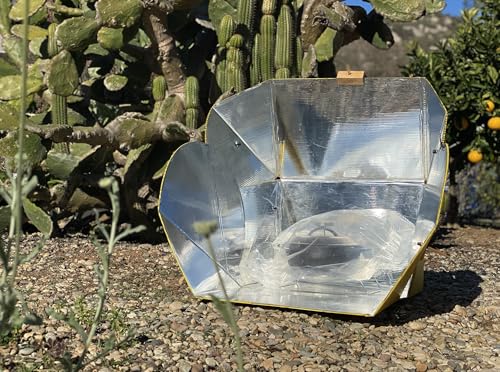
This is a reflector-lid box oven with a tilting stand and a leveled interior. It reaches typical oven-like temperatures in good sun, which means you can bake bread, roast vegetables, and cook casseroles or rice in standard cookware. It is the one most often recommended for emergency preparedness because of its capacity.
It is bulky and heavy compared with tube cookers, and it costs more. Its large reflectors also need regular rotation toward the sun.
Best ultralight: GoSun Go
The Go is the smallest GoSun, with roughly a 0.9 liter capacity that feeds one or two people. It folds down small enough for a pack or a car trunk, and the tube design lets you cook eggs, rice, or vegetables outdoors without fuel.
It is less useful for family-sized meals. Think of it as a camp lunch tool rather than a kitchen replacement.
Best hybrid: GoSun Fusion
The Fusion adds an electric element and battery or plug-in capability to the evacuated tube design, so you can still cook when clouds roll in. With a capacity near 3 liters and weight around 14 pounds, it is the most flexible tube cooker for homes, cabins, and RVs.
It is among the most expensive options, and a hybrid is less appealing if your goal is to avoid all electricity.
Best budget folding oven: Sunflair Portable Solar Oven
Folding reflective ovens are the cheapest route to solar cooking. The Sunflair collapses flat for storage and uses a pot inside a clear bag or enclosure. It suits slow cooking, warming meals, and learning how solar cooking works.
These designs are slower and reach lower temperatures than evacuated tubes or box ovens, and they are more sensitive to wind and cloud cover.
How to choose a solar cooker
Pick the design that fits your cooking
Tube cookers heat fastest and run hotter. Box ovens cook the most food and bake. Folding panels and parabolic reflectors are cheaper or can reach high temperatures but require more attention. Decide whether you mainly want fast single servings or bigger meals.
Check sun hours and climate
Solar cookers need direct sun, ideally between about 10 a.m. and 3 p.m. In many parts of the northern United States, that works from late spring to early autumn. Winter performance drops sharply because the sun is lower and days are shorter, and tube designs hold up better in cold air.
Consider capacity and weight
Count the people you cook for. A rough planning guide is about 0.4 to 0.5 liters of food capacity per person for a main meal. A two-person household can use a small tube cooker, while a family of four does better with a box oven or a larger hybrid.
Plan for safety
Surfaces can reach very high temperatures, so use oven mitts and sunglasses, and never leave reflectors aimed where they can concentrate light on flammable materials. Use a food thermometer, and cook meat to USDA safe internal temperatures such as 165 degrees Fahrenheit for poultry.
Cooking time and fuel savings example
As a planning example, suppose you cook rice and vegetables twice a week from May through September, about 40 meals a season. A propane or electric stove might use the equivalent of 20 to 30 minutes of burner time per meal, so a solar cooker removes roughly 13 to 20 hours of fuel use per season. The savings in money are modest, but the bigger gain is cooking without heating the kitchen and keeping the ability to cook during a power or fuel outage. Treat these figures as estimates that vary with your stove and sun.
| Dish | Cooker type | Planning time in strong sun |
|---|---|---|
| Rice (2 cups cooked) | Tube | About 30 to 45 minutes |
| Chicken pieces | Tube or box oven | About 45 to 90 minutes |
| Bread loaf | Box oven | About 60 to 90 minutes |
| Beans, pre-soaked | Box oven or folding oven | 2 to 4 hours |
What to Look For in a Solar Cooker
Heat Retention When Conditions Are Not Perfect
Peak temperature matters less than how well a cooker holds heat when a breeze blows or a cloud passes. Evacuated-tube designs insulate the food chamber much like a thermos, so they lose little heat between sun breaks. Box ovens rely on a sealed lid and a glazed window, while folding reflective ovens depend on a bag or enclosure that leaks heat faster. If your region has gusty afternoons or patchy cloud, favor the better-insulated designs.
How Often You Must Re-Aim It
The sun moves roughly 15 degrees across the sky every hour, so every cooker drifts out of alignment during a long cook. Solar-cooking community guidance says box ovens with a single back reflector rarely need turning except for slow dishes such as beans, while panel-style cookers need more frequent adjustment. Check whether a model includes a tilting stand or tracking aid, because a cooker you must babysit every twenty minutes is hard to use on a busy day.
Cookware Fit and Food Safety Margins
Dark, thin-walled, lidded pots absorb more heat than shiny or glass ones, and a cooker that accepts standard cookware gives you far more recipe options than one built around a fixed tube. Food safety still sets the finish line: the USDA treats 40 to 140 degrees Fahrenheit as the range where bacteria multiply fastest, so a slow-heating cooker that sits in that zone for hours is a risk. Pair any model with a probe thermometer and aim for 165 degrees Fahrenheit for poultry and leftovers.
Which One Should You Buy?
| If you… | Choose… |
|---|---|
| Cook for one to three people and want fast, hot results | GoSun Sport |
| Bake bread or cook family-sized meals in your own pots | All American Sun Oven |
| Carry gear in a backpack or cook for one or two | GoSun Go |
| Want a backup for cloudy days, cabins, or an RV | GoSun Fusion |
| Are learning solar cooking and want the lowest-cost entry | Sunflair Portable Solar Oven |
If two rows seem to fit, let climate break the tie. Cooler, windier regions favor an insulated tube, while sunny, dry regions make a large box oven more practical.
Common Mistakes When Buying a Solar Cooker
- Buying for the best day, not the average day. Count how many truly clear, high-sun days your area gets before paying for a model that depends on them.
- Oversizing or undersizing capacity. A solo tube cooker cannot feed a family, and a bulky box oven is a chore to haul for a single serving.
- Ignoring storage and weight. A cooker that is awkward to carry or store tends to stay in the garage.
- Skipping a thermometer. Looking done is not the same as being safe, especially for chicken and reheated leftovers.
- Expecting stovetop speed. Slow dishes like dried beans take hours even in strong sun, so plan the meal around the cooker and start early.
- Treating a hybrid as a pure solar tool. If your goal is cooking with zero electricity, the electric backup on a hybrid adds cost you may never use.
Frequently Asked Questions
Do solar cookers work in winter or on cloudy days?
They work best in direct sun. Evacuated tube models can still cook on cold, sunny days, but heavy clouds greatly slow or stop cooking. A hybrid model with an electric backup solves this.
How hot do solar cookers get?
Evacuated tube cookers can reach roughly 500 degrees Fahrenheit or more according to makers, box ovens commonly reach 300 to 400 degrees, and folding panel cookers usually peak lower. Actual temperatures depend on sun angle, air temperature, and load.
Can you bake in a solar oven?
Yes, in box ovens that accommodate pans and reach roughly 350 degrees. Bread, casseroles, and cookies work well in good sun, though baking times are longer than in a kitchen oven.
Are solar cookers safe?
They are safe when used with normal precautions. Handle hot cookware with mitts, protect your eyes from reflected glare, and use a thermometer to confirm food reaches safe internal temperatures.
How much does a solar cooker save?
Savings in fuel are small for most households, but a solar cooker keeps the kitchen cool, cuts emissions from cooking during sunny months, and gives you an off-grid cooking option for camping and emergencies.
More from Amazon
Programs that pair well with the guide above. Offers and eligibility are set by Amazon and may change.
Free shipping on eligible items, Prime Video and more. Eligible new members can start with a free trial.
Start a Prime free trialA Prime membership for ages 18-24 with a trial period. Eligibility is set by Amazon.
See Prime for Young AdultsAudiobooks and podcasts to listen to on the go. Eligible new members can start with a free trial.
Try Audible freeAd-free music streaming. Eligible new subscribers can start with a free trial.
Try Music Unlimited freeAs an Amazon Associate we earn from qualifying purchases.
Write Your Review
No reviews yet. Be the first to share your experience!