

Key takeaways
- Mounting: Use corrosion-resistant brackets and hardware, and follow the roof manufacturer’s guidance for penetrations. A bonded system avoids drilling but depends heavily on surface preparation and compatible sealants.
- Cable routing: Use outdoor-rated solar cable, protect it from sharp edges, and secure it against vibration. Keep positive and negative conductors together where practical to reduce loop area.
- Fuses and disconnects: Install protection appropriate to the array, controller, battery, and conductor sizes. A roof-mounted disconnect can make servicing safer.
- Battery matching: Set the controller for the correct battery chemistry and charging profile. Lithium iron phosphate batteries, AGM batteries, and flooded lead-acid batteries do not use identical settings.
- Voltage drop: Long, undersized cables waste energy. The higher-current battery side deserves particular attention, because even a small voltage drop can affect charging performance.
The best RV solar panels for reliable camp power are usually rigid monocrystalline panels for frequent travel and maximum durability, while flexible panels make more sense when roof weight, clearance, or a curved surface matters more than long-term service life.
Our top picks
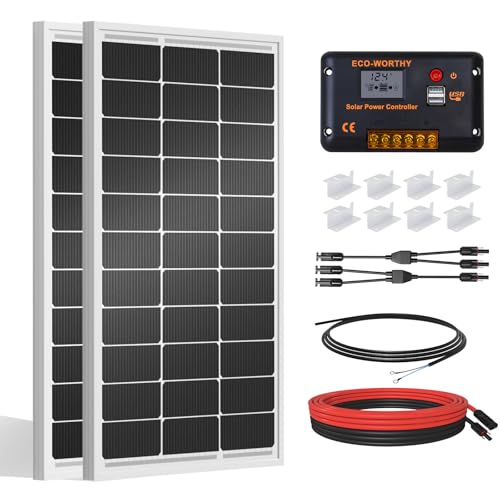


As an Amazon Associate we earn from qualifying purchases at no extra cost to you. Ratings are shown as listed on Amazon.
Quick Picks by RV Situation
| RV situation | Best panel choice | Practical starting size | Why |
|---|---|---|---|
| Weekend camping with lights, phones, and a refrigerator | Rigid monocrystalline | 200–400 watts | Good output, reasonable cost, and better airflow beneath the panels |
| Low-clearance van or curved fiberglass roof | Flexible monocrystalline | 100–300 watts | Lightweight and easier to conform to a modest curve |
| Long boondocking stays with an inverter | Rigid panels with MPPT controller | 400–800 watts | Higher harvest and better energy conversion in cool or variable conditions |
| Small roof with frequent partial shade | Several smaller rigid panels | 300–600 watts | Allows more flexible placement and can reduce the effect of one shaded section |
| Portable, occasional use | Folding portable panel | 100–200 watts | Can be moved into the sun while the RV remains parked in shade |
Rigid vs. Flexible RV Solar Panels
Rigid panels: the better default for many RVs
Rigid panels typically use glass over monocrystalline silicon cells, an aluminum frame, and a junction box rated for outdoor exposure. The glass protects the cells from branches, hail, cleaning, and repeated temperature changes. An air gap below the panel also helps it run cooler; solar panels generally produce less power as cell temperature rises.
The tradeoff is installation effort. Rigid panels need mounting brackets, roof penetrations or a carefully designed adhesive system, and enough clearance to avoid roof fixtures and vents. A typical 100-watt rigid panel may be about 42 by 20 inches and weigh roughly 14 to 18 pounds. Four panels can therefore occupy around 23 square feet and add 55 to 70 pounds before brackets and wiring.
Flexible panels: light and discreet, but less forgiving
Flexible panels commonly use polymer-coated surfaces and can weigh about 4 to 8 pounds for a 100-watt panel. They are useful on van roofs, lightweight trailers, and surfaces where a framed panel would interfere with clearance. Installation can be as simple as bonding the panel to the roof and routing the cable through a sealed entry gland.
That low profile creates two ownership concerns. First, a panel bonded directly to the roof has little airflow underneath, so heat can reduce output. Second, the plastic surface can haze, scratch, or develop edge and laminate problems sooner than glass if it is flexed repeatedly, walked on, or exposed to harsh conditions. Do not assume “flexible” means walkable; most panels are not designed for foot traffic.
How Much Solar Power Does an RV Need?
Size the system from daily energy use rather than from battery capacity alone. A useful planning estimate is:
Daily solar watt-hours needed = daily appliance watt-hours ÷ system efficiency.
For a basic example, suppose an RV uses 600 watt-hours per day for a 12-volt compressor refrigerator, lights, phones, and a water pump. Allowing for controller, wiring, temperature, and charging losses, divide by about 0.75:
600 ÷ 0.75 = 800 watt-hours of solar production required.
In a location averaging four effective sun-hours per day, a 300-watt array could theoretically produce 1,200 watt-hours. After real-world losses, approximately 850 to 1,000 watt-hours may be available, making 300 watts a reasonable starting point. Cloud, tree shade, dust, roof orientation, and seasonal sun can reduce that figure substantially.
High-draw appliances change the calculation. A 1,000-watt appliance used for 30 minutes consumes about 500 watt-hours before inverter losses. Running an air conditioner, electric kettle, induction cooker, or space heater from solar requires a much larger array, a suitably sized battery bank, an inverter with surge capacity, and enough sunlight to replace the energy.
Charge-Controller Compatibility Matters
PWM controllers
Pulse-width modulation controllers are inexpensive and can work acceptably with small, simple 12-volt systems when the panel voltage closely matches the battery bank. They are less effective when roof wiring is long, ambient temperatures are low, or the array uses higher-voltage residential-style panels.
MPPT controllers
Maximum power point tracking controllers usually extract more energy by converting excess panel voltage into useful charging current. They are particularly helpful when panels are wired in series, when cable runs are long, or when the roof has limited space and higher-voltage panels are desirable. A controller must be rated for both the array’s maximum input voltage and its maximum charging current.
For a 400-watt array charging a nominal 12-volt battery bank, the ideal charging current is approximately:
400 watts ÷ 14.4 volts = 27.8 amps.
Allowing for charging peaks and design margin, a 30-amp controller may be marginal depending on the manufacturer’s limits; a 40-amp controller is often a more comfortable match. Confirm the controller’s specifications rather than sizing from the panel’s advertised wattage alone.
Roof Space, Wiring, and Partial Shade
Measure usable roof areas around vents, air conditioners, antennas, skylights, and access panels before buying panels. Leave room for wiring bends, drainage, maintenance, and safe access. A high-wattage panel is not automatically the best choice if one large panel cannot fit in the available space.
Partial shade is one of the most important differences between an RV array and a clear-roof installation. In a series string, shade on one panel can restrict current through the string, although bypass diodes may limit the affected section. Parallel wiring can preserve output from unshaded panels but usually requires heavier wiring and appropriate overcurrent protection.
Several smaller panels can be easier to arrange around roof fixtures than one large panel. However, panel placement alone cannot defeat heavy shade. If trees cover most of the roof, a portable panel placed in a sunny clearing may produce more energy than a larger roof array left under branches.
Installation Choices That Affect Reliability
- Mounting: Use corrosion-resistant brackets and hardware, and follow the roof manufacturer’s guidance for penetrations. A bonded system avoids drilling but depends heavily on surface preparation and compatible sealants.
- Cable routing: Use outdoor-rated solar cable, protect it from sharp edges, and secure it against vibration. Keep positive and negative conductors together where practical to reduce loop area.
- Fuses and disconnects: Install protection appropriate to the array, controller, battery, and conductor sizes. A roof-mounted disconnect can make servicing safer.
- Battery matching: Set the controller for the correct battery chemistry and charging profile. Lithium iron phosphate batteries, AGM batteries, and flooded lead-acid batteries do not use identical settings.
- Voltage drop: Long, undersized cables waste energy. The higher-current battery side deserves particular attention, because even a small voltage drop can affect charging performance.
When drilling into an RV roof, locate wiring, framing, plumbing, and interior fixtures first. If the roof construction or battery wiring is unfamiliar, an RV solar installer or qualified electrician can prevent expensive water damage and electrical faults.
Durability and Ownership Realities
Solar panels are relatively low-maintenance, but the surrounding system has more failure points. Roof seals can crack from ultraviolet exposure and movement. Cable glands can loosen. Adhesive-backed flexible panels can lift at corners. Connectors can corrode if they are left where water pools, and controller fans or displays can eventually fail.
Inspect roof penetrations and bonded edges at least twice a year and after severe storms. Wash dirt, bird residue, and tree sap with water and a soft cloth; abrasive pads and harsh solvents can damage panel surfaces and roof coatings. Avoid coating panels with wax or “protective” products unless both the panel manufacturer and RV roof manufacturer approve them.
Do not park with heavy objects on flexible panels, and do not disconnect a charge controller from the battery while the panel array is still connected unless the controller instructions specifically allow it. Many controllers use the battery connection to establish system voltage.
Bottom Line
Choose rigid monocrystalline panels if you camp regularly, have adequate roof space, and want the strongest long-term balance of output and durability. Choose flexible panels when low weight, low clearance, or a curved roof is decisive, while accepting potentially shorter service life and more heat-related output loss. For shade-prone sites, prioritize movable panels or a layout of multiple smaller panels, and pair the array with an MPPT controller when the wiring, panel voltage, or system size justifies it. The best RV solar panels are the ones that fit the usable roof, match the controller and battery, and produce enough energy for the way you actually camp.





Write Your Review
No reviews yet. Be the first to share your experience!