

Key takeaways
- CRI: aim for 90 or higher for rooms where color matters. Standard bulbs sit around 80.
- Base and shape: E26 A19 is the common US bulb; candelabra, GU10 and BR30 floods are different.
- Enclosed fixtures: use bulbs rated for enclosed fixtures, as trapped heat shortens LED life.
- Rated life: 15,000 hours or more is typical, which is over 13 years at 3 hours a day.
- ENERGY STAR: certification includes testing on lumen output, color and lifetime claims.
The best LED light bulb for most rooms is a 800-lumen, 2700K to 3000K, 90-plus CRI A19 bulb from a major maker such as Philips, GE or Feit Electric, with ENERGY STAR certification. That one spec set replaces a 60-watt incandescent while using about 9 watts. Choose by lumens (brightness), color temperature (warm or cool) and CRI (color accuracy), not by watts.
Our top picks



As an Amazon Associate we earn from qualifying purchases at no extra cost to you.
Quick comparison
| Pick | Best for | Typical spec | Dimmable | Price tier |
|---|---|---|---|---|
| Philips LED A19 soft white | Best all-round | 800 lm, 2700K, about 9 W | Many models | Budget |
| GE Relax and similar GE LED | Value multipacks | 800 lm, 2700K | Check the pack | Budget |
| Feit Electric Enhance | High color accuracy | 800 lm, 90-plus CRI | Yes, on most | Budget to mid |
| Sylvania Natural or Ultra | Dimming and bright rooms | 800 to 1100 lm | Yes | Mid-range |
| Philips Hue White and Color | Smart control | 800 lm, adjustable color | Yes, via app | Premium |
Specifications are typical for each line; always confirm the lumen, kelvin and dimming figures on the pack of the exact product you choose.
Best all-round: Philips LED soft white
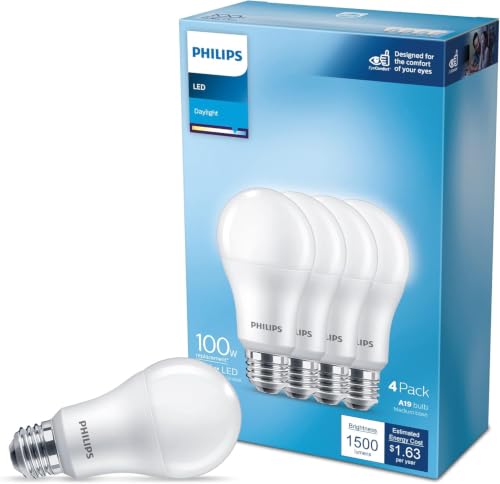
Philips bulbs are widely stocked, come in many bases and are often ENERGY STAR certified. A basic 9-watt, 800-lumen model is the sensible choice for lamps and ceiling fixtures. The trade-offs are that standard versions have CRI in the 80s and that some are not dimmable.
Best value: GE LED multipacks
GE sells multipacks that cut the per-bulb cost, which is useful when you replace every bulb in the house. Its Relax line targets warm light. Check the pack for dimming and enclosed-fixture ratings before you fill every socket.
Best color accuracy: Feit Electric Enhance
Feit’s Enhance line advertises 90-plus CRI, which makes food, skin and fabrics look more natural. This matters most in kitchens, bathrooms and workspaces.
Best for dimmers: Sylvania Natural
Dimming with LEDs can cause flicker or buzzing with older dimmers. Bulbs sold as dimmable and tested for flicker help, and replacing an old dimmer with an LED-rated one cures most issues.
Best smart option: Philips Hue
Hue bulbs link to an app or hub, let you change brightness and color and can follow schedules. They cost more per bulb, so use them where control matters, such as bedrooms and living rooms.
Worked calculation: lumens, watts and energy
Brightness is measured in lumens, and an LED needs far fewer watts to produce them. The table converts common incandescent equivalents.
| Old bulb | Lumens needed | Typical LED wattage |
|---|---|---|
| 40 W | 450 lm | 4 to 5 W |
| 60 W | 800 lm | 8 to 10 W |
| 75 W | 1,100 lm | 11 to 13 W |
| 100 W | 1,600 lm | 14 to 17 W |
Energy per year follows from watts times hours. A 60-watt bulb used 3 hours a day runs about 65.7 kilowatt-hours a year (60 x 3 x 365 / 1000). A 9-watt LED over the same hours uses about 9.9 kilowatt-hours, which is a saving of about 56 kilowatt-hours per bulb. Replace 20 bulbs and you save about 1,100 kilowatt-hours a year, plus the heat they would have added to your home in summer.
Choose the right color temperature
| Kelvin | Look | Best rooms |
|---|---|---|
| 2700K | Warm white, like incandescent | Living rooms, bedrooms, dining |
| 3000K | Soft white, slightly crisper | Kitchens, bathrooms |
| 4000K | Neutral white | Garages, offices, laundry rooms |
| 5000K | Daylight, bluish | Workshops, task lighting |
Keep the same color temperature within a room, since mixing 2700K and 5000K looks patchy.
What else to check
- CRI: aim for 90 or higher for rooms where color matters. Standard bulbs sit around 80.
- Base and shape: E26 A19 is the common US bulb; candelabra, GU10 and BR30 floods are different.
- Enclosed fixtures: use bulbs rated for enclosed fixtures, as trapped heat shortens LED life.
- Rated life: 15,000 hours or more is typical, which is over 13 years at 3 hours a day.
- ENERGY STAR: certification includes testing on lumen output, color and lifetime claims.
Mistakes to avoid
- Buying by watts. Use lumens; a 9 W bulb can be as bright as a 60 W old one.
- Using non-dimmable bulbs on a dimmer. It leads to flicker and early failure.
- Ignoring the disposal. LED bulbs contain electronics, so use a retail recycling program where available.
- Choosing 5000K for living areas. It looks harsh at night and may disrupt evening relaxation.
Decision matrix by room
| Room | Brightness | Color temperature | CRI target | Dimmable? |
|---|---|---|---|---|
| Living room | 800 lm per lamp, 1,500 to 3,000 lm in total | 2700K | 80 to 90 | Yes |
| Bedroom | 450 to 800 lm | 2700K | 80 to 90 | Yes |
| Kitchen | 1,100 to 1,600 lm per fixture | 3000K to 4000K | 90 | Optional |
| Bathroom vanity | 800 to 1,100 lm per bulb | 3000K | 90 | Yes |
| Home office | 1,100 lm or more | 4000K | 90 | Optional |
| Garage and basement | 1,600 lm or more | 4000K to 5000K | 80 | No |
Bulb shapes and bases
- A19, E26 base: the standard household bulb for lamps and ceiling fixtures.
- BR30 and PAR38 floods: recessed ceiling cans and outdoor floodlights; choose wet-rated bulbs outdoors.
- Candelabra E12: chandeliers and decorative sconces, often with low lumen output.
- GU10 and MR16: track and spot lights, which need the right voltage and pin type.
- Filament-style LEDs: clear glass with visible filaments for exposed pendant fixtures, usually warm and dimmable.
Why a bulb may flicker or hum
Flicker usually comes from an incompatible dimmer, a loose socket or a low-quality driver in the bulb. Try the bulb in a lamp without a dimmer first. If it behaves, replace the wall dimmer with one labeled for LED loads; the minimum load rating matters because a few low-wattage LEDs can fall below it. Mixing different LED brands on one dimmer can also cause uneven dimming, so use the same product across a circuit. Hot, enclosed fixtures shorten driver life, which is why bulbs rated for enclosed use are worth the small extra cost.
Frequently Asked Questions
How many lumens do I need?
Plan roughly 450 lumens for lamps, 800 for general room lighting and 1,100 or more for kitchens and workspaces.
What does CRI mean on a bulb?
CRI stands for color rendering index, a scale up to 100 showing how accurately colors look under the bulb. 90 or higher is considered good.
Why do LED bulbs flicker on dimmers?
Old dimmers were designed for high-wattage incandescents. Use dimmable LEDs and, if needed, an LED-compatible dimmer.
Do LED bulbs really last 15 years?
Rated life is a lab estimate at about 3 hours a day. Heat, enclosed fixtures and voltage swings can shorten it.
Are smart bulbs worth it?
They are worth it where scheduling, dimming or color control adds value, but plain LEDs are better for closets and hallways.




Write Your Review
No reviews yet. Be the first to share your experience!