

Key takeaways
- RV air conditioner: approximately 1,300–1,800 running watts, with a much higher brief startup demand
- Microwave: approximately 1,000–1,500 watts while heating
- Converter or battery charger: approximately 300–800 watts, depending on the charging rate
- Refrigerator: approximately 300–600 running watts, with a motor startup surge
- LED lighting and electronics: usually 50–200 watts combined
The best RV generators are quiet inverter models sized around your actual appliances: choose a 2,200–2,500-watt unit for basic charging and one small appliance, or a 3,700–4,500-watt model if you need air-conditioning, microwave use, or several loads at once.
Our top picks
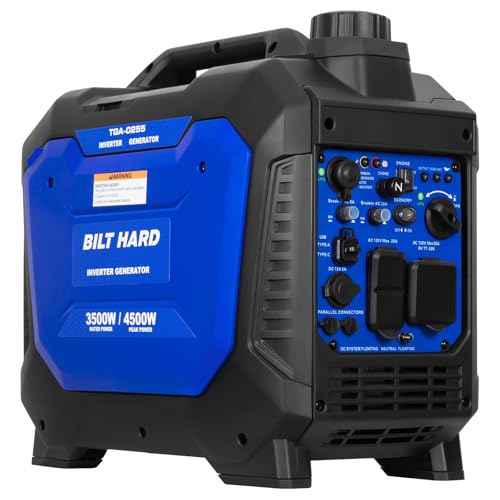


As an Amazon Associate we earn from qualifying purchases at no extra cost to you. Ratings are shown as listed on Amazon.
Quick picks by RV situation
| RV situation | Best fit | Why it makes sense | Main compromise |
|---|---|---|---|
| Small camper, occasional weekend use | Honda EU2200i or Yamaha EF2200iS | Quiet, compact gasoline inverter power with strong voltage regulation | Usually cannot start a standard RV air conditioner alone |
| Lightweight equipment and backup propane | Champion 2500-Watt Dual Fuel Inverter | Low carry weight and gasoline/propane flexibility | Less output on propane and fewer reserves for large startup loads |
| Frequent boondocking with a 13,500-BTU air conditioner | Westinghouse iGen4500DF or a comparable 3,700-watt-plus inverter | More running capacity, remote/electric starting on applicable configurations, and better air-conditioner headroom | Heavier, larger, and more expensive to transport |
| Long periods away from fuel stations | Dual-fuel inverter generator | Propane stores well and gives a second fuel option | Propane generally provides less power and can be less efficient in cold weather |
What matters more than the headline wattage
Running watts versus surge watts
Running watts are the continuous electrical supply a generator can provide. Surge, starting, or peak watts are available briefly for motor-driven equipment such as an RV air conditioner, refrigerator, water pump, or microwave.
Add the running watts of everything you may operate simultaneously, then add the largest starting surge. For example:
- RV air conditioner: approximately 1,300–1,800 running watts, with a much higher brief startup demand
- Microwave: approximately 1,000–1,500 watts while heating
- Converter or battery charger: approximately 300–800 watts, depending on the charging rate
- Refrigerator: approximately 300–600 running watts, with a motor startup surge
- LED lighting and electronics: usually 50–200 watts combined
A 2,200-watt generator may run a microwave or charge batteries comfortably, but it is a marginal choice for a conventional air conditioner. A 3,700-watt model offers a more practical margin. Soft-start equipment can reduce air-conditioner startup demand, but it does not make an undersized generator suitable for every combination of loads.
Inverter output and appliance compatibility
Inverter generators produce a stable output that is generally well suited to laptops, televisions, battery chargers, and modern RV electronics. They also throttle down when demand is low, reducing noise and fuel use. Conventional open-frame generators can provide substantial power for less money, but they are usually louder and less pleasant at a campsite.
Check the generator’s receptacles and your RV connection before buying. A 30-amp RV plug can draw up to 3,600 watts at 120 volts, but a generator with a 30-amp outlet may still have a lower total continuous rating. Some compact models require a suitable adapter, and an adapter does not increase the generator’s capacity.
Head-to-head comparison of popular compact choices
| Model | Fuel | Running / surge watts | Approx. weight | Noise range | Fuel and runtime notes | Parallel capability |
|---|---|---|---|---|---|---|
| Honda EU2200i | Gasoline | 1,800 / 2,200 | 47.4 lb | 48–61 dBA | 0.95-gallon tank; up to about 8.1 hours at 25% load | Yes, with a compatible parallel setup |
| Yamaha EF2200iS | Gasoline | 1,800 / 2,200 | 55.2 lb | Approximately 57 dBA at rated load | 1.24-gallon tank; up to about 10.5 hours at 25% load | Yes, with a compatible parallel setup |
| Champion 2500-Watt Dual Fuel Inverter | Gasoline or propane | About 1,850 / 2,500 on gasoline | About 39 lb | Approximately 53 dBA at 25% load | Gasoline tank is about 1.06 gallons; propane output and runtime vary by cylinder size | Yes, using compatible Champion parallel equipment |
| Westinghouse iGen4500DF | Gasoline or propane | About 3,700 / 4,500 on gasoline | About 104 lb | Approximately 52 dBA at low load | Approximately 3.4-gallon gasoline tank; advertised runtime depends on load and fuel | Not every configuration is intended for parallel operation; verify the exact model |
Noise figures are measured under specific load conditions, so they are not directly interchangeable. A generator rated at 52 dBA at a low load can become noticeably louder while starting an air conditioner. Distance, pavement, enclosure design, and reflected sound from a campsite also affect what neighbors hear.
Gasoline, propane, or both?
Gasoline usually delivers the highest output from a portable generator and is convenient for short trips. Its drawbacks are storage degradation, flammable vapors, and the need to drain or stabilize the fuel before long-term storage.
Propane stores for long periods without the same varnish problem and can be useful when an RV already carries cylinders. However, propane contains less energy per unit of fuel, so the generator normally produces fewer watts and may run for fewer hours at the same load. Cold temperatures can also reduce cylinder pressure. Dual-fuel equipment is valuable for flexibility, not because it makes both fuels equally efficient.
A practical sizing calculation
Suppose your intended load is a 1,500-watt microwave, a 500-watt battery charger, and 100 watts of lights. The steady demand is approximately:
1,500 + 500 + 100 = 2,100 running watts.
That already exceeds the continuous rating of a typical 2,200-watt compact generator once normal operating margin is considered. If the refrigerator or air conditioner starts at the same time, the overload risk increases. A 3,700-watt generator would provide considerably more headroom, although the air conditioner’s actual startup demand should still be checked.
For a 900-watt microwave, 400-watt charger, and 100 watts of lights, the total is about 1,400 watts. A 1,800-watt running-capacity generator can handle that combination more comfortably, provided no major motor load starts simultaneously.
When parallel capability is worth paying for
Parallel operation lets two compatible generators share a load. Two 2,200-watt units may provide roughly 3,600 watts of usable continuous capacity, depending on the manufacturer’s parallel kit and operating limits. This can be easier to lift than one large generator because each unit is carried separately.
The tradeoffs are higher total cost, two engines to maintain, more fuel-system parts, and the need to run matching or explicitly compatible models. Parallel operation is attractive when you sometimes need only a quiet, lightweight generator but occasionally want air-conditioning capacity. It is less appealing if the generators will always travel together and a single larger inverter is easier to secure and refuel.
Ownership details that affect reliability
- Stale fuel is a common failure point. Use fresh fuel, follow the manual’s stabilizer guidance, and run the carburetor dry when the manufacturer permits it.
- Oil level matters. Small engines hold little oil, so a modest loss can trigger low-oil shutdown or cause damage. Check the level on a level surface before every trip.
- Air filters collect dust quickly. Inspect them more often when camping on dirt, gravel, or dusty public-land roads.
- Fuel caps and recoil starters wear first in rough use. Keep the generator protected from rain during operation and avoid dragging it by its frame or cables.
- Do not backfeed the RV. Connect through the RV’s proper shore-power inlet or a transfer switch installed by a qualified electrician. Never connect a generator to a household outlet.
- Carbon monoxide is the serious hazard. Operate the generator outdoors, far from doors, windows, vents, and awnings. A quiet generator is not a safe generator indoors or beneath an enclosed RV compartment.
Bottom line
For the lightest basic setup, the Champion 2500-Watt Dual Fuel Inverter is compelling when propane flexibility and low carry weight matter. The Honda EU2200i and Yamaha EF2200iS are strong gasoline choices for quiet charging and modest appliances, especially when long-term parts and service access are priorities. For regular air-conditioning use, skip the compact class and choose a 3,700-watt-or-larger inverter, such as the Westinghouse iGen4500DF, after confirming the exact startup requirements of your RV.




Write Your Review
No reviews yet. Be the first to share your experience!