

Key takeaways
- Set the panel where no branch, vehicle, tent pole, or person will cast a partial shadow.
- Adjust the angle every few hours if maximum output is important.
- Keep the power station in shade while the panel sits in full sun.
- Leave airflow around the back of the panel so heat can escape.
- Disconnect the panel before changing adapters or moving the equipment.
The best portable solar panels depend on whether you need to top up a phone, keep a power station running at camp, or build a dependable off-grid charging kit: choose a compact 20–30W panel for small electronics, a 100–110W panel for everyday camping, or a 200W folding panel when speed matters more than packability.
Our top picks


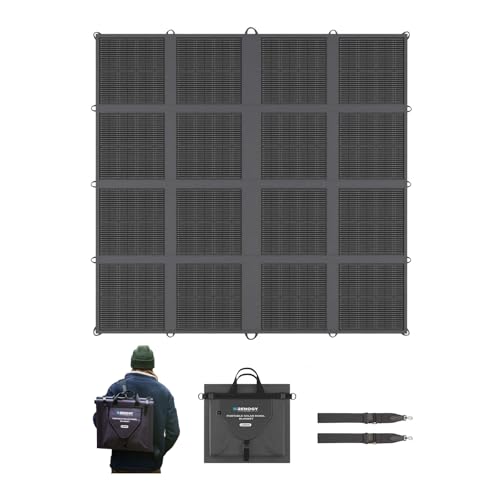
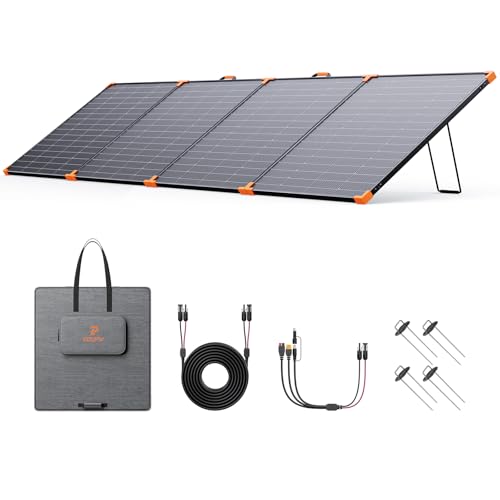
As an Amazon Associate we earn from qualifying purchases at no extra cost to you. Ratings are shown as listed on Amazon.
Quick picks by situation
| Situation | Best panel type | Useful rated output | What matters most |
|---|---|---|---|
| Phone, headlamp, or small USB battery | Compact USB solar charger | 10–20W | Low weight, USB output, easy positioning |
| Weekend camping with a small power station | Folding panel with DC output | 80–120W | Connector compatibility and manageable folded size |
| Refrigerator, CPAP battery, or frequent off-grid use | High-output folding panel | 160–220W | Solar-input limits, stability, and weather resistance |
| Emergency backup stored at home | Rigid or semi-rigid portable panel | 100–200W | Long-term storage, warranty, and safe indoor packing |
Best portable solar panels compared
The figures below are representative manufacturer specifications. Dimensions and weights can vary slightly by revision, region, and whether a cable is included, so check the panel’s current data sheet before buying.
| Product | Rated wattage | Folded or packed size | Weight | Connector compatibility | Stand and weather considerations |
|---|---|---|---|---|---|
| BioLite SolarPanel 10+ | 10W | Approx. 8.25 × 9.75 × 0.75 in | Approx. 1.1 lb | USB output; designed mainly for small devices | Integrated kickstand and sundial; splash-resistant design |
| BigBlue 28W USB Solar Charger | 28W maximum | Approx. 11.1 × 6.3 × 1.3 in folded | Approx. 1.5 lb | USB-A outputs; not a direct match for most DC power stations | Multiple folding sections; protect USB ports from rain |
| Goal Zero Nomad 50 | 50W | Approx. 17 × 11.5 × 1.5 in folded | Approx. 6.1 lb | Goal Zero 8 mm output; adapters may be needed for other systems | Fold-out support; intended for outdoor use but not submersion |
| Jackery SolarSaga 100 | 100W | Approx. 24 × 21 × 2 in folded | Approx. 11.1 lb | DC output commonly used with Jackery power stations; adapter required for some brands | Built-in kickstands; splash resistance, not heavy-rain storage |
| EcoFlow 110W Portable Solar Panel | 110W | Approx. 17.5 × 16.5 × 1 in folded | Approx. 8.8 lb | MC4 solar connector; broadly adaptable with the correct cable | Self-supporting case; many versions have an IP68 rating |
| BLUETTI PV200 | 200W | Approx. 23.2 × 24.8 × 1.8 in folded | Approx. 16.1 lb | MC4 connectors; compatible with power stations accepting the voltage and current | Fold-out legs; heavy enough to resist light wind better than small panels |
Which panel is the right choice?
Best for phones and small USB devices: 10–28W panels
A 10W panel such as the BioLite SolarPanel 10+ is easier to carry than a full power-station panel and makes sense for day hikes, bike touring, or an emergency kit. A 28W USB panel such as the BigBlue 28W offers more collection area and can be a better choice for two phones or a phone plus a power bank.
These panels are not ideal for charging a portable power station. Their USB output may not provide the voltage range or connector required by the station’s solar input. They also need direct sunlight for useful performance; a phone plugged into a small panel can repeatedly stop and start when clouds pass.
Best general-purpose option: 100–110W panels
The Jackery SolarSaga 100 and EcoFlow 110W Portable Solar Panel are practical middle-ground choices for camping and backup power. They are large enough to produce meaningful energy but still fold into a car-friendly package. A 100W-rated panel might deliver roughly 60–85W in strong real-world conditions after accounting for sun angle, heat, cable loss, and the power station’s conversion electronics.
Choose the Jackery when your existing equipment uses its proprietary input ecosystem and you want simple compatibility. Choose an MC4-equipped panel such as the EcoFlow when you want greater flexibility across compatible power stations. MC4 is a connector standard, not a guarantee of compatibility: voltage, current, polarity, and the station’s maximum solar input must also match.
Best for faster charging: 160–220W panels
A 200W panel such as the BLUETTI PV200 can substantially reduce charging time, particularly for a power station used with a refrigerator, induction appliance, or communications equipment. The tradeoff is significant: a panel this size weighs about 16 pounds and occupies roughly two feet when folded.
High-output panels are worthwhile for frequent off-grid use, but less attractive if they will spend most of the year in a closet. Before buying, confirm that the power station can accept the panel’s maximum voltage and current. Connecting a panel that exceeds the input limit can cause charging restrictions or require a different wiring arrangement.
Rated watts are not the same as daily energy
Panel wattage describes peak electrical output under laboratory conditions. A useful planning estimate is:
Daily watt-hours ≈ panel watts × equivalent peak-sun hours × system efficiency.
For example, a 100W panel in a location receiving four equivalent peak-sun hours, with an estimated 75% overall efficiency, could produce:
100 × 4 × 0.75 = 300Wh per day.
A 500Wh power station would therefore need about 1.7 similarly sunny days to recharge from empty, before considering shading or poor orientation. In practice, plan for more time. If you need 500Wh every day, a single 100W panel may be undersized; a 200W panel gives more margin, provided the power station accepts it.
Kickstand stability and setup details matter
Portable panels are light, broad, and vulnerable to wind. Integrated kickstands are convenient, but a narrow support can tip when the panel is angled steeply. Place the panel on firm, level ground, point it toward the sun, and secure the upper edge with small sandbags or non-damaging weights when wind is possible. Do not use stakes through a panel or allow cables to pull against the frame.
- Set the panel where no branch, vehicle, tent pole, or person will cast a partial shadow.
- Adjust the angle every few hours if maximum output is important.
- Keep the power station in shade while the panel sits in full sun.
- Leave airflow around the back of the panel so heat can escape.
- Disconnect the panel before changing adapters or moving the equipment.
Partial shading deserves special attention. A shadow across one section can reduce output far more than the shaded area suggests, especially on panels wired in series. A slightly less convenient sunny location can outperform a perfectly angled panel with a narrow shadow across it.
Weather resistance and ownership realities
“Weather-resistant” does not mean every part of the kit can remain outdoors. Panels may have an IP rating for water and dust, while the cable junction, USB cover, carrying case, and power station have different limits. Close port covers before rain, keep connectors off wet ground, and never charge through standing water.
What usually wears first is not the solar cell. Hinges, fabric sleeves, kickstand joints, connector caps, and cables receive the most handling stress. Store the panel dry and loosely folded according to its designed crease. Do not compress it under heavy gear, and avoid folding it while grit is trapped in the hinges.
Cleaning is simple: disconnect the panel, brush away loose grit, and wipe the surface with a soft damp cloth. Avoid abrasive cleaners, harsh solvents, and pressure washing. Salt spray, mud, and bird droppings can reduce output, so clean them promptly after outdoor use.
Final buying checklist
- Match the output to the load: 10–28W for USB devices, 100–110W for general camping, and 200W or more for demanding or frequent use.
- Check the complete electrical specification: voltage, amperage, connector type, polarity, and the power station’s solar-input ceiling.
- Measure storage space: folded dimensions can matter more than open-panel dimensions in a small vehicle or apartment.
- Budget for useful accessories: the correct MC4, 8 mm, XT60, or manufacturer-specific cable may be essential.
- Prefer stability over a small weight saving: a good stand and secure cable routing make daily charging less frustrating.
- Plan around weather: use solar panels outside, but protect connectors and batteries from rain, flooding, and prolonged damp storage.
For most people, a 100–110W folding panel is the best balance of charging speed, portability, and compatibility. Choose a compact USB model when low weight is the priority, and move to a 200W panel when reliable energy collection is more important than carrying convenience.




Write Your Review
No reviews yet. Be the first to share your experience!