

Key takeaways
- Assembly: Expect installation or tightening of steering parts, wheels, guards, seat components, and decals on many youth karts. After the first ride, recheck wheel nuts, steering fasteners, brake operation, and the throttle return.
- Fit: The rider should reach the pedals or controls without stretching, keep knees clear of the steering wheel, and sit low and securely. Weight capacity alone does not confirm a safe fit.
- Surface inspection: Remove stones, toys, hoses, and loose branches before every ride. A small object can lock a wheel or redirect a low-clearance kart.
- Tire pressure: Follow the manual rather than inflating to the number molded on a replacement tire. Incorrect pressure changes grip, range, and steering response.
- Cleaning: Use a damp cloth and avoid spraying water into the motor, battery compartment, controller, or charging port. Dry the kart before storage.
- Wear items: Expect tires, brake components, bearings, steering joints, and batteries to wear before the frame. Drifting and overloaded riding accelerate that wear.
- Riding rules: Use a helmet and protective clothing, prohibit passengers unless the manufacturer explicitly allows them, and keep children away from roads and public sidewalks unless local law clearly permits use.
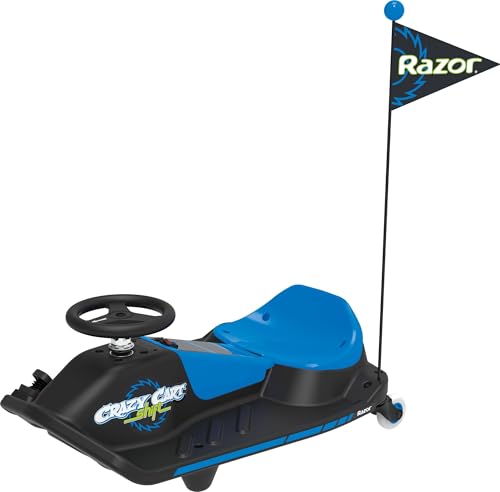
The best electric go karts depend on the rider’s size, available space, terrain, and willingness to manage charging and safety gear: the Razor Crazy Cart Shift suits younger beginners, the Razor Ground Force Drifter Fury suits older children and teens, and the Segway Ninebot Gokart Pro 2 is the most capable choice for responsible adult riders on suitable private pavement.
Our top picks



As an Amazon Associate we earn from qualifying purchases at no extra cost to you. Ratings are shown as listed on Amazon.
Quick comparison of the best electric go karts
| Model | Typical rider guidance | Top speed | Weight limit | Claimed or typical runtime | Best surface | Assembly |
|---|---|---|---|---|---|---|
| Razor Crazy Cart Shift | Ages 6 and up; beginner children | Up to 8 mph | 120 lb | About 40 minutes of continuous use | Flat, smooth pavement | Basic assembly; charge before use |
| Radio Flyer Ultimate Go-Kart | Approximately ages 3–8, depending on size and readiness | Up to 8 mph | 150 lb | About 30–45 minutes, depending on speed and surface | Flat pavement and compact, smooth paths | Moderate parent assembly |
| Razor Ground Force Drifter Fury | Ages 8 and up; children and smaller teens | Up to 12 mph | 140 lb | About 40 minutes of continuous use | Smooth pavement; controlled drifting areas | Moderate assembly |
| Razor Ground Force Elite | Ages 8 and up; experienced young riders | Up to 15 mph | 140 lb | About 40 minutes of continuous use | Flat, paved private areas | Moderate assembly |
| Segway Ninebot Gokart Pro 2 | Teens and adults who fit the manufacturer’s dimensions | Up to about 26.7 mph | 220 lb | Up to about 15.5 miles under stated conditions | Level, smooth private pavement | Usually limited setup; software pairing may be required |
Specifications vary by market, firmware, rider weight, temperature, tire pressure, and terrain. Treat advertised runtime as an upper-bound comparison rather than a guaranteed ride time. Always check the current manual for age, height, weight, charging, and operating restrictions before buying.
Best electric go kart for younger children: Razor Crazy Cart Shift
The Razor Crazy Cart Shift is a sensible first choice when a child needs a lower-speed kart with a simple control layout. Its 8-mph maximum is quick enough to feel exciting without jumping immediately to the higher speeds of youth racing-style models. The enclosed drivetrain, bucket-style seat, steel frame, adjustable speed-control approach, and hand-operated brake make it easier for an adult to establish rules before a child rides independently.
Its main limitation is terrain. Small hard tires and modest ground clearance are intended for smooth, dry pavement, not grass, gravel, mud, steep driveways, or broken sidewalks. A child near the 120-pound limit may also experience shorter runtime and slower acceleration. For a compact driveway or quiet private court, however, it is easier to supervise than a faster kart.
Best for a growing child: Radio Flyer Ultimate Go-Kart
The Radio Flyer Ultimate Go-Kart emphasizes adjustability. Its adjustable seat and selectable speed modes help it accommodate children who are still developing throttle control. Parents may prefer it when several children of different sizes will share one kart, although the actual fit should be checked rather than assumed from age alone.
This is a recreational kart, not an off-road vehicle. The rear tires can handle ordinary smooth paths and pavement, but wet leaves, loose gravel, and grass reduce braking and cornering control. The 150-pound stated capacity gives it more growing room than many small karts, but a larger rider will still reduce battery range and make the vehicle feel less responsive.
Best for drifting and older children: Razor Ground Force Drifter Fury
The Ground Force Drifter Fury is aimed at riders who have already learned gradual acceleration, braking, and cornering. At up to 12 mph, it offers a noticeable step up from beginner models. Its design encourages controlled rear-wheel sliding, so it should be used only in a broad, clear, dry area with no pedestrians, parked cars, curbs, or drop-offs.
Drifting consumes tires faster than ordinary cruising. The rear tires are a predictable wear item, and repeated sliding can also increase stress on the axle, wheel hubs, and steering components. It is a good choice for a family that specifically wants a playful paved-surface kart, but a poor choice for a narrow driveway or a rider who has not mastered braking.
Best faster youth kart: Razor Ground Force Elite
The Ground Force Elite reaches about 15 mph and is better suited to older, confident children or smaller teens than to first-time riders. Its higher speed demands more stopping distance: a rider who reacts late can travel many feet before braking begins, and pavement grip changes quickly with dust, moisture, and temperature.
Choose it only when the riding area is large, private, and free of traffic. The 140-pound limit is not a target; acceleration and range will decline as rider weight increases. A helmet, eye protection, gloves, long trousers, and closed-toe shoes should be considered minimum equipment, with knee and elbow protection particularly useful for beginners.
Best adult-capable option: Segway Ninebot Gokart Pro 2
The Segway Ninebot Gokart Pro 2 is the strongest option here for larger teens and adults. Its adjustable frame, higher weight capacity, multiple driving modes, app-connected controls, and substantially higher top speed make it more versatile than small youth karts. That capability also makes it less forgiving. The fastest mode should be reserved for experienced riders on a closed private course, if permitted by the manual and local rules.
Do not treat its advertised range as a normal afternoon guarantee. Range falls with a heavy rider, repeated acceleration, hills, cold weather, underinflated tires, and frequent stops. Its low ground clearance also makes it a poor match for lawn use or rough paths. It is best viewed as a paved recreational vehicle rather than a substitute for an off-road utility cart.
Decision matrix: which kart fits your situation?
| Your situation | Most suitable direction | Why |
|---|---|---|
| First rider, small driveway, strict speed control | Razor Crazy Cart Shift | Lower speed and straightforward controls reduce the learning curve. |
| Several children will share one kart | Radio Flyer Ultimate Go-Kart | Adjustability and selectable speeds provide more room to grow. |
| Experienced child wants controlled sliding | Razor Ground Force Drifter Fury | Its layout is designed for recreational drifting on smooth pavement. |
| Teen wants more speed and has a large private riding area | Razor Ground Force Elite | It adds speed while retaining a relatively simple youth-kart format. |
| Adult rider, frequent use, higher budget | Segway Ninebot Gokart Pro 2 | Higher capacity, adjustable fit, stronger performance, and more ride modes. |
| Grass, gravel, mud, or steep slopes are essential | None of these standard recreational karts | Look for a purpose-built off-road electric vehicle with suitable clearance and tires. |
How to estimate real battery time
Suppose a kart is advertised for 40 minutes of continuous riding. If a child rides in 10-minute sessions with equal charging breaks, four sessions might appear possible. In practice, reserve the final 20 percent of battery capacity for a safe return and account for acceleration, rider weight, and temperature. A more realistic planning figure is roughly 25–32 minutes of active riding, not four uninterrupted sessions.
Charging between sessions also has an ownership cost. Lead-acid youth-kart batteries are heavy and may lose capacity if repeatedly stored empty. Lithium-powered models are lighter but still require the supplied charger, ventilation, and sensible storage. Never charge a damaged, wet, or unusually hot battery.
Assembly, safety, and maintenance realities
- Assembly: Expect installation or tightening of steering parts, wheels, guards, seat components, and decals on many youth karts. After the first ride, recheck wheel nuts, steering fasteners, brake operation, and the throttle return.
- Fit: The rider should reach the pedals or controls without stretching, keep knees clear of the steering wheel, and sit low and securely. Weight capacity alone does not confirm a safe fit.
- Surface inspection: Remove stones, toys, hoses, and loose branches before every ride. A small object can lock a wheel or redirect a low-clearance kart.
- Tire pressure: Follow the manual rather than inflating to the number molded on a replacement tire. Incorrect pressure changes grip, range, and steering response.
- Cleaning: Use a damp cloth and avoid spraying water into the motor, battery compartment, controller, or charging port. Dry the kart before storage.
- Wear items: Expect tires, brake components, bearings, steering joints, and batteries to wear before the frame. Drifting and overloaded riding accelerate that wear.
- Riding rules: Use a helmet and protective clothing, prohibit passengers unless the manufacturer explicitly allows them, and keep children away from roads and public sidewalks unless local law clearly permits use.
For most families, the best electric go karts are not the fastest ones. Match the speed and weight range to the rider, prioritize a wide private paved area, and choose the model whose safety controls and maintenance demands you can consistently manage.



Write Your Review
No reviews yet. Be the first to share your experience!