

Our Top Picks
 SOARAISE Solar Power Bank 48000mAh Wireless Portable Charger6.38 x 3.43 x 1.57 inchesCheck on Amazon

The FlexSolar 40W foldable solar panel is the best overall pick for camping because it is the only option here that actually harvests meaningful power from the sun, with USB-C, USB-A and DC outputs for phones, power banks and small battery stations. A camping solar charger is any panel or solar-assisted power bank that tops up devices away from an outlet. If you want a single pocket-size device, the BigBlue 28W panel is the lighter folding option, while the solar power banks below work best as weather-resistant batteries that you charge at home first.
Quick List
- FlexSolar 40W Foldable Panel – best overall for real solar charging at camp
- BLAVOR 10,000mAh Solar Power Bank – best compact backup with wireless charging
- Uukto 20000mAh Solar Power Bank – best for built-in cables and a camp light
- SOARAISE 48000mAh Solar Power Bank – best for long trips and multiple devices
- BigBlue 28W Solar Panel Charger – best lighter folding panel for backpacking
- Durecopow 20,000mAh Solar Power Bank – best for sharing a charge across three ports
Which One Is Right for You?
| If you… | Choose |
|---|---|
| want to recharge from sunshine over several days at a campsite | FlexSolar 40W Foldable Panel |
| hike with a light pack and clip a panel to the outside | BigBlue 28W Solar Panel Charger |
| travel with a group and need a very large battery reserve | SOARAISE 48000mAh Solar Power Bank |
| want cables built in so there is nothing to forget | Uukto 20000mAh Solar Power Bank |
| need to charge three devices from one bank | Durecopow 20,000mAh Solar Power Bank |
| need a small emergency reserve for a day hike | BLAVOR 10,000mAh Solar Power Bank |
The key distinction is panel versus power bank. A foldable panel collects real power but needs sunlight and a bank or device to charge. A solar power bank stores power you added before the trip and carries a small panel that only trickles charge. Treat the built-in solar on a power bank as an emergency top-up rather than a primary way of charging.
All 6 Picks in Detail
1. FlexSolar 40W Foldable Solar Panel – Best Overall for Real Solar Charging
As an Amazon Associate we earn from qualifying purchases at no extra cost to you.

This is a foldable panel rated at 40 watts, with USB-C, USB-A and DC outputs, described as waterproof and made for camping, hiking and backpacking. It suits anyone who spends two or more days away from an outlet and wants to keep a phone, headlamp and a power bank topped up. The panel is the part that matters: more surface area simply collects more energy, and 40 watts is meaningfully larger than the tiny panels embedded in power banks.
In real conditions you will see well under the rated figure. Angle, haze, clouds and heat all cut output, and the rated watts apply under ideal lab sunlight. A sensible approach is to prop the panel facing the sun during the middle of the day and plug it into a power bank rather than directly into a phone, so interruptions from passing clouds do not stop the charge.
One practical advantage of a panel with a DC output is flexibility. Many small battery stations and 12V accessories accept DC input, so the same panel can serve a phone today and a larger battery tomorrow. Always match connector type and voltage to your device’s manual before plugging in, and use the USB ports for anything that lists a USB input.
- 40W rated foldable solar panel
- USB-C, USB-A and DC outputs, per the listing
- Waterproof, marketed for camping, hiking and backpacking
- Foldable for transport
- Weight, folded size and USB-C power delivery wattage: confirm on listing
Pros:
- Largest panel in the group, so the most real solar capacity
- Three output types cover phones, banks and DC-powered gear
Cons:
- Needs direct sun and a place to hang or prop it
- Bulkier than a power bank for ultralight trips
It out-collects the BigBlue 28W by a clear margin, while the BigBlue is the easier carry.
2. BLAVOR 10,000mAh Solar Power Bank – Best Compact Backup with Wireless Charging
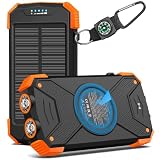
BLAVOR’s 10,000mAh bank has a 20W USB-C output, wireless charging, an IPX5 waterproof rating and two flashlights. It is the smallest and lightest of the banks, aimed at day hikes, festivals and as a spare in the glovebox. IPX5 means the case resists water jets, such as rain splashes, but it does not mean the unit can be submerged.
Ten thousand milliamp-hours gives roughly two phone charges, so it fits a weekend rather than a week away. The wireless pad is convenient for phones that support Qi, though wireless charging is slower and less efficient than a cable, so use the cable when you want to conserve power.
Because it is small, it fits in a jacket pocket on a day hike. Keep it in an inside pocket in cold weather, since lithium batteries lose capacity and charge more slowly when they are cold.
- 10,000mAh capacity
- 20W USB-C, per the listing
- Wireless charging
- IPX5 water resistance and two flashlights
- Weight and exact dimensions: confirm on listing
Pros:
- Small, light and weather resistant
- Wireless charging adds convenience without a cable
Cons:
- Only enough reserve for a couple of phone charges
- Solar charging is very slow at this panel size
It trades capacity for portability when compared with the 20,000mAh models.
3. Uukto 20000mAh Solar Power Bank – Best for Built-In Cables and a Camp Light

Uukto packs 20,000mAh into a rugged-style bank with built-in cables, USB-C in and out, and a camping light plus flashlights. It suits campers who prefer to carry as few loose parts as possible, since the cables are already part of the unit. Twenty thousand milliamp-hours typically supplies several full phone charges, and that capacity sits under the 100 watt-hour limit that most airlines use for carry-on batteries.
The solar panel on a bank this size is best viewed as a safety net. If you leave the bank on the dashboard or tent roof for a day, it may add a small percentage of charge, which can be enough to rescue a dying phone but not enough to rely on for daily use.
The integrated camping light is a nice extra for tent use. Hang it from a loop and use a low brightness setting to save charge. Remember that each hour of lighting draws from the same battery your phone relies on.
- 20,000mAh capacity
- Built-in cables, per the listing
- USB-C input and output
- Camping light and flashlights integrated
- Fast charging wattage and water resistance rating: confirm on listing
Pros:
- No loose cables to lose
- Built-in lights double as emergency lighting
Cons:
- Built-in cables can fail without an easy replacement
- Solar charging is slow
Next to the Durecopow, it focuses on built-in convenience instead of a multi-port layout.
4. SOARAISE 48000mAh Solar Power Bank – Best for Long Trips and Multiple Devices

With 48,000mAh and four built-in solar panels plus four cables, this is the largest reserve in the set. It is the one to choose for group trips and car camping, where the bank is charged from a wall outlet or car port before departure and then shares power across several phones, a tablet and a light. The listing also highlights wireless charging and PD fast charging, but confirm the exact wattage on the product page.
A safety note applies to anything this large. A 48,000mAh lithium battery holds roughly 170 watt-hours at typical cell voltage, which is above the limits that most airlines allow in carry-on baggage, so this is a car-camping power bank, not a flight companion. Keep it out of hot cars and direct sun when idle.
The four panels fold out like pages, which gives more surface than a single-cell bank. Even so, the area is tiny compared with the battery, so the practical charging route is the wall or car adapter. Treat the sun as a bonus on a long trip rather than a plan.
- 48,000mAh capacity
- Four solar panels, per the listing, for emergency trickle charging
- Four cables included
- Wireless charging and PD fast charging mentioned in the name
- Output wattage, weight and waterproof rating: confirm on listing
Pros:
- Huge reserve covers many phone recharges
- Cables included for several devices at once
Cons:
- Heavy and large, and may not be allowed on flights
- Solar panels recharge it very slowly relative to its size
Compared with the 20,000mAh options, it is the right choice only if you truly need the extra reserve.
5. BigBlue 28W Solar Panel Charger – Best Lighter Folding Panel for Backpacking

BigBlue’s 28W panel pairs high-efficiency cells with dual USB-C and USB-A outputs, which means you can charge two devices at the same time or feed a power bank through USB-C. It is the better fit for weight-conscious hikers who still want a real panel rather than a trickle charger. Twenty-eight watts is enough to charge a phone in an afternoon of decent sunshine, but it will not run a laptop or a camp fridge.
The folding design works best when clipped to the outside of a pack while you walk, with the cells facing the sun. Keep the panel flat and avoid partial shade, because a shadow across even a single cell can drop output sharply on many folding panels.
Efficiency claims on solar panels refer to how much of the incoming sunlight the cells turn into electricity under ideal conditions. Real results vary with temperature, sun angle and shade, so treat the rating as a ceiling rather than a promise. For a day hike, clip it to a pack and charge a power bank as you walk.
- 28W rated folding solar panel
- Dual USB-C and USB-A outputs
- High-efficiency cells, per the listing
- Designed for camping and backpacking
- Weight, folded size and water resistance rating: confirm on listing
Pros:
- Lighter and smaller than a 40W panel
- USB-C input and output paths suit modern phones and banks
Cons:
- Lower output than the FlexSolar, so charging takes longer
- Not suited to laptops or larger power stations
Pick it over the FlexSolar if your pack weight matters more than faster charging.
6. Durecopow 20,000mAh Solar Power Bank – Best for Sharing a Charge Across Three Ports
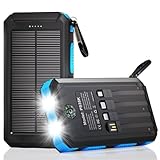
Durecopow offers 20,000mAh, four cables, three ports and fast charging with USB-C. It is a good fit for couples or small groups who want to top up two or three devices in the evening from one source. The included cables are removable, which makes it easier to replace a damaged one than on a bank with permanently attached cables.
As with every power bank, charge it fully at home before you leave, because the built-in solar cell will take many days of sunlight to fill a battery of this size. Use the solar panel only as a backup when the wall is not an option.
Three ports make it easy to share a bank with a partner. Plug in the highest-priority device first, since total output is shared among the ports. Label your cables with tape so you can tell them apart in a dark tent.
- 20,000mAh capacity
- Four cables and three ports, per the listing
- USB-C fast charging
- Solar charging as a backup option
- Output wattage, weight and water rating: confirm on listing
Pros:
- Three ports for charging more than one device
- Cables included for different connector types
Cons:
- Loose cables can tangle in a pack
- Solar cell adds only a small emergency charge
It matches the Uukto in capacity, so choose by whether you prefer built-in or loose cables.
Specs Compared
| Product | Type | Rated power / capacity | Outputs | Water resistance | Extras |
|---|---|---|---|---|---|
| FlexSolar 40W Foldable Panel | Foldable panel | 40W | USB-C, USB-A, DC | Waterproof (confirm rating on listing) | Foldable |
| BLAVOR 10,000mAh | Solar power bank | 10,000mAh, 20W USB-C | USB-C, wireless | IPX5 | 2 flashlights |
| Uukto 20000mAh | Solar power bank | 20,000mAh | USB-C in/out | Confirm on listing | Built-in cables, camp light |
| SOARAISE 48000mAh | Solar power bank | 48,000mAh | Confirm on listing | Confirm on listing | 4 panels, 4 cables, wireless |
| BigBlue 28W Solar Panel | Foldable panel | 28W | Dual USB-C and USB-A | Confirm on listing | High-efficiency cells |
| Durecopow 20,000mAh | Solar power bank | 20,000mAh | 3 ports | Confirm on listing | 4 cables |
How We Chose These
This guide is based on research, not personal use. We began with the six solar charging products in the current catalog and sorted them into two groups: foldable panels that gather power, and power banks with small solar cells that mostly store power. We compared the capacity or wattage, outputs, stated water resistance and extras that each listing names. Where a listing did not specify a value, we marked it “confirm on listing.” We also consulted standard guidance on lithium battery capacity and airline limits, and we leaned on general solar panel behavior to describe realistic expectations rather than quoting any performance numbers.
What to Look For
Panel versus power bank: where the energy comes from
A foldable panel with a rated 28 to 40 watts is a genuine energy source. A solar power bank is mostly a battery with a small panel, often only a watt or two of capacity under ideal light. The difference is huge: a 40W panel in good sun may refill a phone in a couple of hours, while the panel on a power bank may need many days to refill itself. Choose a panel if you want to harvest power across a multi-day trip. Choose a power bank if you want a reserve you charge from the wall, with solar as a backup.
Capacity in milliamp-hours and watt-hours
Milliamp-hours are easy to compare among power banks, but watt-hours tell the real energy. Multiply the milliamp-hours by 3.7 volts and divide by 1,000. For example, 10,000mAh is about 37Wh, 20,000mAh is about 74Wh, and 48,000mAh is about 178Wh. A typical modern phone battery holds roughly 12 to 20Wh, so a 20,000mAh bank gives you in the neighborhood of three to four phone charges after conversion losses. A good rule of thumb is to plan on about 70 percent of the rated capacity as usable output.
Output ports and charging speed
USB-C ports with Power Delivery can charge phones and some tablets quickly, while older USB-A ports are slower but widely compatible. If you plan to charge a tablet or a handheld game console, look for a USB-C port rated at 18W or more. A panel with two outputs can charge two devices at once, but the total power is shared, so each device charges more slowly. A DC output on a panel is useful for small battery stations and some 12V gear, but check the connector and voltage before plugging anything in.
Weather resistance and durability
Look for specific ratings rather than vague claims. IPX5 means resistance to water jets, which covers rain, but not submersion. A foldable panel with a waterproof or water-resistant fabric still needs its USB electronics kept dry. Avoid leaving any solar gear on a hot car dashboard, since lithium batteries degrade in extreme heat, and never charge a swollen or damaged power bank. Store them partially charged and out of direct sun when they are not in use.
Travel rules and safety
In the United States, airlines generally allow lithium power banks up to 100Wh in carry-on bags and require approval between 100 and 160Wh. Power banks must travel in carry-on luggage, not checked bags. That puts 10,000mAh and 20,000mAh banks within the normal limit, while the 48,000mAh bank is best left for car camping. Always confirm with your airline before flying.
A worked example: planning a three-day weekend
Say you are camping for three days with two phones, a headlamp and a small GPS. Estimate the daily energy: each phone uses about one full charge per day, or roughly 15Wh, so two phones need about 30Wh, plus another 5 to 10Wh for the headlamp and GPS. That is roughly 40Wh a day, or 120Wh over three days. A 20,000mAh bank holds about 74Wh and delivers perhaps 50Wh after losses, so one bank covers a day and a bit. Add a 28W or 40W panel that yields even 60 to 80Wh across a sunny day, and the plan works without strain. Without a panel, you would need two 20,000mAh banks, or one 48,000mAh bank, to cover the same trip.
Setting up a panel at camp
Face the panel toward the sun and tilt it so the sun’s rays hit it as close to perpendicular as possible. Move it every hour or two as the sun travels. Keep cables short to limit voltage loss, and keep the panel off dark, hot surfaces that raise cell temperature. Use the panel to fill a power bank during the day, then charge your phone from the bank at night. This keeps your devices off a fluctuating supply and protects the battery from repeated stop-and-start charging.
Questions
Can a solar power bank really charge itself by the sun?
Technically yes, but very slowly. The small panel on a power bank is meant for emergencies, and it may take several days of full sun to fill a large battery. Charge the bank at home before you go.
How long does a 40W panel take to charge a phone?
In good direct sun, a phone usually refills in a few hours, depending on the phone and panel angle. Clouds, shade and heat reduce the output. Plugging the panel into a power bank smooths out the interruptions.
Should I plug a phone directly into a panel?
It works, but a power bank in between is more reliable. Some phones stop and restart charging every time sunlight dips. A bank collects the energy steadily and gives your phone a stable supply.
Are these safe in the rain?
Check each product’s stated water rating. IPX5 protects against rain splashes and jets, while a waterproof panel fabric still depends on how the electronics are sealed. Keep ports covered and dry them before use.
Can I bring a big power bank on a plane?
Many airlines cap carry-on power banks at 100Wh, which is roughly 27,000mAh. A 20,000mAh bank is fine, while a 48,000mAh bank is above the usual limit. Check your airline’s current rules.
How much capacity do I need for a weekend?
For one person, a 10,000 to 20,000mAh bank usually covers a weekend of phone use. Add a panel if you will be out longer than three days or are powering other devices such as a headlamp or GPS.
Update History
- October 20, 2026 – Initial publication; product set drawn from current catalog listings.
- Check the product page for current specifications and availability before buying.
Sources
- Retailer listing titles and specification fields for each product
- Standard watt-hour conversion for lithium batteries and commonly published airline carry-on limits for power banks






Write Your Review
No reviews yet. Be the first to share your experience!