

Key takeaways
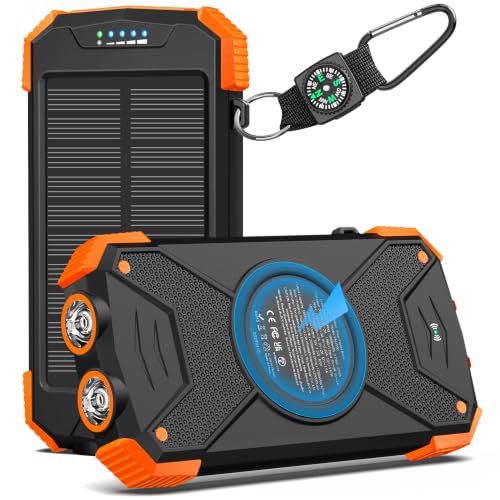
- Best compact emergency option: BLAVOR 10,000mAh solar power bank, if you want a flashlight, wireless charging, and a small backup battery in one unit.
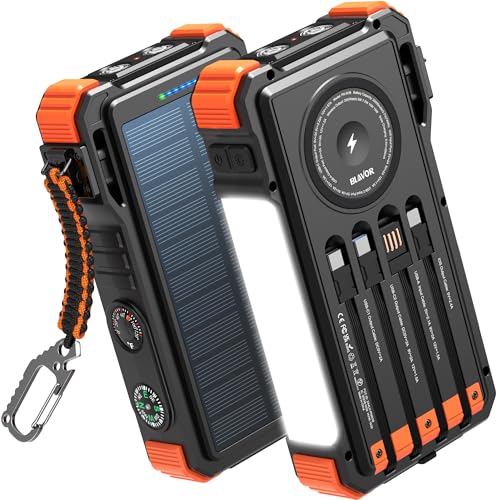
- Best for more stored energy: Hiluckey 25,000mAh Outdoor Portable Solar Charger, whose folding panel array is more useful than the tiny panel on most single-body banks.
- Best reliable system rather than all-in-one gadget: Goal Zero Venture 35 paired with a Goal Zero Nomad 20 or Nomad 50 solar panel.
- Best lightweight USB-C setup: a USB-C power bank such as the Nitecore NB10000 Gen 3 paired with a separate folding solar panel. It is not a solar power bank by itself, but this combination is usually lighter and more efficient than a heavy “solar” bank with a decorative panel.
The best solar power banks are not necessarily the ones with the largest capacity: for dependable off-grid charging in 2026, choose a rugged 10,000–20,000 mAh bank for stored energy and treat its built-in solar panel as an emergency top-up, or pair a USB-C power bank with a separate 20–28W folding solar panel for regular use.
Our top picks


As an Amazon Associate we earn from qualifying purchases at no extra cost to you. Ratings are shown as listed on Amazon.
Quick picks by situation
- Best compact emergency option: BLAVOR 10,000mAh solar power bank, if you want a flashlight, wireless charging, and a small backup battery in one unit.
- Best for more stored energy: Hiluckey 25,000mAh Outdoor Portable Solar Charger, whose folding panel array is more useful than the tiny panel on most single-body banks.
- Best reliable system rather than all-in-one gadget: Goal Zero Venture 35 paired with a Goal Zero Nomad 20 or Nomad 50 solar panel.
- Best lightweight USB-C setup: a USB-C power bank such as the Nitecore NB10000 Gen 3 paired with a separate folding solar panel. It is not a solar power bank by itself, but this combination is usually lighter and more efficient than a heavy “solar” bank with a decorative panel.
What “solar power bank” really means
Most integrated solar power banks contain a lithium battery and a photovoltaic panel measuring only a few square inches. That panel may produce roughly 0.5 to 2 watts in strong, direct midday sun. Recharging a 10,000mAh bank can therefore take several sunny days, especially after conversion losses, heat, clouds, dust, and the panel’s imperfect angle.
A 20–28W folding panel has a much larger collection area and can produce useful energy during a day outdoors, although its real output is commonly closer to 8–20W than the headline rating. The trade-off is extra bulk, a separate cable, and the need to place the panel in full sun while keeping the battery in shade.
Head-to-head comparison
The figures below use commonly published capacities and approximate product weights. Battery capacities are nominal cell ratings; usable output is lower because voltage conversion and circuitry consume energy. Specifications can vary by revision, so confirm the label before buying.
| Option | Nominal capacity | Solar arrangement | USB-C capability | Approx. weight | Best use |
|---|---|---|---|---|---|
| BLAVOR 10,000mAh | 10,000mAh / about 37Wh | Integrated small panel; slow emergency charging | Model-dependent; commonly input-focused rather than high-power output | About 250–300g | Day hikes, emergency kit, flashlight backup |
| Hiluckey 25,000mAh Outdoor Portable Solar Charger | 25,000mAh / about 92.5Wh | Folding multi-panel array, commonly advertised around 5–6W | Usually USB-A outputs; verify the exact revision for USB-C | About 550–650g | Camping where capacity matters more than weight |
| Goal Zero Venture 35 | 9,600mAh / about 35Wh | Requires a separate Nomad solar panel | USB-C input/output, up to about 18W depending on mode | About 286g | Rugged, repeatable outdoor charging |
| Nitecore NB10000 Gen 3 | 10,000mAh / about 38.5Wh | Requires a separate solar panel | USB-C input/output, up to 22.5W output | About 150g | Lightweight backpacking and fast phone charging |
| 20–28W folding solar panel plus USB-C bank | Depends on the bank | Separate panel; practical daytime generation | Depends on the power bank; select 18W or higher USB-C PD | About 450–900g total | Frequent off-grid use and multi-day trips |
Capacity: the number on the box is not your phone’s runtime
A 10,000mAh power bank is normally rated at the internal lithium-cell voltage of about 3.7V. Its nominal energy is therefore approximately:
10,000mAh × 3.7V ÷ 1,000 = 37Wh.
After conversion losses, heat, and the bank’s reserve, about 28–32Wh may reach a device. A phone with a 15Wh battery might receive roughly two full charges, not the 6.6 charges suggested by simply dividing 10,000mAh by a 1,500mAh phone battery. A 25,000mAh bank has about 92.5Wh nominal and may deliver roughly 70–80Wh in practice.
For one phone over a weekend, 10,000mAh is usually sufficient. Choose 20,000–25,000mAh for several phones, a camera, GPS unit, or cold-weather trips. Larger capacity also means longer recharge time and more weight.
Solar recharge limits and USB-C priorities
Solar input matters more than the word “solar” in the product name. Ask three questions:
- What is the panel’s rated wattage? A built-in 1W panel is a backup feature, not a daily charging solution.
- Can the bank charge while supplying power? Pass-through charging is useful for small devices but can increase heat and may be disabled by the manufacturer.
- What does USB-C actually do? Some banks use USB-C only for input. For modern phones, look for USB-C output and USB Power Delivery of at least 18W; 20–30W is more flexible for phones, cameras, and small tablets.
For a rough calculation, a 5W folding panel might produce 15–25Wh during a favorable sunny day after real-world losses. That could replenish around half of a 10,000mAh bank, but shade or hazy weather can reduce production dramatically. A tiny integrated panel may produce less than 5Wh in a full day, so it should be reserved for maintaining emergency charge rather than replacing a wall charger.
Ruggedness, weight, and emergency features
For an emergency kit, useful features include a bright flashlight, SOS or strobe mode, a battery indicator, sealed port covers, and the ability to charge from both USB-C and USB-A. Wireless charging is convenient but inefficient and often requires precise alignment; it should not outweigh a missing USB-C output.
Water resistance is not the same as waterproofing. Look for a clearly stated IP rating rather than “waterproof” marketing. A covered port can protect against rain, but sand, saltwater, and repeated drops are often more damaging than a single splash. Rubberized housings may improve grip, while built-in carabiners can be convenient but do not make a heavy bank suitable for hanging from a backpack all day.
Weight is especially important when the solar panel is attached to the battery. A 600g integrated-panel unit may carry more energy than a 150g compact bank, but a lightweight bank plus a separate panel can offer better collection area and easier positioning. Carbon-fiber or composite-shell banks such as the Nitecore NB10000 prioritize low weight; they are attractive for hiking but may not provide the same impact protection as a thick rubberized emergency model.
How to use a solar charging setup efficiently
- Charge the power bank from the grid before leaving. Solar is a replenishment method, not a substitute for starting with a full battery.
- Put the panel in direct sun and the battery in shade. Lithium batteries lose charging efficiency when hot, even when the panel is producing well.
- Use the panel’s USB-C or USB-A output according to its instructions. Some panels fluctuate when clouds pass, so a power bank with stable solar-input handling is preferable to charging a phone directly.
- Charge the bank during the strongest sun. Use the stored energy for the phone after sunset, when solar output is zero.
- Keep connectors dry and clean. Dust on a folding panel reduces output; wipe it with a soft, dry cloth rather than abrasive material.
Ownership realities and common mistakes
The battery will usually age before the solar panel. Expect reduced capacity after several years or after extensive exposure to heat and full discharge cycles. Do not store a lithium power bank in a hot car, leave it at 0% for months, or charge it while visibly swollen or damaged. For long-term emergency storage, keep it around half charged and top it up every few months.
Solar panels also degrade from cracked hinges, torn fabric, damaged cables, and grit caught in folding seams. Avoid suspending a heavy power bank from a small panel’s cable. Pack the panel dry, protect it from sharp objects, and test the complete setup before an outage or trip.
Bottom line
Buy an integrated solar power bank when you want a compact emergency tool with a flashlight and a trickle-charge option. Choose a rugged 10,000mAh model for personal backup, or 20,000–25,000mAh when multiple devices must share the battery. If you expect solar to provide meaningful energy every day, the better choice is a USB-C power bank plus a separate 20–28W folding panel. That arrangement costs more and takes more space, but it delivers the larger solar collection area, faster recharge, and clearer upgrade path that most all-in-one solar banks cannot provide.




Write Your Review
No reviews yet. Be the first to share your experience!