

Key takeaways
- Battery: Usually the first performance component to decline. Expect replacement to be needed after roughly 1–3 years, depending on heat, charge cycles, and battery quality.
- Solar panel: Dust, pollen, bird residue, and mineral deposits reduce charging. Wipe it with a soft damp cloth every few weeks during dusty seasons.
- Cable insulation: Constant rubbing against metal edges, staples, or tree bark can cause cuts. Use plastic clips or outdoor-rated hooks instead of ordinary staples.
- LED housings: Moisture enters through cracked seals or loose covers. Replace damaged bulbs or sections rather than wrapping them permanently in household tape.
- Mounting hardware: Wind can pull down an otherwise reliable strand. Leave a small amount of slack and add support points at corners and roughly every 2–3 feet.
The best solar outdoor string lights are the ones whose cable length, bulb spacing, panel position, and weather protection match your yard—not simply the ones with the most bulbs.
For a small patio, choose a 20- to 30-foot strand with 6- to 12-inch spacing and an adjustable panel. For a long fence or pergola, look for 48 to 100 feet, 12- to 24-inch spacing, and a panel connected by a separate lead. If reliable illumination matters more than decoration, prioritize a replaceable rechargeable battery, a larger solar panel, and a steady-light mode over a high bulb count.
Our top picks

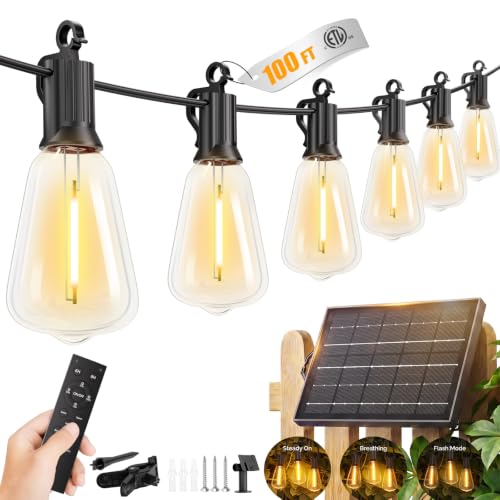


As an Amazon Associate we earn from qualifying purchases at no extra cost to you. Ratings are shown as listed on Amazon.
Quick picks by yard layout
| Yard situation | Best specification | Why it fits |
|---|---|---|
| Small balcony or 8-foot patio table | 20–30 ft cable, 6–12 in bulb spacing, 20–40 LEDs | Reduces loose cable and creates an even glow in a compact area |
| 10 × 12 ft pergola | 40–50 ft cable, 12 in spacing, panel on a 6–10 ft lead | Usually covers the perimeter without forcing the panel into the shade |
| Long fence or deck rail | 50–100 ft cable, 12–24 in spacing, 50–100 bulbs | Wider spacing keeps the strand from becoming visually crowded |
| Large tree or garden path | 50 ft or more, flexible thin cable, separate panel, warm-white LEDs | Provides enough reach for irregular routes and distant sunlight |
| Windy or wet location | Thick insulated cable, sealed sockets, IP65 or better light assembly | Improves resistance to rain, splashing, and repeated movement |
What separates good solar string lights from frustrating ones
Bulb spacing changes the entire look
Close spacing, usually 6 to 12 inches, creates a continuous line of light. It works well around a small seating area or along a short railing, but it can look overly busy across a long fence. Spacing of 12 to 24 inches produces distinct points of light and covers more linear distance with fewer bulbs.
Do not compare bulb counts without checking spacing. A 50-bulb strand with 12-inch spacing may cover roughly 50 feet, while a 50-bulb strand with 6-inch spacing may cover only 25 feet, excluding the lead cable. Count the illuminated section separately from the distance between the panel, first bulb, and mounting point.
Cable length is not the same as coverage
Manufacturers may quote total length, which can include a solar-panel lead and an unlit tail. For planning, use this calculation:
Usable lighting length = total cable length − panel lead − unlit tail.
For example, a 50-foot strand with a 6-foot panel lead and a 2-foot tail gives about 42 feet of illuminated cable. If your pergola perimeter is 44 feet, it is technically close but likely too short once you allow for corners and slack. Buy at least 10 percent extra for a tidy installation.
Panel placement matters more than maximum bulb count
A solar strand cannot compensate for a panel that receives only a small amount of direct sun. Choose a panel with an adjustable angle and, when possible, a separate lead of at least 6 feet. That lets you place the lights under a tree or beside a shaded structure while moving the panel toward open sky.
For a north-facing yard, a wall-mounted or stake-mounted panel with a long cable is generally easier to position than a panel fixed directly to the first bulb. Check the panel’s charging switch before installation: many units will not charge while switched off, and some need the light sensor covered during daytime setup to confirm operation.
Head-to-head: the specifications worth paying for
| Feature | Basic decorative strand | Better everyday choice | Heavy-duty choice |
|---|---|---|---|
| Illuminated length | 20–30 ft | 40–50 ft | 50–100 ft |
| Bulb spacing | 6–12 in | 10–16 in | 12–24 in |
| Typical LED count | 20–40 | 40–60 | 50–100 |
| Panel lead | 1–3 ft | 6–10 ft | 10 ft or more |
| Battery capacity | 600–1,000 mAh | 1,200–2,000 mAh | 2,000–3,600 mAh |
| Expected lighting time after a sunny day | 6–8 hours | 8–10 hours | 8–12 hours |
| Construction target | Plastic cable and sockets | Insulated cable, sealed LED housings | Thicker cable, reinforced joints, IP65-rated assembly |
| Typical market price | $15–$30 | $30–$60 | $60–$120 |
These are useful buying ranges rather than guarantees. Runtime depends on sunlight, temperature, battery age, lighting mode, and whether the strand is partly shaded. A long strand with an undersized panel may perform worse than a shorter strand with better charging hardware.
Lighting modes: decoration or dependable visibility?
Steady light is the most useful default for dining areas and walkways. Flashing, fading, and twinkling modes conserve some energy in certain designs, but they can be distracting around steps and do not necessarily produce better usable light. If the strand offers brightness settings, choose a lower setting for long summer evenings and a higher setting for occasional entertaining.
Warm white, commonly around 2,200 to 3,000 Kelvin, suits seating areas and porches. Neutral or cool white can look brighter against fences and may be easier to see along a path, but it often feels less relaxed. Colored modes are best treated as an extra feature rather than a substitute for useful illumination.
Weatherproof construction and the parts that wear first
Look for an IP65 rating or better for the light assembly when the strand will remain outdoors. IP ratings are not a promise that every connection can be submerged: the panel connector, battery compartment, control button, and cable junction may have different protections. Keep connectors elevated, avoid puddles, and follow the manufacturer’s instructions about winter storage.
- Battery: Usually the first performance component to decline. Expect replacement to be needed after roughly 1–3 years, depending on heat, charge cycles, and battery quality.
- Solar panel: Dust, pollen, bird residue, and mineral deposits reduce charging. Wipe it with a soft damp cloth every few weeks during dusty seasons.
- Cable insulation: Constant rubbing against metal edges, staples, or tree bark can cause cuts. Use plastic clips or outdoor-rated hooks instead of ordinary staples.
- LED housings: Moisture enters through cracked seals or loose covers. Replace damaged bulbs or sections rather than wrapping them permanently in household tape.
- Mounting hardware: Wind can pull down an otherwise reliable strand. Leave a small amount of slack and add support points at corners and roughly every 2–3 feet.
A practical setup method that prevents common mistakes
- Measure the route. Follow the actual path around posts and corners, then add 10 percent for slack. Do not measure only the straight-line distance.
- Mark the panel location first. Choose the sunniest practical position, ideally away from evening shadows cast by the house, fence, or pergola.
- Lay out the strand on the ground. Confirm that the first bulb reaches the intended starting point and that the connector can reach the panel without tension.
- Install the supports. Use outdoor clips, screw hooks, or guide wire for heavier strands. Avoid hanging substantial strands from thin plant stems or gutter edges.
- Set the operating mode before final mounting. Turn the unit on, cover the panel to simulate darkness, and verify that every section lights.
- Recheck after the first windy night. Tighten loose clips, remove rubbing points, and keep the panel upright and unobstructed.
A common mistake is installing the lights perfectly around a patio and placing the panel behind the house. Another is buying a long strand for brightness when the extra bulbs actually divide the available solar energy and shorten evening runtime. Match the panel and battery capacity to the strand length.
Best choice by budget and maintenance tolerance
- Under $30: Choose a short strand for seasonal decoration, preferably with warm-white LEDs and a replaceable battery. Expect simpler mounting and less consistent winter performance.
- $30–$60: This is the useful middle ground for most patios and pergolas: a 40- to 50-foot cable, adjustable panel, multiple modes, and weather-sealed LED housings.
- $60–$120: Pay for length, thicker insulation, a larger panel, a higher-capacity battery, or commercial-style construction—not merely more flashing patterns.
Bottom line
For most yards, the best solar outdoor string lights are a 40- to 50-foot warm-white LED strand with 10- to 16-inch bulb spacing, a separate adjustable panel on a 6- to 10-foot lead, an 1,200–2,000 mAh rechargeable battery, steady and dimming modes, and weather protection rated at IP65 or better. Choose a shorter close-spaced set for a compact patio, or a longer wide-spaced set with a larger panel for a fence, pergola, or garden route. The right fit will deliver more reliable evenings than a higher bulb count chosen without considering sunlight and layout.





Write Your Review
No reviews yet. Be the first to share your experience!