

Key takeaways
- Small cars and sedans: Most 4-cylinder batteries are rated 350-600 CCA. A tester rated 100-1000 CCA is sufficient.
- SUVs, trucks, and diesel pickups: V6/V8 gas trucks are typically 600-850 CCA. Diesel trucks with dual batteries often have 750-1000 CCA per battery. You need a 100-1500 CCA or 100-2000 CCA tester to test each battery individually.
- Why headroom matters: A tester rated 100-2000 CCA is more accurate at the extremes than one rated 500-1000 CCA testing a 550 CCA battery. Look for a lower limit of 100 CCA, which allows testing of lawn tractor, motorcycle, and powersport batteries.
The best battery load testers for most car and truck owners in 2026 are 12V digital conductance testers with a 100-2000 CCA range, Kelvin-style copper clamps, and support for flooded, AGM, and EFB batteries, with the Topdon BT200, Ancel BA101, and Clore Automotive SOLAR BA9 standing out for DIY accuracy while the Foxwell BT705 and Schumacher BT-100 cover professional and traditional carbon-pile needs.
Our top picks


As an Amazon Associate we earn from qualifying purchases at no extra cost to you. Ratings are shown as listed on Amazon.
How to Choose a Battery Load Tester: 3 Specs That Determine Accuracy
A load tester does not just read voltage. It applies a load or sends a conductance signal to estimate how well a battery can deliver cold cranking amps (CCA) under stress. Getting an accurate result depends on three specifications matching your vehicle.
1. CCA Range
CCA is the number of amps a 12V battery can deliver at 0°F for 30 seconds while maintaining at least 7.2 volts. Your tester must cover your battery’s rating with headroom on both ends. If the tester’s range is too narrow, it will read incorrectly or show an error.
- Small cars and sedans: Most 4-cylinder batteries are rated 350-600 CCA. A tester rated 100-1000 CCA is sufficient.
- SUVs, trucks, and diesel pickups: V6/V8 gas trucks are typically 600-850 CCA. Diesel trucks with dual batteries often have 750-1000 CCA per battery. You need a 100-1500 CCA or 100-2000 CCA tester to test each battery individually.
- Why headroom matters: A tester rated 100-2000 CCA is more accurate at the extremes than one rated 500-1000 CCA testing a 550 CCA battery. Look for a lower limit of 100 CCA, which allows testing of lawn tractor, motorcycle, and powersport batteries.
2. Voltage Compatibility
Almost all cars and light trucks use 12V systems. Heavy-duty trucks, commercial equipment, and some classic vehicles use 24V (two 12V batteries in series) or 6V systems. Using the wrong voltage setting gives a false fail.
- 12V only: Fine for 95% of car and light truck owners. Simpler and typically less expensive.
- 6V / 12V / 24V: Necessary if you maintain a mixed fleet that includes diesel trucks with 24V starting systems, RVs, or classic cars. Testers like the Foxwell BT705 handle 12V and 24V, while dedicated 12V models like the Ancel BA101 do not.
- Battery chemistry support: Modern vehicles with start-stop systems use AGM or EFB batteries, which have different internal resistance than standard flooded lead-acid. Choose a tester that explicitly lists AGM, GEL, EFB, and flooded compatibility. Testing an AGM battery on a flooded-only setting will under-report its health.
3. Clamp Design and Cable Quality
Clamps are the most common source of inaccurate readings, not the electronics. Poor contact creates resistance that the tester interprets as a weak battery.
- Kelvin clamps (4-wire): The best design for conductance testers. Two wires carry current and two separate wires measure voltage inside the clamp jaws. This cancels out resistance from the cable and connection. Look for solid copper jaws, not copper-plated steel.
- Double-insulated copper cables: 2.5 to 3.5 feet is ideal. Shorter cables are hard to reach side-post batteries in trucks, longer cables add resistance. 10-12 AWG wire is standard for digital testers.
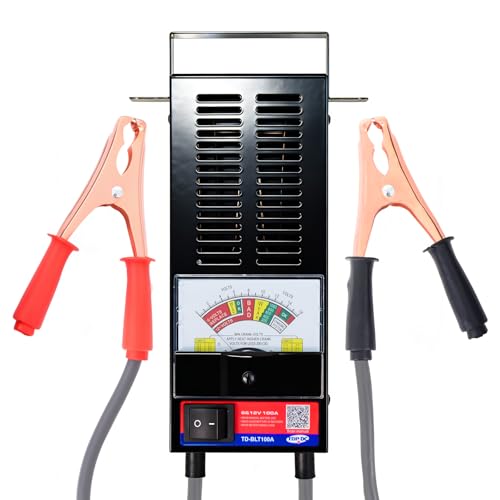
- Carbon-pile clamps: Found on traditional 100-amp load testers like the Schumacher BT-100. They use large, heavy-duty steel clamps with braided copper straps to handle high heat. They are durable but require a firm, clean connection to the battery posts, not just the terminal clamp.
Best Battery Load Testers Compared: Specs and Features
Digital conductance testers have largely replaced old carbon-pile testers for DIY use because they are safer, do not generate extreme heat, and can test without fully charging the battery. Carbon-pile testers remain useful for shop-level load testing that simulates real starter draw.
| Model / Type | Voltage | CCA Range | Battery Types | Cable / Clamp | Weight & Size | Power Source |
|---|---|---|---|---|---|---|
| Topdon BT200 (Digital Conductance) | 12V | 100-2000 CCA | Flooded, AGM, GEL, EFB | 3.2 ft, 10 AWG, Kelvin copper clamps | 0.55 lbs, 5.5 x 3.1 x 1.1 in | From battery tested |
| Ancel BA101 (Digital Conductance) | 12V | 100-2000 CCA | Flooded, AGM, GEL | 2.6 ft, 12 AWG, copper-plated clamps | 0.68 lbs, 5.9 x 3.3 x 1.0 in | From battery tested |
| Clore Automotive SOLAR BA9 (Digital Conductance) | 12V | 100-1600 CCA | Flooded, AGM | 3.0 ft, 10 AWG, Kelvin copper clamps | 1.10 lbs, 6.5 x 3.5 x 1.5 in | From battery tested |
| Foxwell BT705 (Digital Conductance) | 12V / 24V | 100-2000 CCA | Flooded, AGM, GEL, EFB | 4.0 ft, 10 AWG, Kelvin copper clamps | 1.45 lbs, 7.8 x 4.2 x 1.8 in | From battery tested |
| Schumacher BT-100 (Carbon Pile – 100 Amp Load) | 6V / 12V | Up to ~1000 CCA (analog gauge) | Flooded, AGM (with voltage chart) | 4.5 ft, 8 AWG, heavy-duty steel clamps | 3.85 lbs, 10.2 x 5.5 x 3.8 in | From battery tested + internal load coil |
Decision Matrix: Which Tester Fits Your Situation
Choose by what you drive, how often you test, and where you will use it.
| Your Situation | Recommended Type | Why It Fits |
|---|---|---|
| One car or SUV, occasional testing, budget under $60 | Ancel BA101 or similar 12V 100-2000 CCA tester | Covers all standard car batteries, simple pass/fail results, compact storage in glove box |
| Gas truck, SUV, or vehicle with AGM/start-stop | Topdon BT200 or Clore SOLAR BA9 | Accurate AGM/EFB algorithms and true Kelvin clamps prevent false failures on sensitive electronics |
| Diesel pickup, RV, or mixed 12V/24V fleet | Foxwell BT705 | 24V support tests commercial batteries in series and handles dual-battery diesel systems without disconnecting |
| Shop use or verifying a questionable digital result | Schumacher BT-100 carbon pile | Applies a real 100-amp resistive load for 10 seconds, showing voltage drop under true stress and testing starter/charging system |
| Working in tight engine bays or cold weather | Any digital tester with 3.0+ ft cables and removable Kelvin clamps | Longer cables reach recessed truck batteries and allow testing without removing battery covers |
Worked Example: Is a High-CCA Tester Worth It?
A common question is whether to pay more for a 2000 CCA tester when your car is only rated at 600 CCA. The value depends on accuracy margin and future use.
Consider a household with a 2021 Honda Accord (410 CCA) and a 2023 Ford F-150 3.5L with an AGM battery (760 CCA). A tester rated 100-1000 CCA can test the Accord in the middle of its range but tests the F-150 at 76% of its maximum, where error increases by 5-10%. A tester rated 100-2000 CCA tests the same F-150 battery at only 38% of its maximum, well within its most accurate zone. If the 100-1000 CCA tester costs in the $35-$50 range and the 100-2000 CCA tester costs in the $55-$75 range, the $20 difference buys support for future vehicles, including diesels, and avoids replacing the tester if you upgrade trucks. For single-vehicle owners who will never test above 650 CCA, the narrower range is adequate. For multi-vehicle households, the wider range costs less per battery tested over five years.
Durability and Ownership Realities
Battery testers are low-maintenance, but accuracy degrades from user error and wear, not electronics failure.
- What wears first: Clamp springs and jaw teeth. Copper-plated steel clamps lose tension after 2-3 years of frequent use, causing intermittent readings. Solid copper Kelvin clamps last longer but can bend if dropped. Inspect jaws for green corrosion and file lightly with fine sandpaper if needed. Never use the clamps as pliers.
- Cables: Internal wire breakage near the strain relief is the second failure point. Avoid wrapping cables tightly around the unit. A gentle loop prevents conductor fatigue.
- Cleaning and storage: Battery acid vapor corrodes contacts. Wipe clamps with a dry rag after use and store in the included case. Do not store with the cables under tension. Digital testers have no consumables, while carbon-pile testers like the BT-100 have a vented load coil that must cool for at least 5 minutes between 10-second tests to avoid overheating.
- Common mistakes that cause false fails: Testing without cleaning corrosion off battery posts, testing immediately after driving (surface charge inflates voltage – turn headlights on for 30 seconds, then off, before testing), clamping to the terminal bolt instead of the lead post, and testing a battery below 12.0V without charging first. Most digital testers will prompt to charge if voltage is under 11.8V.
How to Get an Accurate Test in 5 Steps
Follow this sequence for both conductance and carbon-pile testers to avoid retesting.
- 1. Safety first: Wear safety glasses and gloves. Turn off ignition, lights, and all accessories. If the battery has removable caps, ensure vents are not blocked.
- 2. Remove surface charge: If the vehicle was recently driven or charged, turn on high beams for 45 seconds, then turn them off and wait 2 minutes. This stabilizes voltage.
- 3. Connect correctly: Connect red to positive (+) post, black to negative (-) post. Rock clamps slightly to bite through oxidation. The tester should show 12.4V-12.7V for a charged battery before testing.
- 4. Enter specs: Input the battery’s rated CCA and type (found on the battery label) as printed, not what you think it should be. Select AGM if your battery says AGM. This calibrates the algorithm.
- 5. Run and interpret: For conductance testers, press test and wait 3-5 seconds for CCA measured, state of health (SOH), and state of charge (SOC). For carbon-pile testers, apply 100-amp load for exactly 10 seconds and read voltage – above 9.6V at 70°F is typically a pass, below 9.6V is fail or needs charging and retesting. Disconnect black first.
Frequently Asked Questions
Can a load tester test a battery that is completely dead?
No. Digital conductance testers need at least 8-11 volts from the battery to power on. If your battery reads under 8 volts, charge it with a battery charger for several hours and retest. A battery that will not hold above 12.4V after charging has likely failed.
What is the difference between CCA, CA, and MCA?
All measure cranking power at different temperatures. CCA is at 0°F, CA (Cranking Amps) is at 32°F, and MCA (Marine Cranking Amps) is also at 32°F but for marine batteries. CA is always higher than CCA for the same battery (typically CA = CCA x 1.25). Enter the rating that matches what your tester asks for – most testers default to CCA.
Do I need to disconnect the battery to test it?
For most conductance testers, no. You can test in-vehicle with cables connected. For carbon-pile testers and for 24V systems with two batteries in series, disconnect the negative cable to isolate each 12V battery for an individual result. Always consult your vehicle manual, as some vehicles require a memory saver when disconnecting power.





Write Your Review
No reviews yet. Be the first to share your experience!