

Our Top Picks

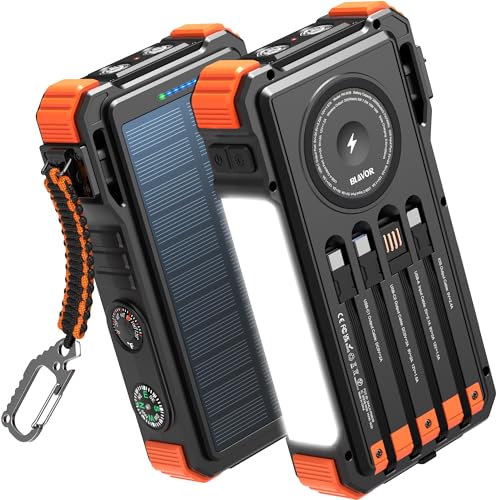

Short answer: For most summer trips, a 20,000 mAh or 25,000 mAh solar power bank with 20W USB-C output covers phones and a tablet for several days. A 10,000 mAh model is the better pocket option for day hikes. The largest option here, the Anker SOLIX C300 DC, is a 288Wh solar-ready station for laptops and 12V gear, with a separate solar panel required and no AC outlet. Built-in panels on pocket banks are for emergency top-ups, not a full recharge, so charge the bank before a trip and treat sunlight as a backup.
As an Amazon Associate, we earn from qualifying purchases.
Table of Contents
- How to Choose
- Quick Comparison
- 1. BLAVOR 10,000mAh
- 2. BLAVOR 20,000mAh
- 3. Hiluckey 25,000mAh
- 4. Hiluckey 27,000mAh
- 5. Anker SOLIX C300 DC
- Which One Fits Your Trip
- Solar Limits
- FAQ
- Conclusion
- ASIN Reference
How to Choose a Solar Power Bank
Capacity comes first. A 10,000 mAh bank holds enough energy for about two full phone charges in practice, after conversion losses, while a 20,000 mAh bank roughly doubles that reserve. A 25,000 mAh or 27,000 mAh bank adds a further margin for a tablet, a second phone, or a longer trip. Output wattage decides charging speed: a 20W USB-C output charges a modern phone far faster than a 5W or 10W port.
Solar panel size comes second. Pocket banks carry a small panel, often rated near 1W to 6W. The BLAVOR 10,000mAh listing states a maximum of 1.15W, a trickle charge. The four-panel Hiluckey 25,000mAh model lists up to 6W in direct sunlight, more useful, but still slow beside a wall charger. A separate 60W or 100W folding panel, paired with a solar-ready station such as the Anker SOLIX C300 DC, is the only setup here that treats solar as a main charging method, and even then the panel is sold separately.
Ports, cables, durability, and weight come third. Built-in cables remove the need to carry separate leads. An IPX5 rating, stated for both BLAVOR models, covers water projected from a nozzle, useful in rain, but it is not a rating for submersion. The Hiluckey models describe dust- and drop-resistant construction rather than a numbered IP rating in the excerpts checked. Weight rises with capacity, from 9.3 oz for the BLAVOR 10,000mAh model to 6.17 lb for the Anker station, so a day hiker feels the difference while a car camper does not.
Quick Comparison
| Product | Capacity | Solar setup | Main output | Tier |
|---|---|---|---|---|
| BLAVOR 10,000mAh | 10,000 mAh | Built-in panel, 1.15W max | 20W USB-C | Budget |
| BLAVOR 20,000mAh | 20,000 mAh | Built-in panel, backup use | 20W USB-C | Mid-range |
| Hiluckey 25,000mAh | 25,000 mAh | 4 foldable panels, up to 6W | 15W max, 5V/3A | Budget |
| Hiluckey 27,000mAh | 27,000 mAh | Built-in panel, backup use | 15W max, 5V/3A | Mid-range |
| Anker SOLIX C300 DC | 288Wh / 90,000 mAh | Solar-ready, 100W max input, separate panel required | 300W total, 140W USB-C | Premium |
1. BLAVOR Solar Power Bank 10,000mAh
This is the pocket option. It is the lightest bank here, and its size suits a day pack, a jacket pocket, or a small dry bag. Capacity covers a phone and a small accessory on a day hike. The listing describes the solar panel as a backup for emergencies, with cable charging as the primary method, and that matches the panel figure: a maximum of 0.23A, or 1.15W. The main output is a 20W USB-C port with Power Delivery, plus a USB-A port and a 10W wireless pad, for three devices at once. Two flashlights and a compass carabiner are built in. It fits a buyer who wants the smallest solar bank that still charges a phone at a useful speed, not a buyer who needs several days of power for two people.
Specs
| Spec | Detail |
|---|---|
| Capacity | 10,000 mAh |
| Solar panel | Built-in, 1.15W max (0.23A) |
| Outputs | USB-C 20W PD, USB-A, 10W wireless; 3 devices at once |
| Weight and size | 9.3 oz; 5.91 x 3.07 x 0.87 in |
| Water resistance | IPX5 |
| Features | Dual flashlights, compass carabiner; model PN-W05; 3-year warranty stated |
| Tier | Budget |
2. BLAVOR Solar Power Bank 20,000mAh
This model is built for a group or a multi-device kit. Its main advantage is the cable set: four built-in cables, two USB-C, one iOS, and one USB-A, plus three charging ports and a wireless area for an Apple Watch. The listing states that up to six devices can charge at once across cables, ports, and the wireless area. That removes four separate cables from a pack, a real benefit on a family camping trip. The USB-C output is rated at 20W, and the input is also USB-C at 20W. The shell is flame-retardant ABS and PC, rated IPX5 waterproof, dustproof, and shockproof. A flashlight, a camping light, a compass, a thermometer, a carabiner, and a bottle opener are built in. The built-in solar panel is described as a backup for emergencies, with cable charging as the primary method, and no panel wattage is stated in the excerpts checked.
Specs
| Spec | Detail |
|---|---|
| Capacity | 20,000 mAh |
| Solar panel | Built-in, backup use; wattage not stated in listing excerpts |
| Outputs | 20W USB-C, USB-A, iOS; 4 built-in cables, 3 ports, wireless area for Apple Watch; up to 6 devices |
| Weight and size | 1.72 lb; 1.5 x 3.85 x 7.28 in |
| Water resistance | IPX5 |
| Features | Flashlight, camping light, compass, thermometer, carabiner, bottle opener; model PN-W39 |
| Tier | Mid-range |
3. Hiluckey Solar Charger 25,000mAh
This is the first four-panel bank in the roundup. Four foldable solar panels open out from the body, and the manual lists solar panel power at up to 6W in direct sunlight. That is several times the panel output of a single-panel pocket bank, and it makes solar top-ups more useful on a sunny day at camp, while still leaving cable charging as the faster method. The manual states that solar charging is slower than wall charging and is intended mainly for emergency use or for maintaining charge. The battery is lithium polymer, at 25,000 mAh. Output is through one USB-C port and two USB-A ports, at 5V/3A, with a maximum output of 15W, for three devices at once. The USB-C port also serves as the input, with a full recharge in about six hours with a PD fast charger, not included. No numbered IP rating is stated in the excerpts checked, so keep it out of heavy rain.
Specs
| Spec | Detail |
|---|---|
| Capacity | 25,000 mAh |
| Solar panels | 4 foldable panels, up to 6W in direct sunlight |
| Outputs | USB-C and 2x USB-A, 5V/3A, 15W max; 3 devices at once |
| Weight and size | 1.21 lb; 6.18 x 3.54 x 1.38 in |
| Water resistance | No IP rating stated in excerpts checked |
| Features | Built-in flashlight, over-charging and short-circuit protection; model HI-S025; 12-month warranty stated |
| Tier | Budget |
4. Hiluckey 27,000mAh Power Bank Solar Charger
This is the cable-free version of the 27,000 mAh design. It keeps the 27,000 mAh lithium polymer capacity and adds three built-in cables: one USB-C output, one Lightning output, and one USB-A input cable. With two USB-A ports and one USB-C input/output port as well, the listing states that up to five devices can charge at once. That cable set suits a family kit with mixed phones and tablets, where carrying separate leads is the usual hassle. Output is 15W PD QC 3.0 fast charging at 5V/3A. The solar panel is listed for emergency recharging, with cable charging as the primary method, and no panel wattage is stated in the excerpts checked. Dual LED flashlights are built in, with safety protection and a waterproof, shockproof, and dust-proof design stated in the manual. Weight is 1.08 lb, close to the 25,000 mAh model, so the larger capacity and built-in cables come with almost no extra bulk. Plan a trip on the stored 27,000 mAh reserve, charge the bank fully before leaving, and use the solar panel only as a backup in daylight.
Specs
| Spec | Detail |
|---|---|
| Capacity | 27,000 mAh |
| Solar panel | Built-in, emergency recharging; wattage not stated in excerpts checked |
| Outputs | 15W PD QC 3.0, 5V/3A; 2x USB-A, 1x USB-C input/output; 3 built-in cables; up to 5 devices |
| Weight and size | 1.08 lb; 6.89 x 3.5 x 1.13 in |
| Water resistance | Waterproof, shockproof, and dust-proof design stated in manual; no IP rating stated |
| Features | Dual LED flashlights, safety-protection system; model T11X |
| Tier | Mid-range |
5. Anker SOLIX C300 DC Portable Power Station
This is not a pocket power bank, and it should not be bought as one. It is a 288Wh lithium iron phosphate (LiFePO4) portable power station, listed at 90,000 mAh, with 300W of total DC output and seven ports. There are no AC outlets. The ports are one 120W car socket, two 140W two-way USB-C ports, one 100W USB-C port, one 15W USB-C port, and two 12W USB-A ports. That port set suits USB-C laptops, tablets, phones, and 12V gear such as a car fridge or a fan, but it cannot run a device that needs a wall plug. Solar charging is through a separate panel, with a maximum solar input of 100W through an XT60 connector at 11 to 28V. No panel is included, and no wall charger is included. The listing recommends a 60W or 100W Anker panel, and states that the station is not compatible with the PS30, PS200, or PS400 panels. At 6.17 lb, this station is a car-camping and emergency-home item, not a hiking item.
Specs
| Spec | Detail |
|---|---|
| Capacity | 288Wh / 90,000 mAh, LiFePO4 |
| Solar input | 100W max, XT60, 11-28V; separate panel required, no panel included |
| Outputs | 300W total; 1x car socket 120W, 2x USB-C 140W, 1x USB-C 100W, 1x USB-C 15W, 2x USB-A 12W; no AC outlets |
| Input | Dual 140W USB-C PD; no wall charger included |
| Weight and size | 6.17 lb / 2.8 kg; 4.89 x 7.87 x 4.72 in |
| Features | Pop-out LED light, Bluetooth and Wi-Fi app control, smart temperature control; model A1726; 3-year warranty stated |
| Tier | Premium |
Which One Fits Your Trip
A day hike points to the BLAVOR 10,000mAh model, the lightest bank here, with 20W charging, a flashlight, and a carabiner. A weekend camping trip for one or two people points to the BLAVOR 20,000mAh model or the Hiluckey 25,000mAh model. The BLAVOR model wins when built-in cables and Apple Watch charging matter; the Hiluckey model wins when a larger solar panel area and a lighter body matter. A trip that includes a tablet or several phones points to the Hiluckey 27,000mAh model, with built-in cables, up to five devices at once, and the largest pocket reserve here. A car-camping trip, a road trip, or a home emergency kit points to the Anker SOLIX C300 DC, paired with a separate 60W or 100W panel that fits its 11 to 28V input. That is the only combination here that can refill a large battery from sunlight in a practical way, and the only option that can charge a USB-C laptop at full speed.
What Solar Charging Can and Cannot Do
Solar charging on a pocket bank is limited by panel area. A panel rated near 1W produces a small current, and even a 6W four-panel set produces far less than a wall charger. Sun angle, cloud, shade, heat, and panel orientation all reduce output further, and a panel left inside a pack or under a tent fly produces almost nothing. The practical rule is simple: charge the bank fully before a trip, use the stored energy first, and let the panel add charge during the day in direct sun. A separate folding panel changes the balance: a 60W or 100W panel, unfolded in full sun and aimed at the sun, can feed a solar-ready station at a useful rate. It still needs direct sun, a clear sky, and regular repositioning as the sun moves.
Frequently Asked Questions
How long does a solar power bank take to recharge in the sun?
A pocket bank with a small built-in panel takes far longer in the sun than on a wall charger. The BLAVOR 10,000mAh listing states a panel maximum of 1.15W and describes solar as a backup, with cable charging as the primary method. A four-panel Hiluckey model lists up to 6W in direct sunlight, faster, but still slow beside a USB-C charger. Charge the bank fully before a trip and use sunlight to stretch the reserve.
Is a 10,000 mAh bank enough for a weekend trip?
For one phone on a short trip, a 10,000 mAh bank is often enough for about two full charges in practice, after conversion losses. For two people, a tablet, or a trip longer than a weekend, a 20,000 mAh or larger bank is the safer choice. The BLAVOR 20,000mAh model and the two Hiluckey models in this roundup are built for that use.
Can a solar power bank charge a laptop?
Most pocket banks in this roundup cannot charge a laptop at a useful speed, because their USB-C output is 20W or 15W. The Anker SOLIX C300 DC can charge a USB-C laptop, with two 140W USB-C ports and a 100W USB-C port, but it has no AC outlet, so a laptop that needs a wall plug will not work with it. Check the laptop charging port before choosing a station.
Does an IPX5 rating mean a power bank can go underwater?
No. An IPX5 rating, stated for both BLAVOR models, covers water projected from a nozzle, useful in rain. It is not a rating for submersion. Keep a bank out of a stream, a lake, or a deep puddle, and dry the ports before charging if the bank has been in rain.
Conclusion
The best solar power bank for summer 2026 depends on the size of the trip and the devices in the pack. The BLAVOR 10,000mAh model is the pocket choice for day hikes. The BLAVOR 20,000mAh model is the cable-free choice for a group. The Hiluckey 25,000mAh model is the light four-panel choice for longer camping trips, and the Hiluckey 27,000mAh model adds built-in cables and five-device charging for a group. The Anker SOLIX C300 DC is the premium choice for laptops and 12V gear, with a separate solar panel required. In every case, charge the bank before leaving, treat the built-in panel as a backup, and match the output ports to the devices you carry.
More from Amazon
Programs that pair well with the guide above. Offers and eligibility are set by Amazon and may change.
Free shipping on eligible items, Prime Video and more. Eligible new members can start with a free trial.
Start a Prime free trialA Prime membership for ages 18-24 with a trial period. Eligibility is set by Amazon.
See Prime for Young AdultsAudiobooks and podcasts to listen to on the go. Eligible new members can start with a free trial.
Try Audible freeAd-free music streaming. Eligible new subscribers can start with a free trial.
Try Music Unlimited freeAs an Amazon Associate we earn from qualifying purchases.




Write Your Review
No reviews yet. Be the first to share your experience!