

Key takeaways
- Manual resistance: inexpensive and dependable, but you change load with a lever or by shifting gears.
- Speed-dependent magnetic resistance: smooth and affordable, though the resistance changes as wheel speed changes.
- Electronic smart resistance: an app can set a target wattage or simulate hills automatically.
- ERG mode: the trainer adjusts resistance to hold a prescribed power output, even when cadence changes.
- Simulation mode: resistance responds to a virtual gradient, usually influenced by rider weight, gearing, and speed.
The best bike trainers for most riders are direct-drive models, but a wheel-on trainer remains the better choice for a tight budget, occasional use, or a bike that must be stored quickly.
Quick picks by home setup
| Your situation | Best fit | Why | Typical market range in 2026 |
|---|---|---|---|
| Lowest cost and occasional riding | Basic wheel-on trainer | Uses your existing rear wheel and stores compactly | $150–$350 |
| Apartment or shared living space | Quiet direct-drive trainer | Eliminates tire noise and gives smoother resistance | $450–$1,000 |
| Regular indoor training on a budget | Wahoo KICKR CORE or similar | Strong smart-training feature set without flagship pricing | $500–$700 |
| Maximum realism and premium construction | Tacx NEO 2T Smart | High resistance capacity, very quiet operation, and advanced simulation | $1,300–$1,500 |
| Frequent training with a second bike | Direct-drive trainer with a spare cassette | Faster changeovers and less tire wear | $600–$1,100 plus cassette |
Wheel-on versus direct-drive trainers
Wheel-on: inexpensive and easy to put away
A wheel-on trainer clamps onto the rear axle or quick-release skewer while a resistance unit presses against the rear tire. This is the simplest route into indoor cycling. You keep the bike largely unchanged, and many models fold small enough to fit under a bed or in a closet.
Our top picks


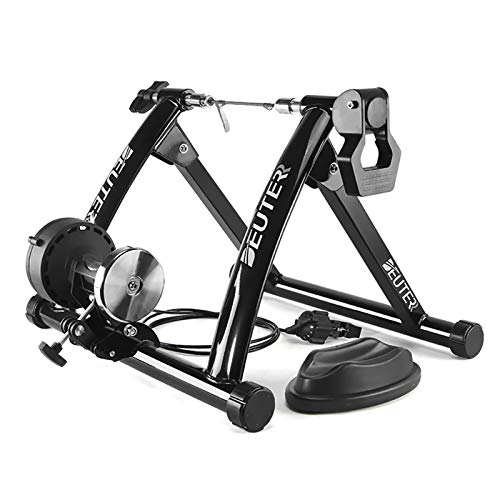
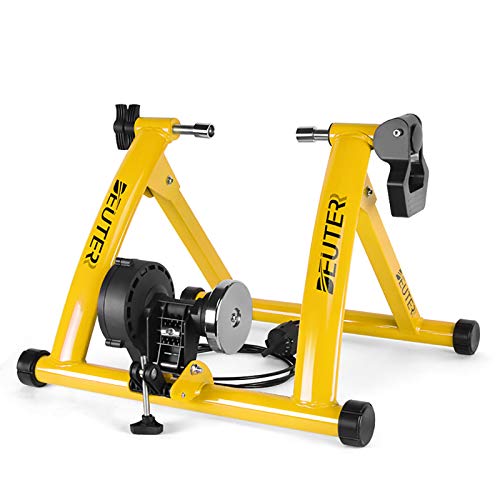
As an Amazon Associate we earn from qualifying purchases at no extra cost to you. Ratings are shown as listed on Amazon.
The trade-off is contact noise, tire wear, and less consistent power measurement. A standard road tire can become noisy and may wear rapidly against the roller, especially during hard intervals. A dedicated trainer tire usually lasts longer and reduces some noise, but it is another consumable. Wheel-on trainers also need careful roller tension: too little causes slipping, while too much accelerates tire wear.
Basic magnetic models may have several manually selected resistance levels but no automatic control. Smart wheel-on trainers can change resistance through an app, although the bike’s shifting and the tire-to-roller connection still affect the experience. Expect roughly 60–75 decibels near the trainer depending on speed, tire, floor, and resistance design; the sound is often more noticeable than the number suggests because it contains a steady mechanical whine.
Direct-drive: quieter, steadier, and better for structured training
With a direct-drive trainer, you remove the rear wheel and mount the chain onto a cassette attached to the trainer. A large flywheel and electronic resistance unit then provide the load. There is no tire slipping and no rear-tire wear, and power control is generally more stable for intervals, virtual racing, and planned workouts.
Direct-drive trainers are usually quieter, often around 50–65 decibels at moderate riding intensity, but “quiet” does not mean silent. The bicycle drivetrain still produces chain and gear noise, and vibration can travel through a hard floor or lightweight wall. A thick exercise mat helps protect the floor and reduces vibration; placing the trainer directly above a bedroom can still be inconsiderate in an apartment.
The drawbacks are price, weight, and setup. Most direct-drive units weigh about 15–22 kilograms, and you may need to install the correct cassette or freehub body. Check your bike’s axle standard, cassette speed, and derailleur compatibility before buying.
Resistance control matters more than maximum wattage
For casual spinning, almost any resistance system is adequate. For training, look at how resistance is controlled rather than choosing the biggest wattage number.
- Manual resistance: inexpensive and dependable, but you change load with a lever or by shifting gears.
- Speed-dependent magnetic resistance: smooth and affordable, though the resistance changes as wheel speed changes.
- Electronic smart resistance: an app can set a target wattage or simulate hills automatically.
- ERG mode: the trainer adjusts resistance to hold a prescribed power output, even when cadence changes.
- Simulation mode: resistance responds to a virtual gradient, usually influenced by rider weight, gearing, and speed.
For a first smart trainer, a resistance ceiling of 1,500–1,800 watts is plenty for most cyclists. A higher ceiling is useful for powerful riders, sprint work, or steep virtual climbs, but it does not automatically make a trainer quieter or more accurate.
Representative trainer specifications
| Trainer type or model | Resistance capacity | Gradient simulation | Power accuracy | Best use |
|---|---|---|---|---|
| Basic wheel-on magnetic | Usually not stated in watts | Manual levels | Often no power measurement | Easy fitness riding and low-cost entry |
| Wahoo KICKR SNAP | 1,500 W | Up to 12% | Approximately ±3% | Smart training with minimal bike changes |
| Wahoo KICKR CORE | 1,800 W | Up to 16% | Approximately ±2% | Frequent training and value-focused buyers |
| Tacx FLUX S Smart | 1,500 W | Up to 10% | Approximately ±3% | Stable direct-drive training at moderate cost |
| Elite Direto XR-T | 2,300 W | Up to 24% | Approximately ±1.5% | Hard intervals and demanding virtual climbs |
| Tacx NEO 2T Smart | 2,200 W | Up to 25% | Approximately ±1% | Premium realism and very quiet operation |
Published numbers are useful for comparison, but firmware, calibration, drivetrain condition, and the app can affect the result. Maximum gradient figures are simulations, not proof that the trainer physically tilts like a climb.
How to choose for an apartment
Noise has three sources: the trainer’s motor or flywheel, the bicycle drivetrain, and vibration through the floor. A direct-drive unit with a belt-driven resistance system generally offers the best starting point. The Tacx NEO 2T is among the premium quiet options, while the KICKR CORE and FLUX S occupy more attainable price brackets.
Use a dense rubber mat, keep the drivetrain clean and lubricated, and avoid standing sprints if vibration is a serious concern. A thick layer of carpet alone may not protect a hard floor from sweat. If someone lives below you, test the setup at the time you normally train and ask whether the vibration is noticeable.
Buying by budget and frequency
- Under $300: choose a wheel-on magnetic trainer if you ride indoors once or twice a week and do not need automatic workouts. Include a trainer tire in the budget.
- $300–$550: a smart wheel-on trainer can provide app connectivity, but compare the cost of a replacement tire and speed sensor.
- $550–$800: this is the practical sweet spot for a direct-drive smart trainer. It suits riders training three or more times weekly.
- $800–$1,500: pay for lower noise, better accuracy, stronger resistance, improved ride feel, or convenience—not simply a larger wattage number.
A simple ownership calculation can change the decision. Suppose a wheel-on setup costs $250, requires a $45 trainer tire, and the tire lasts 400 indoor hours. At 150 hours per year, the first-year cost is about $295, or $1.97 per hour. A $600 direct-drive trainer with no special tire costs about $4 per hour in the first year at the same usage, before resale value. At 400 hours over two years, however, the direct-drive cost falls to about $1.50 per hour, while additional wheel-on tires narrow the gap. Frequent riders are more likely to recover the higher initial price through durability and convenience.
Setup and maintenance that prevent common problems
- Confirm compatibility first. Check axle type, cassette speed, freehub body, and the manufacturer’s approved tire or bike size list.
- Level the trainer. Adjust its feet so the frame does not rock. A rocking trainer wastes energy and can loosen hardware.
- Install the cassette carefully. Tighten the lockring to the specified torque and use the correct spacer for your cassette.
- Update firmware and calibrate. Follow the manufacturer’s warm-up and calibration procedure. Calibration should be repeated after moving the trainer or changing major setup conditions.
- Control sweat. Use a towel or sweat guard, wipe the frame and flywheel housing, and clean the floor promptly. Salt and moisture can corrode bolts, chains, and electrical contacts.
- Inspect wear points. On wheel-on models, monitor the tire and roller. On direct-drive models, check the chain, cassette, freehub, power cable, and folding legs.
The most common mistake is buying a trainer that is technically compatible but inconvenient to use. If you dread removing the rear wheel, a direct-drive model may receive less use than a simpler wheel-on unit. Conversely, if you train indoors throughout winter, the quieter and more stable direct-drive design usually justifies its footprint and price.
Bottom line
Choose a wheel-on trainer for occasional riding, minimal storage space, and the lowest entry cost. Choose a direct-drive smart trainer for regular workouts, apartment-friendly noise levels, dependable resistance control, and less tire maintenance. For many households, a midrange direct-drive model such as the Wahoo KICKR CORE offers the best balance; premium options like the Tacx NEO 2T make sense when quiet operation and advanced simulation matter more than purchase price.





Write Your Review
No reviews yet. Be the first to share your experience!