

Key takeaways
- The burrs usually outlast the batteries. Inexpensive models are more likely to suffer from switch failure, stripped adjustment parts, or a tired motor than from visibly worn ceramic burrs.
- Moisture is the common enemy. Do not fill the mill from a steaming pot, rinse the grinding chamber, or store it beside a kettle. Damp peppercorns can bridge the burrs and cause clogging.
- Refill only with dry peppercorns. Wet ingredients, salt crystals, and spice blends can damage or obstruct a mechanism intended for pepper.
- Keep the hopper below its stated maximum. Overfilling makes the lid difficult to remove and can increase pressure on the motor when large peppercorns are tightly packed.
- Clean without water. Empty the hopper, turn the mill upside down, and run it briefly to release loose fragments. Brush residue from the opening with a dry, soft brush.
Best Electric Pepper Mills for Effortless Grinding
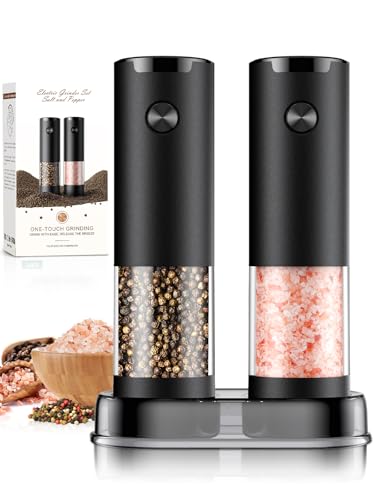
The best electric pepper mill for most kitchens is a rechargeable or battery-powered model with ceramic burrs, adjustable coarseness, a hopper of at least 20 grams, and a control that works with one hand while the other is stirring or serving.
Electric mills are not interchangeable, though. A compact mill used occasionally has different priorities from a large, rechargeable model used several times a day. The useful comparison is not simply which mill is strongest: it is how consistently it grinds, how often it needs refilling, what its batteries cost, and whether the controls are practical during cooking.
Our top picks


As an Amazon Associate we earn from qualifying purchases at no extra cost to you. Ratings are shown as listed on Amazon.
Quick picks by situation
| Kitchen situation | Best choice | Why it fits | Trade-off |
|---|---|---|---|
| Lowest upfront cost | Basic 4-AA or 4-AAA mill | Usually available for about $15–$30 and needs no charging base | Battery replacement and weaker performance as cells drain |
| Frequent daily cooking | Rechargeable electric mill with ceramic burrs | Consistent power, fewer disposable batteries, convenient charging | Higher price, typically $40–$90 |
| Serving at the table | Compact one-button mill | Simple vertical operation and less countertop space | Often has a smaller hopper, around 15–20 grams |
| Cooking for a household | Large-hopper mill holding 25–40 grams | Fewer refills during meal preparation | Heavier and less comfortable for small hands |
| People with limited grip strength | Gravity- or tilt-activated model | No button press or twisting motion is required | Less precise control over when grinding starts |
Head-to-head: the features that matter
Grind adjustment
Look for a continuously adjustable collar or a clearly indexed adjustment ring rather than a switch labeled only “fine” and “coarse.” A useful range is roughly 0.5 to 3 millimeters at the burr opening. Fine settings suit sauces and dressings; medium settings work for general cooking; coarse settings are useful for finishing steaks, salads, and soups.
Adjustment location matters. A ring near the burr is usually more repeatable than a dial hidden under the battery compartment, but it may be difficult to turn while the motor is running. Avoid changing the setting while peppercorns are jammed in the burrs. Run the mill briefly, then adjust in small increments.
Burr material
Ceramic burrs are the preferred choice for most home electric mills. They resist corrosion, tolerate normal peppercorn oils, and do not add metallic contact to the grinding mechanism. Hardened steel burrs can also be durable and may grind quickly, but they need more protection from moisture and can eventually show wear or corrosion if stored above a steamy cooktop.
Do not confuse burr material with the casing. A stainless-steel exterior says little about the internal grinder. The product description should specifically identify ceramic or steel grinding burrs.
Battery type and charging
Battery-powered mills generally use four AA or four AAA cells. AA models can provide more capacity, but they are also heavier. Rechargeable AA cells are a practical compromise if the mill accepts them, although a low-cost mill may not include a battery-level indicator.
Built-in lithium-ion rechargeable mills are neater for daily use. They commonly charge through USB or a dedicated base and may run for several weeks between charges in ordinary household use. Their main ownership disadvantage is that the internal battery is not usually user-replaceable. For a product expected to last many years, removable batteries can be easier to maintain.
Hopper capacity and refill frequency
Hopper capacity is usually listed in grams or milliliters. Because peppercorn size varies, a 25-gram capacity is more useful than a vague claim such as “large capacity.” As a working estimate, one teaspoon of whole peppercorns weighs about 2 grams.
A 20-gram hopper therefore provides approximately 10 teaspoons of pepper. If your cooking uses half a teaspoon per day, that is about 20 days of use. At one teaspoon per day, it is about 10 days. Actual results vary with grind size and how long the motor runs, but this calculation helps distinguish a table mill from a high-frequency cooking tool.
One-handed controls
A top-mounted push button is usually the most predictable design: hold the mill over the pan and press with your thumb. Tilt activation is faster when your hands are occupied, but it can dispense pepper accidentally when the mill is moved or stored.
Check whether the control requires continuous pressure. A momentary button gives better portion control and avoids producing a large pile of pepper. A lock-on switch is convenient for grinding into a bowl, but it can waste pepper and may run down the battery if left engaged.
Representative specifications to compare
| Mill type | Typical power | Typical hopper | Burr material | Approximate weight | Likely refill interval |
|---|---|---|---|---|---|
| Compact 4-AAA model | 4 AAA batteries | 15–20 g | Ceramic | 250–350 g empty | 1–3 weeks |
| Standard 4-AA model | 4 AA batteries | 20–30 g | Ceramic or steel | 350–500 g empty | 2–5 weeks |
| Rechargeable countertop model | Built-in lithium-ion battery | 25–40 g | Ceramic | 400–650 g empty | 3–8 weeks between refills |
| Gravity-activated serving mill | 4–6 AAA or AA batteries | 15–25 g | Usually ceramic | 300–500 g empty | 1–4 weeks |
These are useful comparison ranges rather than guarantees. Motor speed, peppercorn hardness, grind setting, and household usage can change both runtime and refill frequency.
Where named models fit
The Peugeot Elis Sense is a premium rechargeable option designed around one-handed electronic operation and Peugeot’s adjustable grinding mechanism. It suits cooks who want a polished table mill and are willing to pay more for rechargeable convenience. Its relatively premium construction does not remove the need to keep the grinding chamber dry.
The Cuisinart SG-3 Rechargeable Salt, Pepper and Spice Mill is a more feature-oriented choice for people who want rechargeable operation and adjustable grinding in a familiar countertop format. It is worth checking the current package contents and charging arrangement because accessories and regional versions can differ.
Basic battery-operated mills from established kitchenware brands, including Cuisinart and similar mainstream manufacturers, can be sensible for occasional use. Their advantage is low purchase cost and easy replacement; their disadvantage is that the motor may slow noticeably as batteries lose charge. If a listing does not specify burr material, hopper capacity, or battery requirements, treat it as a budget convenience item rather than a durable precision grinder.
Durability and ownership realities
- The burrs usually outlast the batteries. Inexpensive models are more likely to suffer from switch failure, stripped adjustment parts, or a tired motor than from visibly worn ceramic burrs.
- Moisture is the common enemy. Do not fill the mill from a steaming pot, rinse the grinding chamber, or store it beside a kettle. Damp peppercorns can bridge the burrs and cause clogging.
- Refill only with dry peppercorns. Wet ingredients, salt crystals, and spice blends can damage or obstruct a mechanism intended for pepper.
- Keep the hopper below its stated maximum. Overfilling makes the lid difficult to remove and can increase pressure on the motor when large peppercorns are tightly packed.
- Clean without water. Empty the hopper, turn the mill upside down, and run it briefly to release loose fragments. Brush residue from the opening with a dry, soft brush.
How to choose the best electric pepper mill
For occasional table use, choose a compact ceramic-burr model with a top button and a 15–20-gram hopper. For daily cooking, step up to a rechargeable model or one accepting replaceable AA batteries, with at least 25 grams of capacity. If refill frequency matters most, prioritize hopper size over a decorative exterior.
For precise seasoning, choose a momentary push button and an external adjustment ring. For accessibility, choose tilt activation only after confirming that its motion is comfortable and that it cannot start accidentally in a drawer. Finally, compare the cost of ownership: a $20 mill that consumes four disposable batteries every two months may cost more to operate over three years than a $60 rechargeable model.
The best electric pepper mill is therefore the one whose controls match your cooking habits. Ceramic burrs, useful adjustment, a dry and accessible hopper, and a realistic battery plan matter more than maximum motor speed or a premium-looking shell.





Write Your Review
No reviews yet. Be the first to share your experience!