

Key takeaways
- Measure the tow vehicle’s hitch height from the ground to the center of the pin or ball.
- Check the cart’s hitch height and whether the drawbar can be flipped or adjusted.
- Confirm the pin diameter and hole size; common garden-cart pins are not interchangeable with every receiver accessory.
- Make sure the hitch allows enough articulation for turns and uneven ground.
- Use a safety pin or retaining clip that cannot vibrate out.
Best Dump Carts for Tractors and Garden Work
The best dump carts for tractors are steel or heavy-duty poly carts with a capacity suited to your tow vehicle, a compatible hitch, wide pneumatic tires, and a bed that dumps far enough to clear the load without manual shoveling. For most homeowners, a 1,000–1,200-pound poly cart is the best balance of corrosion resistance, maneuverability, and price; frequent tractor users moving soil, gravel, or firewood should consider a 1,500–2,000-pound steel cart with a reliable foot-pedal or hand-release dump mechanism.
Quick picks by situation
| Work situation | Best cart type | Useful target specifications | Why it fits |
|---|---|---|---|
| Occasional mulch, leaves, and garden soil | Poly utility dump cart | 10–12 cubic feet; 600–1,000 lb capacity; 10–13 inch tires | Light, rust-resistant, and easy to wash |
| Compact lawn tractor and narrow gates | Small steel or poly cart | 4–7 cubic feet; 400–800 lb capacity; 36–42 inch width | Turns more easily and fits through restricted access |
| Frequent soil, gravel, or firewood hauling | Heavy-duty steel dump cart | 12–17 cubic feet; 1,500–2,000 lb capacity; 16 inch tires | Better resistance to impact and concentrated loads |
| Uneven ground, slopes, or soft turf | Wide-track cart with pneumatic tires | Two 16 inch tires or four 13–16 inch tires; low bed height | Improves flotation and reduces bouncing |
| ATV or utility tractor towing | Cart with convertible clevis or ball hitch | 1,000–1,500 lb capacity; adjustable hitch height | Works with more towing vehicles and attachment heights |
What matters most when choosing a dump cart
Load capacity is more than a headline number
Manufacturers commonly list both volume and weight capacity, and you need both figures. A cart may hold 12 cubic feet but reach its weight limit before it is full of wet soil. As a rough planning guide, a cubic foot of dry mulch may weigh about 20–40 pounds, while a cubic foot of damp topsoil can weigh roughly 70–100 pounds. Gravel may exceed 100 pounds per cubic foot.
Our top picks
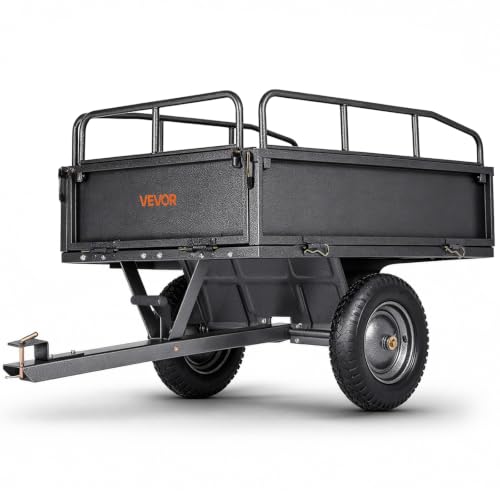

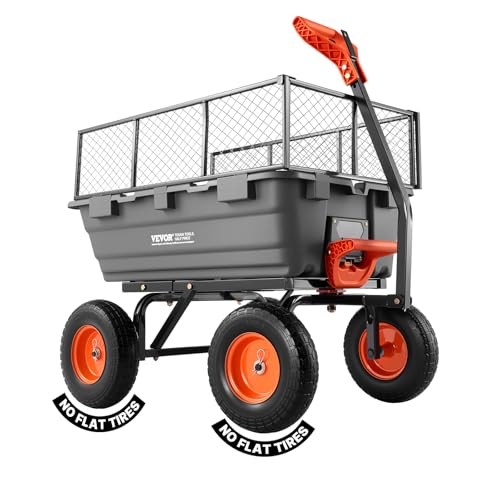

As an Amazon Associate we earn from qualifying purchases at no extra cost to you. Ratings are shown as listed on Amazon.
For example, filling a 10-cubic-foot cart with damp soil at an estimated 80 pounds per cubic foot would produce 800 pounds before accounting for uneven distribution. A cart rated for 1,000 pounds has only a modest safety margin, especially on slopes. For dense materials, fill the bed partially rather than treating the volume rating as the usable payload.
Also check whether the advertised capacity applies to a level surface and slow towing. A full cart exerts more stress on the frame, axle, hitch, and tractor when braking or crossing a rut.
Poly versus steel beds
Polyethylene beds are usually the better choice for compost, manure, wet mulch, salt, and fertilizer because they do not rust and are easy to rinse. Their smooth surfaces also help loose material slide out during dumping. The trade-off is that thin plastic can crack if overloaded, dragged against rocks, or struck by frozen clumps.
Steel beds suit heavier and more abrasive work. A steel floor and sidewalls tolerate gravel, split wood, and repeated impacts better, but painted steel eventually develops scratches and rust—especially around the tailgate, bolt holes, and underside. Galvanized steel improves corrosion resistance but may cost more.
For normal residential use, prioritize a reinforced poly bed or a steel bed with a protected underside over decorative features. Look for a supported floor, gusseted corners, and hardware that can be replaced rather than permanently riveted parts.
Dump angle and unloading mechanism
A high advertised dump angle does not guarantee a clean unload. The material, moisture level, bed surface, tailgate design, and ground slope all matter. A practical target is at least 45 degrees for mulch and leaves, while 50–60 degrees is more useful for damp soil or gravel.
A foot-operated release lets you remain beside the tractor and keep both hands available when operating the hydraulic lift or moving the tow vehicle. A hand lever is simpler and may be easier to repair. Whichever design you choose, confirm that the bed locks securely in the transport position and that the release cannot be triggered accidentally by a branch or rut.
Removable or hinged tailgates are valuable when the cart will also carry long materials. However, extra hinges and latches create more points for packed dirt to collect. A simple rear panel is often more dependable for bulk material.
Hitch compatibility: measure before buying
Many garden carts use a pin-style clevis hitch, while some tractor and ATV attachments use a standard receiver or ball connection. Do not assume that a cart advertised for “tractor use” will connect directly to your particular machine.
- Measure the tow vehicle’s hitch height from the ground to the center of the pin or ball.
- Check the cart’s hitch height and whether the drawbar can be flipped or adjusted.
- Confirm the pin diameter and hole size; common garden-cart pins are not interchangeable with every receiver accessory.
- Make sure the hitch allows enough articulation for turns and uneven ground.
- Use a safety pin or retaining clip that cannot vibrate out.
A level or slightly nose-down drawbar is usually preferable. A sharply nose-up cart can unload weight from its front end, while a nose-down setup may increase tongue load and make tight turns harder.
Tires and maneuverability on uneven ground
Pneumatic tires generally outperform solid tires when a cart is towed across lawn, gravel, roots, or shallow ruts. They absorb shock, reduce vibration, and provide a larger contact patch. Their drawbacks are punctures and the need to check pressure.
| Tire style | Best surface | Advantages | Limitations |
|---|---|---|---|
| Small solid tires | Paved paths and smooth yards | No flats; little maintenance | Harsh ride; poor performance in ruts |
| 10–13 inch pneumatic tires | Lawns and general garden work | Good balance of flotation and turning | Can puncture or lose pressure |
| 16 inch pneumatic tires | Gravel, fields, slopes, and rough ground | Roll over obstacles more easily | Higher bed height and wider turning clearance |
| Four-wheel wagon layout | Heavy loads on relatively smooth ground | Stable and high capacity | Less maneuverable in tight turns |
| Two-wheel balanced layout | Narrow paths and frequent turning | Small turning radius; simple design | More tongue weight and less stable on side slopes |
For uneven ground, width is as important as tire diameter. A narrow cart can pass through gates but is more prone to tipping when a wheel drops into a rut. A wide axle improves stability but may scrape fences or damage turf during tight turns. Four-wheel carts usually track steadily with heavy loads, whereas two-wheel carts are easier to maneuver around garden beds.
Brands and price expectations
Agri-Fab and Ohio Steel are established names in residential lawn and garden hauling, with product lines that include poly and steel utility carts. John Deere also sells lawn and utility attachments through its dealer network. Availability and specifications vary by model, so compare the actual bed dimensions, axle rating, and hitch design rather than choosing by brand alone.
In 2026, general market ranges are approximately $150–$300 for light-duty carts, $300–$600 for better-built residential models, and $600–$1,200 or more for heavy-duty steel carts intended for frequent tractor use. Larger capacities, hydraulic dumping, galvanized components, and commercial-grade tires can raise the price substantially.
Ownership realities: what wears out first
The first parts to need attention are usually tires, wheel bearings, hitch hardware, and the dump latch—not the bed itself. Pneumatic tires slowly lose pressure even without a puncture. Underinflation increases rolling resistance and can damage the sidewall; overinflation reduces traction and makes the cart bounce.
After hauling wet or corrosive material, rinse the bed, axle area, and latch. Let the cart dry before storing it. Grease wheel bearings according to the manufacturer’s instructions, inspect the hitch pin for elongation, and tighten wheel hardware at the start of each season. Touch up scratches on painted steel before rust spreads under the coating.
Avoid three common mistakes: loading heavy material above the sidewalls, towing quickly over rough ground, and dumping on a side slope. Keep the load centered, reduce speed before turns, and confirm that no person or animal is behind the cart before releasing the bed.
Bottom line
Choose a poly cart in the 600–1,200-pound range for routine mulch, leaves, compost, and garden soil. Choose a reinforced steel cart rated around 1,500–2,000 pounds for regular gravel, firewood, or construction debris. If your property is uneven, spend less effort comparing cosmetic features and more on wide pneumatic tires, a low center of gravity, a secure dump lock, and a hitch that matches your tractor. Those details determine whether the cart remains useful after the first season or becomes difficult to control when fully loaded.

Write Your Review
No reviews yet. Be the first to share your experience!