

Key takeaways
- New pilot with limited storage: Choose the Mini 4 Pro. Its automated takeoff, return-to-home, tracking, and obstacle sensing make the learning curve gentler.
- Occasional vacation use: Choose a small sub-250-gram camera drone, but budget for at least two batteries. A single battery may deliver only about 25 practical minutes after reserving power for return and landing.
- Weekly filming or paid-looking footage: Choose the Air 3S. Its larger main sensor, second focal length, and longer endurance justify the extra size when the drone is used regularly.
- Fast movement, trails, and immersive flying: Choose the Avata 2, especially if propeller guards and a motion controller appeal to you. Learn in an open area before trying confined spaces.
- Very limited budget: Avoid choosing by camera megapixels alone. A lower-cost drone with a real gimbal, GPS position hold, replacement parts, and a dependable return-to-home feature is preferable to a high-resolution camera mounted on an unstable aircraft.
The best drones with cameras for most buyers are the DJI Mini 4 Pro for portability and beginner-friendly filming, the DJI Air 3S for longer flights and stronger obstacle sensing, and the DJI Avata 2 for immersive first-person flying.
Our top picks


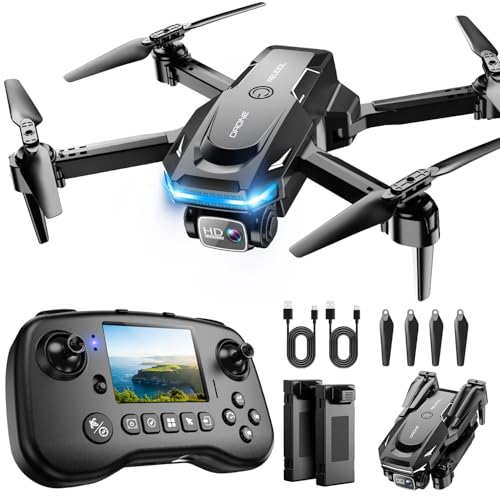
As an Amazon Associate we earn from qualifying purchases at no extra cost to you. Ratings are shown as listed on Amazon.
Quick picks by situation
| Best for | Recommended drone | Why it stands out | Typical market range |
|---|---|---|---|
| Travel, hiking, and small spaces | DJI Mini 4 Pro | Under-249-gram weight, 4K/60 HDR video, vertical shooting, omnidirectional obstacle sensing | $750–$1,100, depending on controller and battery bundle |
| Real-estate, landscape, and frequent filming | DJI Air 3S | One-inch wide camera, telephoto camera, long flight time, night obstacle sensing | $1,100–$1,600 |
| First-person flying and action footage | DJI Avata 2 | 4K/60 video, built-in propeller guards, motion-controller option, acrobatic flight modes | $800–$1,300 |
| Lower-cost camera flying | Entry-level GPS camera drone | Simple controls and stabilized 4K or 2.7K video without premium obstacle systems | $250–$600 |
Best overall for beginners: DJI Mini 4 Pro
The DJI Mini 4 Pro is the easiest recommendation when you want a serious camera without carrying a large aircraft. It weighs 249 grams with its standard battery, folds into a compact package, and records up to 4K/60 frames per second in HDR. Its three-axis mechanical gimbal keeps footage level while the drone moves, which is much more useful than a high megapixel number alone.
Its omnidirectional obstacle sensing can detect objects around much of the aircraft, while automated return-to-home and subject tracking reduce the workload for a new pilot. The drone is not crash-proof: thin branches, wires, poor lighting, and fast lateral movement can still defeat sensors. Treat obstacle avoidance as a backup, not permission to fly close to trees or buildings.
Flight time is rated at up to 34 minutes with the standard battery and up to 45 minutes with an Intelligent Flight Battery Plus in regions where that battery is supported. Wind, cold weather, fast flight, and repeated takeoffs shorten those figures. For practical planning, regard 25–30 minutes as a more useful target per standard battery.
Best camera and flight endurance: DJI Air 3S
The DJI Air 3S is the stronger choice when image quality matters more than minimum size. It combines a 50-megapixel one-inch wide-angle camera with a 48-megapixel medium-telephoto camera. The larger main sensor generally gives you more flexibility in dim light and more natural-looking background separation than a small travel-drone sensor.
Its two-camera design is also valuable for composition. You can establish a landscape with the wide camera, then switch to the telephoto camera to compress distant mountains, buildings, or subjects without physically flying as close. The Air 3S records up to 4K/120 slow motion and offers a rated maximum flight time of about 45 minutes.
This is a larger aircraft at approximately 724 grams, so it needs more room for takeoff and landing and is more noticeable in public places. Its advanced sensing and low-light obstacle features are helpful at dusk, but they do not replace a visual check of the flight path. Choose the Air 3S if you will fly often enough to benefit from its cameras and longer battery life; otherwise, the Mini 4 Pro is easier to store and transport.
Best for immersive action footage: DJI Avata 2
The DJI Avata 2 is designed around first-person-view flying rather than quiet, traditional aerial photography. It uses a wide-angle stabilized camera capable of up to 4K/60 video and has integrated propeller guards. With compatible goggles and a motion controller, a beginner can steer by pointing the controller, while a conventional remote provides more precise manual-style control.
The trade-off is important: the Avata 2 is noisier, less discreet, and less suited to slow, polished landscape compositions than the Mini 4 Pro or Air 3S. It has downward sensing and protective guards, but it does not provide the same all-around obstacle avoidance expected from a premium camera drone. Its rated flight time is about 23 minutes, and FPV flying usually consumes that time quickly because of acceleration and frequent maneuvers.
Camera, stabilization, and control comparison
| Model or type | Camera resolution and sensor | Stabilization | Rated flight time | Obstacle avoidance | Controller transmission range |
|---|---|---|---|---|---|
| DJI Mini 4 Pro | 48 MP; 1/1.3-inch sensor; up to 4K/60 HDR | Three-axis mechanical gimbal | 34 minutes standard; up to 45 with Plus battery | Omnidirectional sensing plus downward vision | Up to 20 km FCC-rated with DJI O4; local rules and interference reduce it |
| DJI Air 3S | 50 MP one-inch wide camera plus 48 MP telephoto; up to 4K/120 | Three-axis mechanical gimbal | Up to 45 minutes | Omnidirectional sensing, forward-facing LiDAR, and night-focused assistance | Up to 20 km FCC-rated with DJI O4 |
| DJI Avata 2 | 12 MP; 1/1.3-inch sensor; up to 4K/60 | Electronic stabilization, including RockSteady and HorizonSteady modes | Up to 23 minutes | Downward sensing and protective guards; limited compared with camera drones | Up to 13 km FCC-rated with DJI O4 |
| Entry-level GPS camera drone | Usually 12–48 MP; sensor size varies; often 2.7K or 4K | Two- or three-axis gimbal, or electronic stabilization | 18–30 minutes | Often none or front/downward-only | Approximately 1–10 km claimed, depending on system |
Transmission distance is a ceiling measured under controlled conditions, not a practical target. In a neighborhood, trees, buildings, radio interference, and legal line-of-sight requirements matter more than the headline number. A reliable live video feed at 500 meters is more useful than a theoretical multi-kilometer range you cannot legally or safely use.
How to choose by experience, space, and frequency of use
- New pilot with limited storage: Choose the Mini 4 Pro. Its automated takeoff, return-to-home, tracking, and obstacle sensing make the learning curve gentler.
- Occasional vacation use: Choose a small sub-250-gram camera drone, but budget for at least two batteries. A single battery may deliver only about 25 practical minutes after reserving power for return and landing.
- Weekly filming or paid-looking footage: Choose the Air 3S. Its larger main sensor, second focal length, and longer endurance justify the extra size when the drone is used regularly.
- Fast movement, trails, and immersive flying: Choose the Avata 2, especially if propeller guards and a motion controller appeal to you. Learn in an open area before trying confined spaces.
- Very limited budget: Avoid choosing by camera megapixels alone. A lower-cost drone with a real gimbal, GPS position hold, replacement parts, and a dependable return-to-home feature is preferable to a high-resolution camera mounted on an unstable aircraft.
The ownership costs and maintenance that listings omit
Battery capacity affects useful filming time more than the advertised maximum. Suppose a standard Mini 4 Pro battery gives 27 practical minutes after allowing a safety reserve. A two-hour outing requires roughly five batteries of usable time, or four batteries if you are willing to accept tighter margins. At a general replacement price of about $65–$100 per battery, buying a multi-battery kit can be more economical than purchasing batteries one at a time. Store lithium batteries partly charged in a cool, dry place rather than leaving them full for months.
Propellers are the most common consumable. Replace them after a hard strike, visible nicks, bending, or unusual vibration; do not wait for a dramatic failure. Clean the camera glass with a blower and lens cloth, remove grit from motors with a soft brush, and inspect the gimbal before every flight. Salt spray, sand, wet grass, and fine dust can damage moving parts even when the aircraft appears to fly normally.
For a lower-waste setup, buy only the batteries and charging accessories you will use, choose a model with readily available replacement propellers and guards, and keep the aircraft’s firmware current. Avoid flying in rain unless the manufacturer specifically permits it. Waterproofing is not a standard feature on these consumer camera drones.
Beginner setup checklist
- Charge the aircraft, controller, and batteries, then update firmware at home where you have a stable connection.
- Confirm local registration, remote-identification, airspace, and line-of-sight requirements before visiting a launch site.
- Choose an open area away from people, roads, power lines, and reflective surfaces.
- Set a conservative return-to-home altitude that clears nearby trees and structures.
- Practice hovering, gentle yaw, braking, and landing before recording cinematic movements.
- Keep enough battery for the return journey; landing at the automatic low-battery warning is not a safe flight plan.
Final verdict
For the broadest range of beginners and travelers, the DJI Mini 4 Pro is the best balance of camera quality, stabilization, safety assistance, and portability. Select the DJI Air 3S when its larger sensor, telephoto perspective, and longer flights will be used frequently. Select the DJI Avata 2 when the flying experience and action perspective matter more than maximum obstacle avoidance. Whatever you choose, prioritize a stable gimbal, replaceable parts, sensible battery management, and safe controls over an impressive but unrealistic range or megapixel claim.


Write Your Review
No reviews yet. Be the first to share your experience!