

Key takeaways
- For most kitchens, the OXO Easy-Clean Compost Bin offers the best balance of capacity, cleaning ease, and purchase price. Choose the Simplehuman Compost Caddy when a small stainless-steel footprint and replaceable filter matter most. Choose a Brabantia Sort & Go-style recycled-plastic bin for higher-volume scraps…
The best kitchen compost bins for odor-free scraps are a lidded, easy-to-wash bin with a replaceable charcoal filter: choose the OXO Easy-Clean Compost Bin for simple everyday use, the Simplehuman Compost Caddy for a compact premium setup, or a larger recycled-plastic Sort & Go-style bin if you cook often and want fewer trips outside.
Our top picks


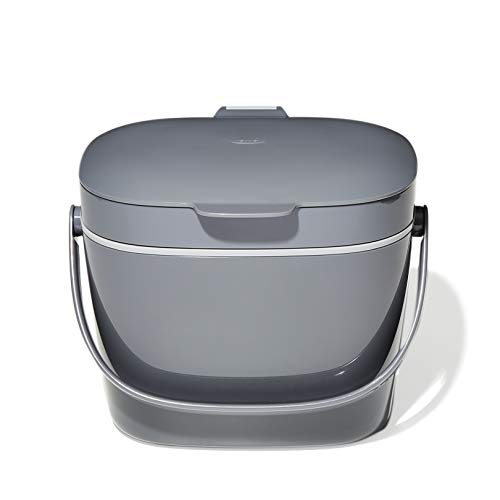

As an Amazon Associate we earn from qualifying purchases at no extra cost to you. Ratings are shown as listed on Amazon.
Quick comparison: the best kitchen compost bins by use case
| Best for | Representative product | Capacity | Material | Odor-control system | Typical market range |
|---|---|---|---|---|---|
| Most kitchens | OXO Easy-Clean Compost Bin | 1.75 gal / 6.6 L | Plastic body with smooth interior | Ventilated lid; optional charcoal filter depending on version | $25–$40 |
| Small countertop footprint | Simplehuman Compost Caddy | 4 L / 1.06 gal | Stainless steel | Replaceable activated-carbon filter | $50–$80 |
| Frequent cooking | Brabantia Sort & Go food-waste bin | 6 L / 1.6 gal | Recycled plastic | Tight-fitting lid; no filter in many configurations | $25–$45 |
| Lightweight, lower-plastic choice | Bamboozle Food Composter | 1.2 gal / 4.5 L | Bamboo-fiber composite | Replaceable charcoal filter | $40–$60 |
| Lowest-cost basic setup | Vented plastic countertop bin | 0.75–1.5 gal / 2.8–5.7 L | Polypropylene or recycled plastic | Ventilation, usually no filter | $10–$25 |
Capacities and configurations can vary by retailer and production year, so check the current specification before buying liners or replacement filters. The important distinction is not simply whether a bin has a lid. A sealed, damp container can develop smells faster than a ventilated container that allows moisture to escape.
Our picks, compared head-to-head
OXO Easy-Clean Compost Bin: best overall for straightforward daily use
The OXO’s main advantage is its simple cleaning design. The lid flips up with one hand, the inner bucket has rounded corners, and the body is designed to release scraps without requiring a narrow brush. Its 1.75-gallon capacity suits a household that cooks most days without taking up the space of a large under-sink container.
Choose it if you want a practical plastic bin, use compostable liners, and prefer washing the container rather than managing replacement filters. Its lid helps contain smells, but it is not the strongest choice for warm kitchens or households that leave food scraps sitting for several days. A smaller liner prevents the bag from collapsing into the bottom; a 2- to 3-gallon compostable liner is usually easier to handle than an oversized bag.
Simplehuman Compost Caddy: best premium option for odor control
The 4-liter Simplehuman Compost Caddy is a good fit when counter space matters more than maximum capacity. Its stainless-steel body resists staining and does not absorb food odors, while the charcoal filter in the lid helps reduce smells between emptying days. The removable inner bucket makes it easier to carry scraps outside without taking the entire caddy.
The tradeoff is ownership cost. Replacement filters and custom-fit liners add recurring expense, and the smaller capacity may require emptying every one or two days for a family that cooks frequently. Stainless steel also shows fingerprints and can develop surface marks if scrubbed with abrasive pads. Wipe it with mild dish soap rather than scouring powder.
Brabantia Sort & Go: best for high-volume scraps and cabinet storage
The Sort & Go range is especially useful when you want to keep food waste off the countertop. Its recycled-plastic construction is lightweight, and the rectangular shape uses cabinet or utility-room space efficiently. The 6-liter size is large enough for vegetable peels and coffee grounds from regular cooking, while larger Sort & Go sizes can work as a collection container near the back door.
This is more of a convenient collection bin than a filter-based odor-control system. It works best when scraps are emptied frequently, wet food is drained first, and the lid is not treated as a substitute for cleaning. Recycled plastic is less expensive and easier to carry than stainless steel, but it may retain odors if food residue remains in the seams.
Bamboozle Food Composter: best when material choice is a priority
The Bamboozle Food Composter uses a bamboo-fiber composite rather than a conventional stainless-steel body or standard plastic. It has a countertop-friendly capacity and a replaceable charcoal filter, making it a reasonable middle ground for shoppers who want a softer-looking bin and basic odor management.
Its material is not indestructible. Do not assume that a plant-fiber composite bin should go in the dishwasher unless the current care instructions specifically allow it. Hand washing, thorough drying, and avoiding prolonged soaking will help preserve the body and lid. This is a better choice for moderate scrap volume than for a large household that fills a bin rapidly.
Decision matrix: match the bin to your routine
| Your situation | Look for | Best fit | Why |
|---|---|---|---|
| One or two people, limited counter space | 2–4 L capacity, compact footprint, removable bucket | Simplehuman-style stainless caddy | Small enough to keep accessible and easy to empty often |
| Family cooking most days | 6 L or more, carry handle, washable body | Brabantia Sort & Go-style recycled-plastic bin | Higher capacity reduces trips without becoming difficult to move |
| Warm home or infrequent emptying | Activated-carbon filter, ventilated lid, tight fit | Filtered stainless-steel or bamboo-fiber caddy | Better control of odors between emptying days |
| First-time composter on a budget | Smooth plastic interior and standard liners | OXO-style plastic bin | Lower purchase price and fewer proprietary consumables |
| Trying to reduce disposable liners | Removable washable bucket and wide opening | Any filter bin with a leak-resistant inner pail | Allows direct loading and easier rinsing |
Capacity is a sizing decision, not just a bigger-is-better feature
A 4-liter bin holds about 1 gallon, but usable capacity is lower when you leave room to close the lid. If your household produces approximately 1 liter of compostable scraps per day, a 4-liter bin may need emptying every two to three days. At 2 liters per day, the same bin may be full in roughly 36 hours.
That calculation explains why a smaller filtered bin can smell fresher than a larger unfiltered one: frequent emptying matters more than volume alone. For most households, 4–6 liters is a practical countertop range. Go larger only if you have a convenient place to store the container and can comfortably carry it when full.
Filter systems, liners, and cleaning: what matters after purchase
Activated-carbon filters
Charcoal filters absorb some odor compounds but eventually become saturated. Many need replacement about every two to six months, depending on use and ventilation. A filter cannot compensate for meat, dairy, oily food, or wet scraps sitting in a warm bin for a week. Check whether replacements are widely available and whether the lid accepts a standard filter or a proprietary shape.
Compostable and reusable liners
Check the rules of your municipal or private compost program before buying liners. Some facilities accept certified compostable bags; others require loose scraps or paper bags. Liners also vary in size and strength. A bag that is too large folds over the rim and can trap liquid against the lid, while a bag that is too small may tear when lifted.
For a 4-liter bin, choose a liner with a stated capacity around 4–6 liters. For a 6-liter bin, a 6–10-liter liner generally leaves enough material to tie securely. Avoid using ordinary plastic bags if your collection program prohibits them; they may contaminate an otherwise usable load.
Cleaning routines
- Empty the bin before liquid accumulates at the bottom.
- Scrape stuck food away with a soft spatula rather than a sharp utensil.
- Wash the bucket with warm water and dish soap after leaks or at least weekly.
- Dry the interior fully before adding a new liner.
- Wipe the lid and filter housing separately so moisture does not saturate the charcoal filter.
Line the bottom with a folded sheet of newspaper or a small amount of dry shredded paper if your compost program allows it. This absorbs condensation without creating a permanent damp layer. Do not put the whole bin in the dishwasher unless the manufacturer explicitly approves it; heat can warp lids, seals, bamboo composites, and filter holders.
Which material lasts longest?
Stainless steel is the most odor-resistant and usually the easiest material to keep looking clean, but it costs more and can dent. Recycled plastic is light, affordable, and practical for a large bin, though scratches and seams can retain smells over time. Bamboo-fiber composite offers a lower-plastic aesthetic but needs gentler care and should not be left soaking.
The part most likely to wear first is usually not the body. Inspect the lid hinge, latch, rubber seal, handle, and filter holder. A bin with a removable inner bucket may remain useful even if the outer lid eventually needs replacement. Before buying, confirm that filters, lids, buckets, or liners can be purchased separately rather than replacing the entire product.
Bottom line
For most kitchens, the OXO Easy-Clean Compost Bin offers the best balance of capacity, cleaning ease, and purchase price. Choose the Simplehuman Compost Caddy when a small stainless-steel footprint and replaceable filter matter most. Choose a Brabantia Sort & Go-style recycled-plastic bin for higher-volume scraps and cabinet storage, or a Bamboozle Food Composter when bamboo-fiber construction is part of your buying priorities. Whatever the material, the most reliable odor-free routine is a correctly sized liner, dry scraps when possible, a clean lid, and emptying the bin before it becomes wet and full.

Write Your Review
No reviews yet. Be the first to share your experience!