

Key takeaways
- Do not carry a chair by its joystick, armrests, or footplates unless the manual specifically permits it.
- Keep drive wheels, casters, and wheel bearings free of hair, thread, and grit.
- Inspect tire wear, loose fasteners, frayed cables, and damaged battery cases every few weeks.
- Do not store lithium batteries fully depleted or in extreme temperatures.
- Avoid rain and standing water around the controller, charging port, and battery compartment.
- Have a qualified professional check seating, posture, and pressure-relief needs when the chair will be used for extended periods.
Best Electric Wheelchairs for Everyday Mobility
The best electric wheelchairs for everyday mobility are the WHILL Model C2 for indoor maneuverability, the Pride Jazzy Carbon for a lightweight folding design, and a full-size rear-wheel or mid-wheel drive chair when range, stability, and outdoor comfort matter more than car transport.
There is no single best choice for every user. A chair that is easy to lift into a vehicle may have a shorter range and lower weight capacity, while a full-size power chair can provide better suspension, seating, and terrain performance but usually needs a ramp or accessible vehicle. Compare the measurements—not only the advertised top speed—before buying.
Our top picks


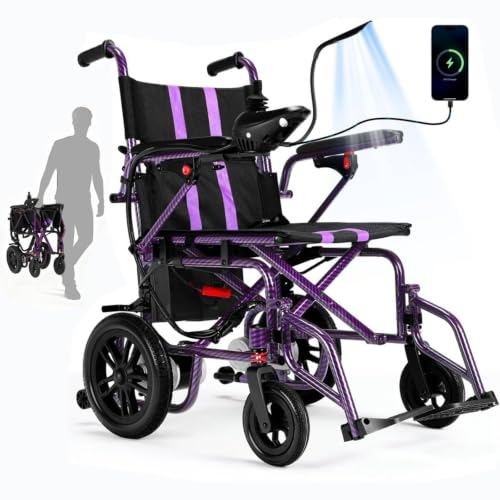
As an Amazon Associate we earn from qualifying purchases at no extra cost to you. Ratings are shown as listed on Amazon.
Quick comparison of leading everyday options
The figures below are representative published specifications and common market ranges. Exact dimensions, battery options, and prices can change by configuration, so confirm the final specification with the manufacturer or an authorized dealer.
| Chair or category | Seat width | Weight capacity | Turning radius | Typical range | Chair weight | Best fit |
|---|---|---|---|---|---|---|
| WHILL Model C2 | 18.5 in | 330 lb | 30.7 in | 11.8 miles | 約114 lb with battery | Indoor use, tight spaces, paved paths |
| Pride Jazzy Carbon | 18 in | 300 lb | 20.5 in | 9.3 miles | 59.5 lb without battery | Folding and vehicle transport |
| Folding travel power chair, typical class | 17–19 in | 250–400 lb | 24–32 in | 8–15 miles | 55–75 lb without battery | Lower-cost occasional travel |
| Full-size mid-wheel drive chair | 18–22 in | 300–450 lb | 20–26 in | 12–20 miles | 250–400 lb | Daily use, indoor maneuvering, varied terrain |
| Full-size rear-wheel drive chair | 18–24 in | 300–450 lb | 30–40 in | 15–25 miles | 250–450 lb | Outdoor stability and longer trips |
The listed chair weight deserves special attention. A folding model may weigh 60 to 75 pounds before its battery, but that does not mean one person can safely lift it. A 59.5-pound chair is still awkward to place in a trunk. If lifting is difficult, budget for a vehicle ramp, hoist, or help from another person.
Best electric wheelchair by everyday situation
Best for tight indoor spaces: WHILL Model C2
The WHILL Model C2 is designed around maneuverability. Its compact turning radius, independently controlled front omni-wheels, and relatively narrow seating make it attractive for homes, elevators, shops, and paved public areas. The front wheels can handle small surface irregularities better than many basic castered travel chairs.
Its disadvantages are ownership weight and transportability. At roughly 114 pounds with the battery, it is not a practical lift-in-and-out chair for most people. It also costs more than entry-level folding power chairs. Choose it when the chair will usually be driven, stored, or transported using equipment rather than carried by hand.
Best for car transport: Pride Jazzy Carbon
The Pride Jazzy Carbon is a strong choice for users who prioritize a folding frame and low lifting weight. Its carbon-fiber construction helps keep the base light, and its small turning radius works well in hallways and stores. It is suitable for paved sidewalks, shopping centers, airports, and other relatively smooth surfaces.
The trade-offs are typical of lightweight travel chairs: less range than many full-size models, limited suspension, and a seat that may not provide the same pressure relief or adjustability as a rehab-style power chair. Its roughly 300-pound capacity should be treated as a total occupant-and-carried-load limit, not merely a target body weight.
Best for frequent outdoor use: a full-size rear-wheel or mid-wheel chair
If the chair will be used for several hours most days, over cracked sidewalks, ramps, grass, or longer distances, a full-size power chair is usually the better value. Larger drive wheels, stronger motors, adjustable seating, and larger batteries improve stability and comfort. Mid-wheel drive generally makes tight indoor turns easier; rear-wheel drive often feels more predictable on outdoor slopes and uneven ground.
These chairs are much harder to transport. Their batteries may be removable, but the base can still weigh several hundred pounds. Before ordering, check doorway widths, ramp slopes, elevator dimensions, vehicle loading, and where the chair will be serviced.
How the key specifications affect your decision
Seat dimensions and fit
Measure the user while seated, wearing normal clothing. Seat width should provide enough room for a small amount of winter clothing without allowing excessive side-to-side movement. Seat depth should support most of the thigh without pressing behind the knee. A seat that is too deep can interfere with foot positioning; one that is too narrow can create pressure and make transfers harder.
Also measure the overall chair width, not just the seat. Door trim, armrests, joystick mounts, and anti-tip wheels can add several inches. For a home with a 30-inch doorway, a chair advertised as 28 inches wide may fit on paper but still be difficult to enter if the approach is not straight.
Turning radius
A small turning radius matters in bathrooms, kitchens, elevators, and narrow aisles. Measure the widest obstacle area in the home and leave clearance for hands, footplates, and the joystick. A chair may rotate within its published radius yet still need extra space to align with a doorway.
Range and battery realism
Advertised range is generally measured under controlled conditions with a new, fully charged battery, a particular user weight, and a smooth surface. Cold weather, hills, frequent stops, soft tires, heavier loads, and aged batteries reduce usable distance. For daily planning, a 20% to 30% reserve is sensible.
For example, if a travel chair claims 10 miles of range and your round trip is 6 miles, the nominal reserve is only 4 miles. Allowing a 25% reserve leaves a practical planning range of about 7.5 miles, so that trip may be too close if it includes hills or rough pavement.
Charging time and battery type
Many lithium-battery travel chairs charge in roughly 4 to 8 hours. Sealed lead-acid batteries commonly require 8 to 12 hours and are heavier, although they can cost less to replace. Charge after substantial use rather than repeatedly running the battery completely flat. Use the supplied charger, keep charging connections dry, and follow the manual’s storage instructions.
Terrain capability
Small folding chairs are best on smooth, firm surfaces. They can struggle with gravel, wet grass, steep curb cuts, and broken pavement. Look for adequate ground clearance, solid or pneumatic tires suited to the surface, anti-tip protection, and a published safe slope limit. Never infer hill capability from motor wattage alone.
Ownership costs beyond the purchase price
General market pricing is approximately $2,000–$5,000 for many folding travel chairs, $4,000–$10,000 for more advanced compact models, and $6,000–$20,000 or more for complex full-size power chairs with specialized seating. Insurance coverage, dealer support, and customization can change the amount paid substantially.
Budget for battery replacement. A replacement lithium battery commonly costs about $400–$1,000, while a pair of sealed lead-acid batteries often costs about $200–$500. Battery life varies with use and storage, but two to four years is a reasonable planning range for many owners. A chair used daily in heat, cold, or frequent deep-discharge conditions may need batteries sooner.
Other recurring costs include tires or casters, joystick covers, armrest pads, footplate hardware, charger replacement, and occasional motor or controller repairs. Ask whether parts are stocked domestically, whether the battery is user-replaceable, and who performs warranty service. A low purchase price is less attractive if a minor fault leaves the chair unusable for weeks.
Decision matrix for choosing a chair
| Your priority | Most suitable type | What to accept as a trade-off |
|---|---|---|
| Lowest practical transport weight | Folding lithium travel chair | Shorter range and less suspension |
| Very tight home layout | Compact mid-wheel or maneuverable compact chair | Higher price or lower outdoor capability |
| Daily outdoor distances | Full-size rear-wheel or mid-wheel chair | Ramp, lift, or accessible van may be necessary |
| Higher user weight or extensive seating needs | Heavy-duty full-size chair | Greater width, weight, and battery expense |
| Occasional use and limited budget | Basic folding chair with published parts support | Fewer adjustments and less durable components |
Maintenance mistakes that shorten chair life
- Do not carry a chair by its joystick, armrests, or footplates unless the manual specifically permits it.
- Keep drive wheels, casters, and wheel bearings free of hair, thread, and grit.
- Inspect tire wear, loose fasteners, frayed cables, and damaged battery cases every few weeks.
- Do not store lithium batteries fully depleted or in extreme temperatures.
- Avoid rain and standing water around the controller, charging port, and battery compartment.
- Have a qualified professional check seating, posture, and pressure-relief needs when the chair will be used for extended periods.
Bottom line
Choose the WHILL Model C2 when indoor control and a refined compact design outweigh lifting and price concerns. Choose the Pride Jazzy Carbon when folding transport is the central requirement. Choose a full-size power wheelchair when daily comfort, longer range, higher capacity, and uneven outdoor surfaces matter most. Before purchase, verify the complete seated dimensions, actual loaded weight, battery replacement price, local service arrangements, and the chair’s ability to fit both your home and your transportation.




Write Your Review
No reviews yet. Be the first to share your experience!