

Key takeaways
- New to grinding or brewing mainly drip, pour-over, or French press: The Baratza Encore is a practical entry point. Its stepped dial makes it simple to return to a familiar setting. It is not designed as a dedicated espresso grinder.
- You make filter coffee often and want a more convenient workflow: The Virtuoso+ keeps the Encore’s broad, stepped range while adding a timer and a digital display. That can help with repeatability, though weighing beans separately is still the more reliable way to control a dose.
- You have limited counter space or want one grinder for several methods: Consider the Fellow Opus. Its smaller hopper encourages grinding closer to the amount you need, and its fine-to-coarse range offers more flexibility. Switching between brewing methods can require adjustment and a little dialing in.
- You make espresso every day: Choose a grinder with fine adjustment suited to espresso, and consider whether you want stepless control. The Opus can cover espresso and filter methods, but its stepped controls and the need to purge grounds when switching settings may be less convenient than a dedicated espresso grinder.
- You value repairability and long-term ownership: Baratza has a reputation for offering replaceable parts and repair support for many grinder models. Check parts availability in your country and for the exact version before purchasing.
Best Electric Burr Grinders for Better Coffee: Picks by Budget, Space, and Brewing Style
The best electric burr grinders match your brewing method and daily routine: choose the Baratza Encore for an adaptable everyday grinder, the Fellow Opus for a compact all-rounder, or the Baratza Virtuoso+ for quicker, more repeatable adjustments. For espresso, prioritize a grinder designed for fine, precise adjustment rather than assuming any burr grinder will do.
Burr grinders crush beans between two surfaces; blade grinders chop them unevenly. More uniform grounds make it easier to brew consistently, but burr material alone does not determine quality. Burr geometry, alignment, motor speed, adjustment design, and how much coffee remains inside the grinder all matter. The comparison below focuses on practical ownership, not just feature lists.
Our top picks
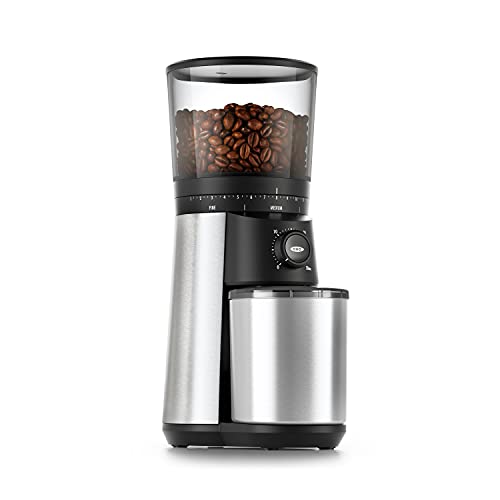
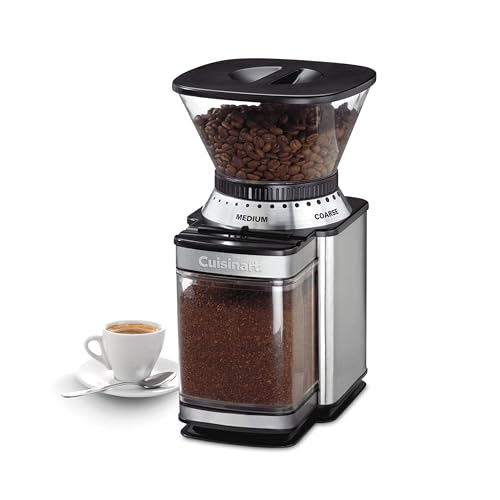
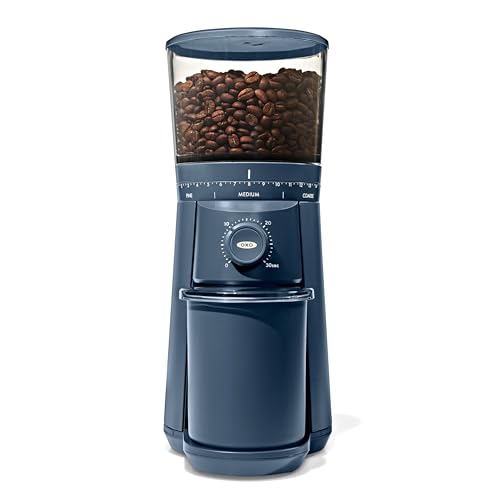

As an Amazon Associate we earn from qualifying purchases at no extra cost to you. Ratings are shown as listed on Amazon.
Quick comparison
| Grinder | Burrs and adjustment | Hopper capacity | Footprint (W × H × D) | Best fit |
|---|---|---|---|---|
| Baratza Encore | 40 mm conical steel; 40 settings | 8 oz / 227 g | 5.5 × 13.4 × 6.3 in | Filter coffee and beginners |
| Baratza Virtuoso+ | 40 mm conical steel; 40 settings | 8 oz / 227 g | 5.5 × 13.4 × 6.3 in | More convenient, repeatable filter grinding |
| Fellow Opus | 40 mm conical stainless-steel burrs; 41 stepped settings, with inner calibration adjustment | about 110 g | about 5.1 × 10.6 × 8.3 in | Compact, versatile use including espresso |
Dimensions and capacities are manufacturer-published specifications; small variations can occur between product versions or markets. Settings are not directly comparable between brands: a numbered step on one grinder does not equal the same grind size on another. Check the current manual before buying, particularly if you need to fit a grinder beneath a cabinet.
Which grinder suits your situation?
- New to grinding or brewing mainly drip, pour-over, or French press: The Baratza Encore is a practical entry point. Its stepped dial makes it simple to return to a familiar setting. It is not designed as a dedicated espresso grinder.
- You make filter coffee often and want a more convenient workflow: The Virtuoso+ keeps the Encore’s broad, stepped range while adding a timer and a digital display. That can help with repeatability, though weighing beans separately is still the more reliable way to control a dose.
- You have limited counter space or want one grinder for several methods: Consider the Fellow Opus. Its smaller hopper encourages grinding closer to the amount you need, and its fine-to-coarse range offers more flexibility. Switching between brewing methods can require adjustment and a little dialing in.
- You make espresso every day: Choose a grinder with fine adjustment suited to espresso, and consider whether you want stepless control. The Opus can cover espresso and filter methods, but its stepped controls and the need to purge grounds when switching settings may be less convenient than a dedicated espresso grinder.
- You value repairability and long-term ownership: Baratza has a reputation for offering replaceable parts and repair support for many grinder models. Check parts availability in your country and for the exact version before purchasing.
What matters beyond the burr label
Burr material and consistency
Steel burrs are common in household electric grinders and can produce excellent coffee. “Steel” does not automatically mean better or worse than ceramic: burr shape, sharpness, alignment, and the grinder’s ability to feed beans evenly are more useful considerations. Burrs gradually wear, especially with heavy use or very hard foreign material in the beans, but ordinary home use does not usually require frequent replacement.
Particle consistency matters because very fine fragments can extract faster than larger pieces. A grinder that produces a reasonably even distribution is easier to dial in, but the result also depends on fresh beans, a suitable brewing recipe, and keeping the grinder clean.
Adjustment range and repeatability
Stepped grinders click between defined settings. That makes returning to a previous brew setting straightforward, but it can leave you between two steps when dialing in espresso. More adjustment points can help, but the number on the dial is not a quality score. For switching from coarse French press to espresso, look for a grinder whose manual clearly supports both and expect to spend time finding workable settings.
Capacity, retention, and freshness
A large hopper is convenient if you brew several pots a day, but storing beans in it for long periods exposes more coffee to air and light. For one or two cups, weighing beans into the grinder for each brew can reduce stale-bean exposure. It also makes hopper capacity less important.
Retention is the ground coffee left inside the burr chamber and chute after grinding. Some grounds may emerge during the next use, so changing from a coarse setting to a fine one can carry older, coarser particles into the next dose. If you switch brew methods, grind a small amount through after changing settings and discard or use it for a less exact brew. This “purge” uses a little extra coffee but helps the new setting behave more predictably.
Noise, power, and cleaning
These are motorized appliances, so none is silent. Noise varies with the beans, dose, counter surface, and room; published specifications do not always use comparable measurement methods. If you grind early in a shared home, a brief morning dose is likely less disruptive than filling a large hopper and grinding repeatedly.
Electric burr grinders use power only while running, so their electricity use is generally small compared with appliances that heat water. For context, even a 200-watt grinder running for one minute uses about 0.0033 kWh (200 W × 1/60 hour). That figure is illustrative, not a measured rating for any grinder above; use the actual motor rating for a closer estimate.
Clean the grounds bin and brush accessible burr areas regularly, following the manufacturer’s instructions. Avoid water on burrs or inside the motor housing unless the manual explicitly permits it. Rice is sometimes suggested as a cleaning shortcut, but it can be too hard or starchy for some grinders and may damage parts or leave residue. Use a grinder-specific cleaning product only if the manufacturer approves it.
Cost and ownership: a quick way to compare
Electric burr grinders span general market ranges from roughly $100–$200 for many entry-level filter models to $200–$350 for more feature-rich or versatile home grinders; espresso-focused options can cost more. Prices change by model, region, and sale period. A higher purchase price may be worthwhile if the grinder better fits your daily method or has parts you can replace.
For a simple cost-per-use estimate, divide the purchase price by the number of brews you expect before replacing or upgrading it. For example, a $150 grinder used once daily for three years makes about 1,095 brews, or roughly 14 cents per brew before electricity, cleaning supplies, and any repairs. This is a planning example, not a lifespan guarantee. Using it twice daily would lower the purchase cost per brew, while replacing it sooner would raise it.
Bottom line
For most filter-coffee drinkers, the Baratza Encore is the value-oriented starting point; the Virtuoso+ makes sense if its timer and display suit your routine. Choose the Fellow Opus when compact size and a broad brewing range matter more than a generous hopper. If espresso is your priority, compare fine-adjustment control and retention carefully, and avoid buying on burr material or setting count alone.






Write Your Review
No reviews yet. Be the first to share your experience!