

Key takeaways
- Pit size: Measure the inside diameter and depth. Two pumps, their float switches, and discharge fittings must move freely without trapping the float.
- Pipe size: Many residential sump systems use 1 1/4-inch or 1 1/2-inch discharge pipe. Reducing the pipe can lower flow and increase cycling.
- Check valves: Use a check valve on each pump branch where required. Install it in the correct flow direction.
- Electrical separation: Keep the primary pump on a properly protected AC circuit and connect the backup controller according to its instructions. A battery backup does not protect an improperly wired primary pump.
- Discharge routing: Confirm that the outdoor outlet cannot freeze, clog, or send water back toward the foundation.
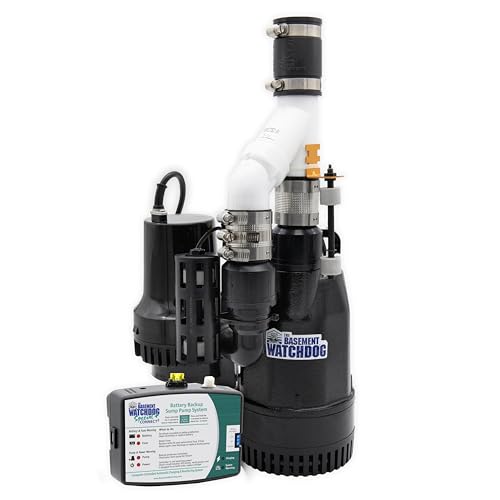
The best battery backup sump pumps for most homes are the Zoeller Aquanot 508 paired with a suitable primary pump, the Basement Watchdog BWE1000 for high-capacity protection, and the Wayne WSS30V for homeowners who want a packaged, easier-to-install system.
A battery backup is not a substitute for a properly sized primary sump pump. Its job is to keep removing water during a power outage, primary-pump failure, or unusually heavy inflow. The right choice depends less on the highest advertised gallons-per-hour figure than on pumping height, battery capacity, alarm quality, charger behavior, and whether the backup will fit beside your existing pump.
Our top picks



As an Amazon Associate we earn from qualifying purchases at no extra cost to you. Ratings are shown as listed on Amazon.
Best battery backup sump pumps by situation
| Situation | Best fit | Why it makes sense | Watch for |
|---|---|---|---|
| Maximum backup capacity | Basement Watchdog BWE1000 | High-output 12-volt backup system with a substantial controller and alarm | Requires adequate battery space, ventilation, and careful plumbing |
| Compact, established backup system | Zoeller Aquanot 508 | Designed for sump-pit backup use and commonly paired with a primary Zoeller pump | Confirm discharge height and controller compatibility before installation |
| Packaged DIY installation | Wayne WSS30V | Integrated primary-and-backup arrangement reduces the need to select separate pump components | Its combined layout needs sufficient pit diameter and clearance |
| Infrequent outages and moderate water inflow | 12-volt backup pump with a single deep-cycle battery | Usually the lowest-cost route, with simpler replacement parts | Do not choose by horsepower alone; compare flow at your actual lift height |
Head-to-head comparison
| System or type | Power | Published maximum flow class | Typical useful battery | Alarm and charger considerations | Installation difficulty |
|---|---|---|---|---|---|
| Zoeller Aquanot 508 | 12 volts DC | About 2,000 gallons per hour at zero lift; substantially less at 10 feet | 75–100 amp-hour AGM or flooded deep-cycle battery | Controller alarm, battery monitoring, and automatic charging; verify exact controller version | Moderate; requires a separate backup discharge connection |
| Basement Watchdog BWE1000 | 12 volts DC | Up to roughly 2,500 gallons per hour at zero lift, depending on configuration | 75–120 amp-hour deep-cycle battery | Audible alarm and charging controller; some installations add a water or battery alarm | Moderate to advanced |
| Wayne WSS30V | Primary AC pump plus 12-volt backup | Combined system; flow varies significantly with lift and pipe size | 75–100 amp-hour battery is commonly appropriate | Controller includes outage and battery-condition alerts; confirm included components | Moderate; packaged design can simplify selection but not plumbing |
| Generic 12-volt backup pump | 12 volts DC | Often 1,500–2,500 gallons per hour at zero lift | 75–100 amp-hour deep-cycle battery | Feature quality ranges from basic buzzer to full battery and charger monitoring | Moderate to advanced; instructions and fittings vary widely |
Zero-lift flow is useful for comparing pump designs but is not a realistic basement result. Every vertical foot, horizontal run, check valve, elbow, and narrow fitting adds resistance. A pump advertised at 2,000 gallons per hour may deliver only around 1,000 gallons per hour at a 10-foot discharge height.
What matters more than the headline gallon-per-hour number
Pumping capacity at total dynamic head
Measure from the pump outlet to the point where water exits outdoors, then add the effect of pipe friction and fittings. Many residential systems have 8–12 feet of total lift. Compare manufacturer pump curves at that height, not the maximum-flow figure.
As a practical example, suppose water enters the pit at 900 gallons per hour and your backup pump delivers 1,200 gallons per hour at the actual discharge height. The pump has a 300-gallon-per-hour margin. If inflow rises to 1,400 gallons per hour, the pit will still gain about 200 gallons per hour even though the pump is running continuously. In a high-water basement, capacity margin is more valuable than a slightly longer runtime.
Battery runtime
Battery runtime depends on amp draw, battery condition, temperature, and how often the pump cycles. A rough estimate is:
Runtime in hours ≈ battery amp-hours × 12 volts × 0.7 ÷ pump watts.
For example, a 100-amp-hour battery contains about 1,200 watt-hours in theory. Allowing for usable capacity and conversion losses gives approximately 840 watt-hours. A 400-watt backup pump could therefore run for about two hours continuously. Intermittent operation can extend the outage coverage considerably, but it does not create more pumping capacity.
Choose a deep-cycle marine or AGM battery recommended by the controller manufacturer. A standard automotive starting battery is designed for short, high-current bursts and is a poor substitute for repeated sump-pump cycling. AGM batteries cost more but avoid liquid electrolyte spills and generally work well in enclosed basement utility areas. Flooded batteries can be economical, but they require upright placement, ventilation, and periodic inspection.
Alarm and charger performance
A useful controller should identify more than a power outage. Look for separate indications for low battery voltage, charging failure, pump activation, and a high-water condition. An alarm that can be heard from living areas is important; a silent indicator in a utility corner is easy to miss.
Charging speed matters after a storm. A charger rated around 1.5–3 amps is common for residential backup systems. A higher charge rate can restore a partially depleted battery sooner, but the charger must be matched to battery type and capacity. If outages are frequent, a controller that supports temperature compensation or a manufacturer-approved AGM setting can reduce overcharging and undercharging.
Installation compatibility with the primary pump
The cleanest arrangement has two independent pumps in the same pit, each with its own check valve and discharge connection. Do not simply splice a backup pump into the primary pump’s discharge line without following the pump manufacturer’s plumbing instructions. Water can flow backward through an idle pump, and a failed check valve can allow the backup system to discharge back into the pit.
- Pit size: Measure the inside diameter and depth. Two pumps, their float switches, and discharge fittings must move freely without trapping the float.
- Pipe size: Many residential sump systems use 1 1/4-inch or 1 1/2-inch discharge pipe. Reducing the pipe can lower flow and increase cycling.
- Check valves: Use a check valve on each pump branch where required. Install it in the correct flow direction.
- Electrical separation: Keep the primary pump on a properly protected AC circuit and connect the backup controller according to its instructions. A battery backup does not protect an improperly wired primary pump.
- Discharge routing: Confirm that the outdoor outlet cannot freeze, clog, or send water back toward the foundation.
The Wayne WSS30V can be appealing when replacing an entire sump arrangement because its components are designed as a system. A Zoeller Aquanot 508 or Basement Watchdog unit may be a better choice when you already have a reliable primary pump and want an independent backup. In either case, tight pits, shallow lids, and crowded plumbing can turn a nominal DIY project into a job for a plumber.
Durability and ownership costs
The battery is usually the first consumable to fail. Plan on inspecting it several times a year and replacing it commonly every three to five years, though heavy cycling, heat, and poor charging can shorten that period. AGM batteries may last longer in some installations, but they are not maintenance-free.
Other common failure points include a stuck float switch, corroded battery terminals, a clogged pump inlet, a failed check valve, and an alarm whose battery has gone flat. Remove sediment from the pit, test the backup pump with clean water, and confirm that the discharge line flows outdoors. Testing only the alarm does not prove that the pump can move water.
For ownership budgeting, a complete backup setup commonly falls in the general range of $300–$900 before professional installation. Add the cost of a deep-cycle battery, replacement battery every few years, discharge fittings, and possibly a dedicated high-water alarm. A more expensive system can be worthwhile when basement flooding would damage finished space, a furnace, or electrical equipment.
A practical buying decision
- Choose a higher-capacity system when your basement receives water quickly, the discharge rises more than 10 feet, or outages last for many hours.
- Choose a compact established system when you have a suitable pit and a dependable primary pump but need independent outage protection.
- Choose a packaged system when you are replacing the primary pump and want fewer compatibility decisions.
- Choose a basic backup pump only when your measured inflow is modest, the discharge height is low, and you are willing to verify alarm and charger quality carefully.
Before purchasing, record the pit diameter, discharge height, pipe size, primary-pump model, and estimated outage frequency. Then compare the backup pump’s flow at your actual lift, its alarm functions, charger output, battery requirements, and access for future maintenance. Those details provide a more reliable flood-protection decision than maximum horsepower or zero-lift gallons per hour alone.







Write Your Review
No reviews yet. Be the first to share your experience!