

Key takeaways
- Compare clear window bird feeders by suction strength, seed capacity, drainage and placement to watch finches and cardinals up close at home.
- Top Pick: Nature Anywhere Window Bird Feeder
- Runner-up: Gray Bunny Window Bird Feeder
- Also consider: Nature's Way Crystal Window Seed Feeder
A window bird feeder brings feeding birds to the glass itself, so a kitchen, home office, or living room window becomes a close viewing spot without binoculars, a deck railing, or a yard pole. Clear acrylic and clear plastic models mount outside the glass with suction cups, hold seed in a shallow tray, and let small songbirds land inches away while people and indoor pets watch from inside. The cups must hold through wind and temperature changes, and the tray must drain after rain so seed stays dry. This guide covers five window-mounted seed feeders, explains how their cup counts, tray sizes, and drainage designs differ, and sets out placement and cleaning choices that help birds find the feeder and keep returning.
As an Amazon Associate, we earn from qualifying purchases.
Quick answer
For most windows, choose a clear feeder with four or more suction cups, a removable seed tray, and drainage holes under the seed. The Nature Anywhere and Gray Bunny models suit larger trays and frequent viewing, while the Nature’s Way Crystal model suits a compact window. Clean the glass before mounting, fill with fresh seed, and clean the tray weekly.
Nature Anywhere Window Bird Feeder
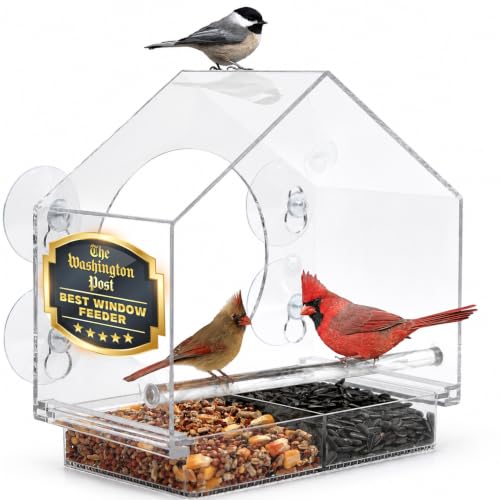
The Nature Anywhere Window Bird Feeder is a clear acrylic, house-shaped feeder built around a sliding seed holder and four extra strong suction cups. The sliding holder is the practical detail to note first. Instead of reaching outside to scoop seed into a fixed tray, the holder pulls out for filling and cleaning, then slides back into the frame. That design lowers spilling and makes a full wash easier, since the seed holder can go to the sink on its own.
The clear body gives an open view from inside, with the birds feeding in front of the glass rather than behind a colored frame. Four cups spread the load across the back of the feeder, which matters when several finches or a heavier cardinal land at once and the tray is full. As with every suction model here, hold depends on clean, smooth glass and firm pressure when the cups are pressed on.
A shallow tray like this one works well with sunflower hearts and black oil sunflower seed. Drainage helps seed stay drier, but no open tray stays dry in driving rain, so placement under an eave helps. Choose this feeder when the sliding tray and house shape appeal most, and when the window is wide enough that a larger viewing frame will not block light needed indoors.
Gray Bunny Window Bird Feeder

The Gray Bunny Window Bird Feeder is a large, clear window feeder sold in a house style, with strong suction cups, drainage holes, a removable tray, and a rubber perch in its deluxe descriptions. Its stated strength is seed capacity. Related listings describe a tray holding about three cups of seed with a divider, so two seed types can sit side by side, for example sunflower hearts on one side and a finch blend on the other. A divided tray is useful because different birds prefer different seed.
Lift the removable tray out, discard damp or clumped seed, wash and dry it fully, then refill. Drainage holes let rainwater escape instead of pooling under seed, which slows spoiling.
Press each cup firmly onto clean glass, check the feeder is level, and recheck the cups after the first day. Window mounting removes the pole route squirrels use most, but a window near a ledge, railing, or branch can still be reached, so placement away from launch points matters. Choose this model when capacity and a divided tray matter most.
Nature’s Way Crystal Window Seed Feeder

The Nature’s Way Crystal Window Seed Feeder is a compact clear feeder with four secure suction cup mounts on the sides, a two-cup seed capacity, and a stated size of about six and a half inches. Side-mounted cups are a thoughtful detail. Cups at the sides leave the center viewing area clearer, so the view of feeding birds is less interrupted by cup hardware, and the feeder can lift away for service while the mounting arrangement stays simple to understand.
The body is UV-stabilized, crack-resistant plastic rather than acrylic. Acrylic models often lead on clarity, while this plastic body leads on stated weather resistance and a compact footprint. A two-cup tray holds less seed than the larger models in this guide, so refills come more often, but smaller trays have an upside for seed freshness. Seed turns over faster, less seed sits through wet weather, and each refill is a natural moment to wipe the tray and check the cups.
The listed target birds include cardinals, chickadees, finches, nuthatches, titmice, juncos, and wrens, which matches the small to medium songbirds a window tray serves best. A removable tray supports routine cleaning. Choose this feeder for a smaller kitchen or apartment window, for a first window feeder where a compact size feels manageable, or for a household that prefers frequent small refills over a large tray that sits full for longer.
Jarkyfine Window Bird Feeder

The Jarkyfine Window Bird Feeder is a clear acrylic feeder with four strong suction cups measuring about two and a third inches across, a removable seed tray, and no assembly required on arrival. Cup size is the headline detail. Larger cups present more contact area against the glass. Four oversized cups, one toward each corner area, spread weight and grip across the back panel.
The acrylic body is see-through, so birds are visible from inside as they approach, land, and feed. The removable tray lifts out for cleaning and refilling. Listed target species include cardinals, finches, blue jays, woodpeckers, and orioles, although a shallow tray will in practice serve smaller visitors most comfortably.
Capacity is listed at about half a pound, placing this model at the smaller end of this guide. That size suits windows where a large frame would dominate. Check the mount before relying on it, as the listing advises. Choose the Jarkyfine model when oversized cups and a simple, ready-to-mount acrylic design are the priority.
WLLKOO Window Bird Feeder

The WLLKOO Window Bird Feeder is a small clear acrylic feeder with strong suction cups, drain holes, and two perch rods, sized at about six inches square with a shallow depth. The two rods set it apart from the other four feeders here. The rods give birds separate standing points in front of the seed, which can let two small birds feed with space between them.
The listed target birds include blue jays, cardinals, chickadees, finches, juncos, and nuthatches, and the compact tray is best matched to chickadees, finches, and other light visitors that use a small tray comfortably. Capacity is listed at about half a kilogram in the product data, and the shallow format again favors regular refills and fresher seed over bulk storage at the window.
Heavy duty acrylic is the stated material, and drain holes in the base address the same rain issue as the other trays in this guide. Its small size fits narrow windows and upper floor windows where a compact unit is easier to reach safely from inside. Mounting follows the standard pattern: clean and dry the glass, insert and lock the cups as directed, and press firmly. Choose the WLLKOO model when a compact feeder with extra perch rods suits the window and the birds expected are mostly small songbirds.
How to choose
Start with the window, not the feeder. Suction cups need smooth, flat, clean glass, so a window with divided panes, heavy texture, or a damaged surface is a poor mount, while a single large pane is ideal. Measure the pane, leaving room to reach the tray. Four cups are common here, larger cups add contact area, but no cup count compensates for dirty glass or rushed mounting. Clean the glass, dry it fully, press each cup firmly from the center outward, and test the hold before filling the tray.
Next, match tray capacity to refill habits. A tray holding about three cups suits a busy window and less frequent refills, while a half pound or two-cup tray suits easy daily access and fresher seed turnover. Look for a removable or sliding tray, since a tray that comes out will be washed more often, and look for drainage holes under the seed area.
Consider squirrels honestly. A window feeder removes pole access, yet squirrels can still reach windows near ledges, railings, fences, and branches. Choose a window away from those launch points, and avoid placing seed on the ground below, which draws squirrels to the wall. Finally, plan the view. A feeder at sitting eye level gets watched most, and a quiet window with shrubs nearby gives birds cover to approach from.
Who should skip
Skip a window feeder if the only available windows have textured, divided, or curved glass that suction cups cannot grip, or if the window cannot be reached safely for weekly cleaning. A household unable to clean a tray regularly should choose a yard feeder that is easier to service. Skip these models if the goal is feeding large birds in numbers, serving suet or nectar, or filling once for a long stretch, since shallow seed trays are built for small songbirds and regular refills. Households with a window beside a busy door or a very reflective pane should also pause, place the feeder on a quieter window, and use window markers where birds may mistake glass for open space.
FAQ
How long do birds take to find a window feeder?
Birds often need days to a few weeks to trust a new feeder, especially one close to indoor movement. Placing the feeder near shrubs or an existing yard feeder, keeping seed fresh, and staying still at the window during early visits all help birds settle.
How often should a window feeder be cleaned?
Clean the tray about once a week, and sooner when seed looks wet, clumped, or soiled. Remove old seed, wash the tray with warm soapy water, rinse well, and dry it fully before refilling, and wipe the suction cups and glass at the same time.
What seed works best in a window tray?
Black oil sunflower seed and sunflower hearts suit many small songbirds and create less shell mess under a window. A finch blend suits finches, and a divided tray lets two seed types sit side by side so different birds can feed at once.
Can squirrels reach a window bird feeder?
Yes, if the window sits near a ledge, railing, fence, or branch that a squirrel can jump from. A window away from launch points is the strongest defense, and removing spilled seed below the window keeps the area less attractive to squirrels.
Final verdict
For close-up watching, the best window feeder is the one whose cups match the glass, whose tray matches refill habits, and whose size matches the window. Nature Anywhere suits viewers who want a sliding tray, Gray Bunny suits capacity and divided seed, Nature’s Way Crystal suits a compact window, Jarkyfine suits oversized cups and simple setup, and WLLKOO suits a small window with perch rods. Pick by window and routine first, mount on clean glass, keep seed dry and fresh, and the reward is songbirds feeding at arm’s length through the glass.
More from Amazon
Programs that pair well with the guide above. Offers and eligibility are set by Amazon and may change.
Free shipping on eligible items, Prime Video and more. Eligible new members can start with a free trial.
Start a Prime free trialA Prime membership for ages 18-24 with a trial period. Eligibility is set by Amazon.
See Prime for Young AdultsAudiobooks and podcasts to listen to on the go. Eligible new members can start with a free trial.
Try Audible freeAd-free music streaming. Eligible new subscribers can start with a free trial.
Try Music Unlimited freeAs an Amazon Associate we earn from qualifying purchases.









Write Your Review
No reviews yet. Be the first to share your experience!