

Key takeaways
- 8 mil: The lightest practical option. It can work for a small seasonal pool or an owner who removes the cover often, but it is more vulnerable to wind, folding damage, and accidental punctures.
- 12 mil: The sensible middle ground for many residential pools. It is easier to handle than a very thick cover while offering better resistance to normal wear.
- 16 mil: The better choice for frequent use, larger pools, and owners who want stronger insulation. Its extra weight makes a reel much more valuable.
- 20 mil and thicker: Useful when maximum durability is the priority, but the additional weight and cost can make removal awkward without mechanical assistance.
The best pool solar covers for warmer water are 12-mil or 16-mil blue bubble covers for most pools, with 16-mil covers preferred when heat retention and longer service life matter more than the lowest price.
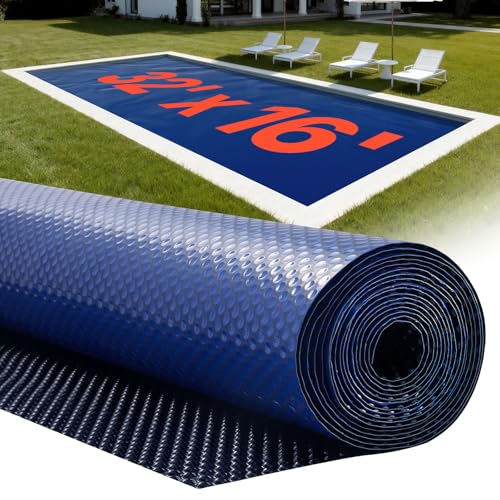
A solar cover is a floating layer of plastic bubbles that slows overnight heat loss and reduces evaporation. It is not a pool heater: its performance depends on direct sunlight, air temperature, wind, water temperature, and how closely it fits the surface. The right choice comes down to six practical questions—bubble thickness, heat retention, shape, UV resistance, cutting, and how easily you can remove and store it.
Our top picks


As an Amazon Associate we earn from qualifying purchases at no extra cost to you. Ratings are shown as listed on Amazon.
Best pool solar covers by situation
| Pool-owner situation | Best choice | Why it fits | Trade-off |
|---|---|---|---|
| Lowest upfront cost or occasional use | 8-mil to 12-mil blue cover | Light, inexpensive, and easy to cut to shape | Shorter life and less insulating value |
| Regular summer use | 12-mil blue or clear-blue cover | Good balance of heat gain, weight, and handling | Still needs careful storage to prevent sun damage |
| Cool nights or an extended swimming season | 16-mil cover | More material provides better insulation and resists tearing | Heavier and more difficult to roll without a reel |
| Large pool used several times per week | 12-mil or 16-mil cover plus a reel | Fast removal reduces the temptation to leave the cover in damaging sunlight | Higher total cost and more deck space required |
| Irregular, kidney, oval, or free-form pool | Oversized rectangular cover to trim | Usually easier to source and gives enough material for the full waterline | Requires measuring and careful cutting |
Thickness: 8 mil, 12 mil, or 16 mil?
“Mil” means one-thousandth of an inch, not millimeters. A 12-mil cover is approximately 0.012 inches thick. Thickness affects durability, weight, handling, and insulation, but it does not tell the whole story. Bubble size, resin quality, color, sunlight exposure, and chemical balance also influence how long a cover lasts.
- 8 mil: The lightest practical option. It can work for a small seasonal pool or an owner who removes the cover often, but it is more vulnerable to wind, folding damage, and accidental punctures.
- 12 mil: The sensible middle ground for many residential pools. It is easier to handle than a very thick cover while offering better resistance to normal wear.
- 16 mil: The better choice for frequent use, larger pools, and owners who want stronger insulation. Its extra weight makes a reel much more valuable.
- 20 mil and thicker: Useful when maximum durability is the priority, but the additional weight and cost can make removal awkward without mechanical assistance.
Thicker does not automatically mean warmer during the day. A transparent or clear-blue cover can allow more sunlight into the water, while darker blue covers can reduce light transmission but still limit evaporation effectively. For a pool that needs daytime solar gain, prioritize a cover described as transparent or high-transmission. For a pool that mainly loses heat overnight, thickness and a close fit become more important.
Head-to-head: common solar-cover types
Blue bubble covers
Blue covers are the standard choice because they are widely available in rectangular sizes and are usually priced in the general range of $40 to $250, depending on pool size and thickness. They provide a useful balance of sunlight transmission, evaporation control, and affordability. Brands such as Sun2Solar, Swimline, Blue Wave, GLI, and Intex sell pool-cover products in this broad category, although exact construction varies by model.
Choose blue when you want a dependable all-purpose cover and do not need to optimize every degree of daytime solar gain. A 12-mil blue cover is often the best value for a frequently used above-ground or in-ground pool.
Clear or high-transmission covers
Clear and clear-blue designs are intended to let more sunlight reach the water. They can be a good match for a pool in an open, sunny location where the main goal is raising the water temperature during the day. Their advantage is less noticeable in a shaded yard, during cloudy weather, or when the cover is removed for much of the daylight period.
Do not assume a clear cover is the best option for every climate. If nighttime temperatures fall sharply, a thicker cover that remains on the pool after swimming may conserve more usable heat than a thinner, high-transmission model.
Liquid solar covers
Liquid products are not a direct substitute for a floating bubble cover. They may reduce evaporation under some conditions, but they do not provide the same physical insulation, wind protection, or debris barrier. They are worth considering only when a conventional cover cannot be used, such as on a pool with an unusual obstruction or a strong need for unobstructed access.
Pool shape and cutting: buy for the waterline, not the deck
Solar covers should float on the water, not overlap the coping or rest on sharp edges. Measure the longest waterline length and the widest waterline width, including the usable swimming area beneath steps if the cover needs to reach that section. Buy a cover at least as large as those measurements, then trim it after positioning it on the pool.
For example, if an oval pool measures 28 feet by 14 feet at the waterline, a 30-by-16-foot cover provides a practical cutting margin. The extra area is 480 square feet before trimming, while the pool surface is approximately 308 square feet using the oval-area formula: 3.14 × 14 × 7. The margin allows you to follow the actual curve and account for measurements that are not perfectly symmetrical.
Use a clean marker and sharp scissors or a utility knife. Make several small adjustments rather than cutting aggressively on the first pass. Keep the finished cover slightly inside the coping so it does not catch on the edge when the water level changes. Do not cut the cover while it is on rough concrete, and do not drag it across the deck.
UV durability and the ownership details that matter
Ultraviolet light is often what wears out a solar cover first. The plastic may become brittle, the bubbles may collapse, or seams and edges may split. Strong chlorine, high sanitizer levels, and concentrated chemical additions can accelerate deterioration if the cover is put on immediately after treatment.
- Remove the cover before adding shock or concentrated chemicals, and follow the chemical manufacturer’s stated wait time before covering again.
- Never leave a rolled-up cover in direct sunlight. The trapped heat can damage bubbles far faster than a flat cover floating on water.
- Rinse the cover with fresh water when it develops a visible chemical film or heavy dust.
- Store it dry, loosely rolled rather than sharply folded, in a shaded location.
- Keep pets, children, and swimmers off the cover. It is not a safety cover and cannot support a person.
A cover reel is more than a convenience. Repeated folding creates creases that stress the bubble layer, while dragging can snag or puncture it. A reel lets one person remove a large cover with less contact against the ground. For a 16-mil cover or a pool wider than about 16 feet, a reel can substantially improve everyday usability.
How to choose the right thickness with a simple cost-per-use check
Suppose an 8-mil cover costs about $70 and lasts two seasons, while a 16-mil cover costs about $150 and lasts four seasons. The purchase cost per season is approximately $35 for the thinner option and $37.50 for the thicker one. If the thicker cover also reduces replacement hassle and is less likely to tear during removal, its higher price may be justified even before considering energy savings.
Actual service life varies widely. A carefully stored cover in moderate sunlight may last several seasons; one left on a hot deck or exposed to excessive chemicals may fail much sooner. Treat the published thickness as a starting point, not a guarantee.
Setup and removal routine
- Clean the pool first. Leaves and grit trapped beneath the cover can stain the material and complicate removal.
- Place the bubble side down. The bubbles contact the water; the smooth side faces upward.
- Trim only after floating it in position. Allow the cover to settle before marking the final edge.
- Remove it before swimming. Fold or roll it onto a reel rather than pushing it underwater or dragging it over the deck.
- Dry and shade it for storage. Avoid tight folds, hot surfaces, and direct midday sun.
For most owners, the best pool solar covers are not the thickest or most expensive models. A properly fitted 12-mil cover is the strongest all-around recommendation; choose 16 mil when the pool is large, nights are cool, or the cover will be used for several seasons. Choose a high-transmission clear design when daytime sun is plentiful, and budget for a reel if regular removal would otherwise become a chore.
Frequently asked questions
Can a solar cover heat a pool without a heater?
It can help the pool absorb and retain solar heat, particularly in direct sun, but results depend on weather and pool exposure. Its most reliable benefit is reducing evaporation and nighttime heat loss.
Should the bubbles face up or down?
The bubbles should face down toward the water. The smooth side remains exposed to sunlight and debris.
How long should a pool solar cover last?
Many covers last roughly two to five seasons, but storage, UV exposure, chemical practices, wind, and handling have a major effect. Brittle bubbles and widespread cracking indicate that replacement is due.







Write Your Review
No reviews yet. Be the first to share your experience!