

Key takeaways
- 40-degree white tip: Best starting point for vehicles, painted siding, windows, outdoor furniture, and delicate wood.
- 25-degree green tip: A general-purpose option for masonry, moderately dirty decks, fences, and patio furniture.
- 15-degree yellow tip: Useful for stubborn grime on durable concrete or unpainted masonry, but keep it moving.
- 0-degree red tip: Usually too aggressive for routine home cleaning. It can gouge wood and damage surfaces quickly.
- Soap nozzle: Applies detergent at low pressure. It does not replace a high-pressure rinse.
The best electric pressure washers for most homes are 1,800–2,300 PSI models delivering about 1.2–1.8 gallons per minute (GPM): they provide enough cleaning power for cars, patios, siding, and decks without the noise, fuel, fumes, and maintenance of a gas machine.
For the best balance, choose a 2,000 PSI-class unit with 1.2–1.5 GPM, a 25-foot high-pressure hose, a 35-foot power cord, and interchangeable quick-connect nozzles. A lighter 1,400–1,800 PSI washer is better for vehicles and small spaces, while a 2,300–2,400 PSI model is more useful for large patios and heavily weathered decking.
Our top picks



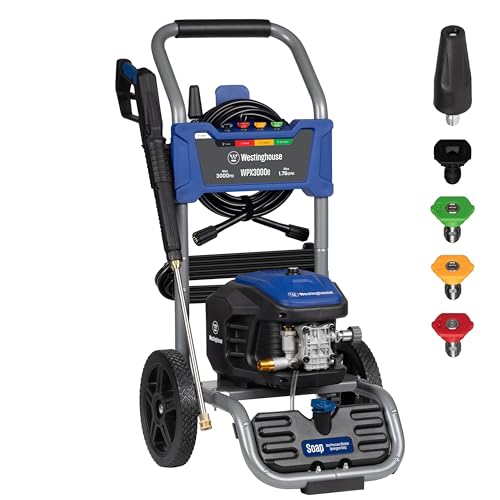
As an Amazon Associate we earn from qualifying purchases at no extra cost to you. Ratings are shown as listed on Amazon.
Best electric pressure washers by situation
| Best for | Recommended specification | Good example | Why it fits |
|---|---|---|---|
| Cars and occasional household cleaning | 1,500–2,000 PSI; 1.2–1.5 GPM; under 30 pounds | Greenworks 2000 PSI class | Manageable, economical, and less likely to damage paint when used correctly |
| One washer for most home jobs | 2,000–2,300 PSI; 1.2–1.8 GPM; 25-foot hose | Sun Joe SPX3000 | Versatile nozzle and detergent options at a moderate price |
| Large patios and frequent cleaning | 2,200–2,400 PSI; at least 1.4 GPM; metal or reinforced hose fittings | DEWALT 2,400 PSI electric class | Higher output reduces the number of slow passes over hard surfaces |
| Compact storage and occasional use | 1,400–1,800 PSI; under 25 pounds; onboard hose and cord storage | Kärcher K2 or similar compact model | Easy to carry and store in a closet or small shed |
| Durable everyday ownership | 2,000 PSI class; longer warranty; replaceable hose and fittings | Ryobi 2,000 PSI electric class | Common fittings and local service support can simplify repairs |
Product specifications vary by model year and configuration, so confirm the rating on the manufacturer’s current label. “Maximum PSI” is a peak rating under ideal conditions; the pressure available while spraying is usually lower.
Head-to-head: what matters more, PSI or GPM?
PSI, or pounds per square inch, describes the force of the water stream. GPM, or gallons per minute, describes how much water moves across the surface. PSI helps loosen dirt, while GPM helps rinse it away. A practical way to compare machines is cleaning power, sometimes expressed as cleaning units:
PSI × GPM = approximate cleaning units.
For example, a 2,000 PSI washer flowing at 1.2 GPM produces about 2,400 cleaning units. A 2,000 PSI washer flowing at 1.8 GPM produces about 3,600. The second machine can rinse a patio faster, but it also uses 50% more water while the trigger is held.
For routine residential work, chasing the highest PSI is usually a mistake. Excessive pressure can strip softwood fibers, etch concrete, remove vehicle wax, force water behind siding, or damage window seals. A moderate-pressure machine with a useful nozzle selection is more versatile than a powerful machine used too close to delicate surfaces.
How the leading electric options differ
Sun Joe SPX3000
The Sun Joe SPX3000 is a widely recognized 2,030 PSI-class electric washer with a rated flow around 1.76 GPM and multiple quick-connect spray tips. Its dual detergent-tank arrangement is useful when switching between general cleaner and a vehicle-safe soap. It is a strong value choice for homeowners who want one machine for cars, walkways, siding, and modest patio cleaning.
Its trade-offs are typical of this price category: the stated maximum pressure is not the same as working pressure, and the compact hose and cord storage may feel less refined than on heavier premium machines. It is best for occasional or moderate use rather than prolonged commercial-style cleaning.
Greenworks 2,000 PSI-class washers
Greenworks offers several compact electric models around the 2,000 PSI and 1.2 GPM range. These machines are attractive for vehicle owners and people with limited storage because they are generally lighter and easier to move than high-output units. Their lower water flow can also reduce splashing and make soap application easier to control.
Choose this class for cars, outdoor furniture, small decks, bicycles, bins, and lightly dirty siding. For a large concrete patio covered in deep organic staining, expect slower progress than with a 1.8 GPM machine.
Ryobi 2,000 PSI electric washers
Ryobi’s 2,000 PSI electric models sit in the useful middle ground between small portable washers and heavier patio-cleaning machines. They are suitable for general household maintenance, including vehicles, fences, siding, and medium-size paved areas.
The main reason to consider Ryobi is ownership convenience: hose connections, replacement accessories, and support may be easier to find locally than for a lesser-known brand. Check the exact model’s hose length and included tips, because those details differ across versions.
DEWALT 2,400 PSI electric models
DEWALT’s 2,400 PSI electric class is aimed at homeowners who want more output for driveways, patios, and weathered decks without moving to a gas engine. The extra pressure is useful for stubborn surface dirt, but technique matters more at this level. Start with a wider fan tip and work from farther away before selecting a narrower stream.
These machines are generally less convenient to carry and store than compact washers. They also need a properly rated outdoor extension cord if the built-in cord cannot reach the work area.
Nozzle choice determines whether the job is safe
- 40-degree white tip: Best starting point for vehicles, painted siding, windows, outdoor furniture, and delicate wood.
- 25-degree green tip: A general-purpose option for masonry, moderately dirty decks, fences, and patio furniture.
- 15-degree yellow tip: Useful for stubborn grime on durable concrete or unpainted masonry, but keep it moving.
- 0-degree red tip: Usually too aggressive for routine home cleaning. It can gouge wood and damage surfaces quickly.
- Soap nozzle: Applies detergent at low pressure. It does not replace a high-pressure rinse.
For a car, begin with a wide spray at least 18 inches from the surface, rinse loose grit first, apply vehicle soap, and finish with another wide spray. Never use a narrow high-pressure tip on tires, sidewall lettering, door seals, electrical connectors, or chipped paint.
Hose, cord, water use, and noise
| Feature | Useful target | What it changes in practice |
|---|---|---|
| High-pressure hose | 25 feet | Lets you move around a car or patio without repeatedly relocating the washer |
| Power cord | 35 feet or more | Reduces extension-cord use and helps keep electrical connections away from spray |
| Water flow | 1.2–1.8 GPM | Higher flow rinses faster but consumes more water |
| Typical operating sound | About 75–85 dB at close range | Quieter than many gas washers, but still loud enough to disturb nearby occupants |
| Machine weight | 20–35 pounds for compact models | Determines whether carrying it upstairs or around a garden is practical |
A 1.2 GPM machine running for 30 minutes uses about 36 gallons, while a 1.8 GPM machine uses about 54 gallons. Actual use is often lower because the motor runs only while the trigger is pressed. Turning off the trigger while repositioning can save water and reduce pump wear.
Setup and maintenance that prevent common failures
- Connect the garden hose and run water through the washer briefly before switching on the motor. This purges air that can cause pump surging.
- Use a grounded outdoor outlet protected by a GFCI. Keep the plug connection elevated and covered from direct spray.
- Inspect the inlet screen before each use. Leaves, grit, and mineral scale can restrict flow and overwork the pump.
- Start with the widest nozzle and test an inconspicuous area, especially on painted wood, composite decking, and older masonry.
- Flush detergent from the system with clean water after washing. Dried soap can clog the injector and nozzle.
- Release trigger pressure before disconnecting the hose. In freezing weather, drain the pump and store the unit indoors.
The first parts to wear are often O-rings, quick-connect fittings, spray tips, and the high-pressure hose—not the motor. Replace cracked hoses rather than patching them. A machine that pulses may have a blocked nozzle, restricted inlet screen, trapped air, or a worn seal; replacing the pump should not be the first response.
Bottom line
For most households, the best electric pressure washers are 2,000 PSI-class models with at least a 25-foot hose, a long power cord, four useful spray angles, and accessible replacement parts. Pick a compact 1,500–2,000 PSI machine if cars and light cleaning dominate. Choose a 2,200–2,400 PSI model with higher GPM for frequent patios, concrete, and large decks. Whichever model you buy, nozzle distance and steady movement matter more than the biggest number printed on the box.





Write Your Review
No reviews yet. Be the first to share your experience!