

Key takeaways
- Direct or chain-drive feel: Often crisp and immediate, with more audible mechanical movement.
- Belt-drive feel: Usually smoother and quieter at the drivetrain, with less routine lubrication.
- Fan noise: Increases rapidly with speed. A belt-driven bike may still be too loud for early-morning use in an apartment.
- Frame stability: Weight and base width matter more during standing efforts than small differences in console features.
The best air bikes for home cardio workouts are the Rogue Echo Bike for maximum stability, the AssaultBike Classic for a compact value-oriented setup, and the Schwinn Airdyne AD7 for quieter, more adjustable everyday training. All three use fan resistance that increases as you pedal and push harder, but their different fan sizes, frames, consoles, and dimensions make them better suited to different home gyms.
Our top picks

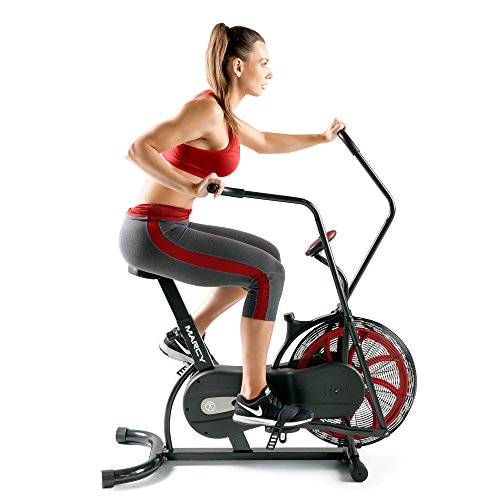
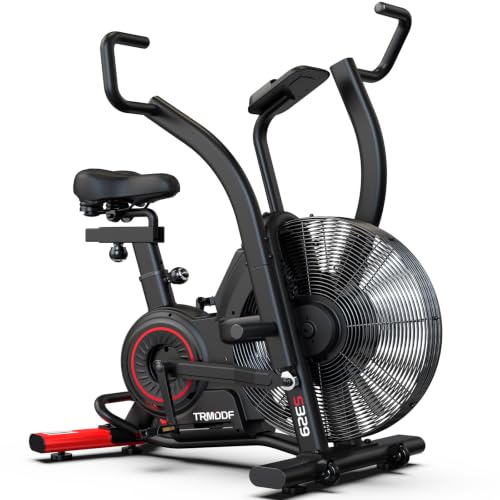
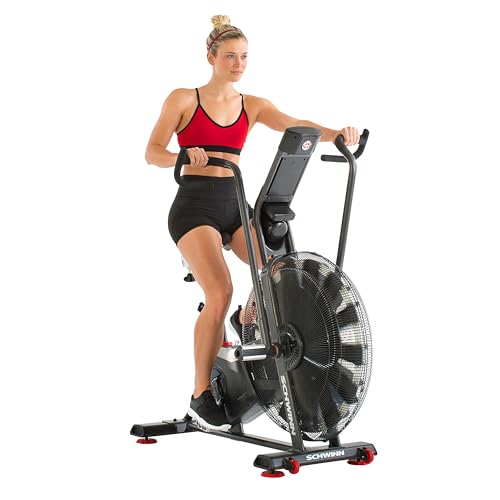
As an Amazon Associate we earn from qualifying purchases at no extra cost to you. Ratings are shown as listed on Amazon.
Best air bikes at a glance
| Air bike | Fan and resistance | Approx. size and weight | Seat adjustment | Best for |
|---|---|---|---|---|
| Rogue Echo Bike | Large steel fan; smooth, high-drag feel | 52.75 × 29.875 × 51 in; 127 lb | Four-way adjustable seat; multiple height positions | Hard intervals, heavier users, maximum stability |
| AssaultBike Classic | 25-in fan; responsive, direct-drive resistance | About 51 × 23 × 50 in; about 95 lb | Four-way adjustable seat | Smaller spaces and budget-conscious buyers |
| AssaultBike Pro X | 25-in fan; belt drive with quieter operation | About 51 × 23 × 50 in; about 135 lb | Four-way adjustable seat | Frequent training and lower-maintenance drive feel |
| Schwinn Airdyne AD7 | Large perimeter fan; progressive resistance | About 53 × 26 × 50 in; about 113 lb | Four-way adjustable seat | Comfort, adjustability, and general home cardio |
Dimensions and weights are approximate manufacturer specifications and can vary slightly by revision. Allow additional clearance around the fan and moving handles, especially if the bike will be used for standing intervals.
Head-to-head: which bike fits your training style?
Rogue Echo Bike: best for stability and powerful intervals
The Echo Bike is the strongest choice when frame movement is your main concern. Its approximately 127-pound frame, wide base, steel tubing, and substantial front stabilizer keep it planted during all-out sprints. That mass is useful for high-intensity workouts, but it also makes the bike difficult to move frequently.
Its large fan produces a noticeable resistance ramp: easy pedaling is manageable, while fast leg speed and forceful arm drive quickly become demanding. The feel is smooth and substantial rather than light or whippy. It uses a chain drive, which can create more mechanical noise and requires periodic lubrication and tension checks than a belt-driven model.
The console provides practical interval information such as time, distance, calories, watts, RPM, speed, and heart-rate compatibility depending on the setup and monitor version. It is a performance-focused display rather than an entertainment screen. Choose the Echo if you prioritize repeatable sprint sessions, frame rigidity, and a high user-weight capacity over portability.
AssaultBike Classic: best value for limited space
The AssaultBike Classic is narrower and lighter than the Echo, making it easier to place in a spare room or move with its transport wheels. Its approximately 23-inch width is useful when floor space is tight, although the rotating fan and handles still require safe clearance at the sides.
The 25-inch fan gives the bike a responsive feel. It does not offer preset resistance levels: your output determines the resistance. That makes it simple to use, but beginners should avoid treating every session as a maximal sprint. Short intervals can become very demanding before the display or muscles make the effort feel obvious.
The Classic’s console generally covers the essentials, including time, distance, calories, watts, RPM, speed, and interval programs. Seat height and horizontal position can be adjusted, but fit depends on using the correct post holes and locking hardware rather than making infinitely fine adjustments. At general market pricing, it is often one of the more affordable full-size air bikes from an established manufacturer.
AssaultBike Pro X: best for frequent use and a quieter drive
The Pro X keeps the familiar air-bike format but uses a belt drive instead of the Classic’s chain-driven system. The fan itself still makes wind noise, so it is not silent; however, a belt drive can reduce drivetrain clatter and eliminates routine chain lubrication. This matters in a home gym located near bedrooms or shared living areas.
Its heavier frame improves stability compared with lighter budget air bikes. The console supports common metrics and interval training, while the four-way seat adjustment helps accommodate different riders. The Pro X is most sensible for households that expect frequent use—such as several workouts per week—where reduced drivetrain maintenance and a more refined feel can justify the higher general market price.
Schwinn Airdyne AD7: best for comfort and adjustability
The AD7 is a strong all-purpose option for riders who care about a comfortable saddle, a broad fit range, and a somewhat more polished home-use experience. Its four-way seat adjustment allows you to alter height and reach, which is important because the handlebars move as you pedal and an incorrect reach can make the shoulders or lower back feel unnecessarily strained.
Like other fan bikes, the AD7 becomes harder as you produce more effort. Its large fan creates progressive resistance without a resistance knob or motor. Schwinn’s console emphasizes workout data such as time, distance, calories, RPM, watts, speed, and heart-rate information when paired with a compatible sensor.
The AD7 remains a substantial piece of equipment at roughly 113 pounds and about 53 inches long. It is not the best choice if you must store the bike vertically after every session, but it can be a good compromise between a lightweight budget bike and an especially heavy competition-style frame.
Decision matrix for a home gym
| Your situation | Best match | Why |
|---|---|---|
| Under roughly $1,000 for a full-size model | AssaultBike Classic or comparable established-brand model | Lower initial cost without abandoning a full fan-bike frame |
| Heavy sprinting or a larger rider | Rogue Echo Bike | High mass and wide stance reduce rocking |
| Three or more users, several days per week | AssaultBike Pro X or Schwinn Airdyne AD7 | Belt-drive convenience or comfort-focused adjustability |
| Narrow exercise area | AssaultBike Classic | Approximately 23-inch body width, though operating clearance is still required |
| Need to move equipment often | AssaultBike Classic | Lower weight than the heavier Echo and Pro X |
| Want the quietest practical choice | AssaultBike Pro X | Belt drive reduces mechanical noise; fan noise remains |
Fan size, resistance feel, and noise explained
A larger fan generally moves more air and can deliver a broad resistance range, but fan diameter alone does not determine the workout. Gear ratio, crank design, drive system, and calibration also affect how quickly resistance builds.
- Direct or chain-drive feel: Often crisp and immediate, with more audible mechanical movement.
- Belt-drive feel: Usually smoother and quieter at the drivetrain, with less routine lubrication.
- Fan noise: Increases rapidly with speed. A belt-driven bike may still be too loud for early-morning use in an apartment.
- Frame stability: Weight and base width matter more during standing efforts than small differences in console features.
For perspective, a 20-minute workout performed four times weekly equals about 69 hours of use per year. At 3 workouts per week, the same session totals about 52 hours annually. That makes a durable frame and readily available replacement parts more important than saving a small amount on a bike that feels unstable or requires frequent repairs.
Fit and footprint: measurements that matter
Measure more than the bike’s listed length and width. Leave at least 24 inches of open space on each side of the moving handles when possible, plus room behind the seat for mounting and dismounting. A bike listed as approximately 30 inches wide may need around 78 inches of total side-to-side clearance for comfortable use.
Set the saddle so your knee remains slightly bent at the bottom of the pedal stroke. If your hips rock from side to side, the seat is likely too high. If your knees remain deeply bent or the front of the knee feels crowded, raise the seat gradually. Adjust the seat fore and aft so your reach to the handles is comfortable without rounding your back or locking your elbows.
Ownership realities: what wears first
The fan blades and frame usually are not the first maintenance concerns. Pedal threads, crank arms, seat hardware, drive components, and monitor batteries receive more practical attention. Check bolts periodically because repeated sprinting can loosen hardware over time. Inspect the pedals and toe straps for cracking, and replace worn parts rather than continuing to train with a loose connection.
Keep dust and pet hair away from the fan housing and wipe sweat from the frame after each session. Sweat can corrode bare hardware and damage console connections. On chain-driven models, follow the manufacturer’s lubrication schedule and inspect chain tension. On belt-driven models, listen for slipping or squealing and check alignment rather than applying chain oil.
A common mistake is storing an air bike directly against a damp basement wall. Use a level mat, maintain ventilation, and avoid blocking the fan. Before buying, confirm that the manufacturer sells pedals, belts or chains, seats, monitor batteries, and hardware separately.
Bottom line
Choose the Rogue Echo Bike if stability and hard intervals are your priorities. Choose the AssaultBike Classic when you want a capable, narrower, lower-cost air bike. Choose the AssaultBike Pro X for frequent use with less drivetrain maintenance, or the Schwinn Airdyne AD7 when fit and comfort matter most. Whichever model you select, verify the available floor clearance, seat range, noise tolerance, and replacement-parts support before placing it in your home gym.



Write Your Review
No reviews yet. Be the first to share your experience!