

Key takeaways
- Compare the best dethatching rakes for small lawns and spot repair, from a 24-tine steel rake to wheeled and dual-action models for pulling thatch.
Thatch is the layer of dead stems, roots, and debris that builds up between the soil surface and the green grass above it. A thin layer is harmless, but once it grows thick it can keep water, air, and nutrients from reaching the roots, and the lawn starts to look thin and tired even with regular mowing and watering. A dethatching rake is the hand tool built for this job: its sharp, closely spaced tines are angled to bite into the thatch layer and pull it loose as you rake, which is something an ordinary garden rake or leaf rake is not designed to do.
For a small lawn, or for fixing a few worn patches rather than a whole yard, a manual dethatching rake is often the most practical route. There is no engine to maintain, no power dethatcher to rent, and you can work one problem area at a time. The five picks below cover the main head styles on the market — a wide steel tine head, dual-sided and dual-action heads, a spring steel tine head, and a wheeled model with an adjustable handle — so you can match the tool to the size of the patch and the effort you want to put in.
As an Amazon Associate, we earn from qualifying purchases.
Quick answer
For most small lawns, a wide steel tine head like the Bully Tools 24-tine rake gives the strongest all-round dethatching action, while dual-sided and dual-action heads from Jardineer and MILLIONHOME add a finishing side for leveling the surface afterward. The CKLT, with fewer spring steel tines, suits targeted spot repair on single worn patches, and the wheeled adjustable model eases longer, repeated sessions.
How to choose
Start with the head. Dethatching rakes use short, sharp tines set at an angle so they slice into the thatch layer and lift it out rather than skating over the surface. Tine count and head width decide how much ground each pull covers: a 24-tine or 15-inch head clears a small lawn faster, while a narrower head is easier to control in a tight repair patch. Some heads are dual-sided or dual-action, with dethatching tines on one side and a smoother leveling edge on the other, so the same tool can loosen thatch and then tidy the surface.
Handle length matters for posture and reach. The picks here run from a 61.4-inch handle up to a 68-inch fiberglass handle, plus one model that adjusts between 37 and 65 inches. A longer handle lets you stand more upright and cover ground with a longer stroke; an adjustable handle can be shortened for close work in a small patch or shared between users of different heights.
Consider the form that matches your lawn. A wheeled dethatching rake rolls as you pull, which changes the feel of the work and can help keep the head at a steady angle across a longer run. A spring steel tine head flexes slightly as it works, which some gardeners prefer for spot repair where the thatch layer is uneven. Finally, think about timing rather than the tool: dethatching is usually done when the grass is actively growing so it can recover, and the soil should be moist but not muddy so the tines pull thatch instead of tearing out healthy grass.
Bully Tools 24-Tine Thatching Garden Rake, 68-Inch Fiberglass Handle

This is the widest, most traditional pick in the group. Per the roundup record, it carries 24 tines on a heavy steel head, paired with a 68-inch fiberglass handle. That combination is aimed at coverage: more tines per pull means fewer passes over a small lawn, and the long handle supports an upright stance while you work through a thatch layer.
The fiberglass handle is a practical choice for a tool that gets pulled hard against resistance, and the head width suits open areas where you can take long, even strokes. For spot repair, the same head can be worked in short pulls over a single patch. If your priority is a straightforward, sturdy dethatching rake without extra mechanisms, this is the benchmark the rest of the list is measured against.
Specs
- Head: 24-tine steel head, described as heavy steel in the roundup record
- Handle: 68-inch fiberglass
- Tine count: 24
- Weight: not stated
- Warranty: not stated
Jardineer Thatch Rake for Lawns, 61.4-Inch Handle
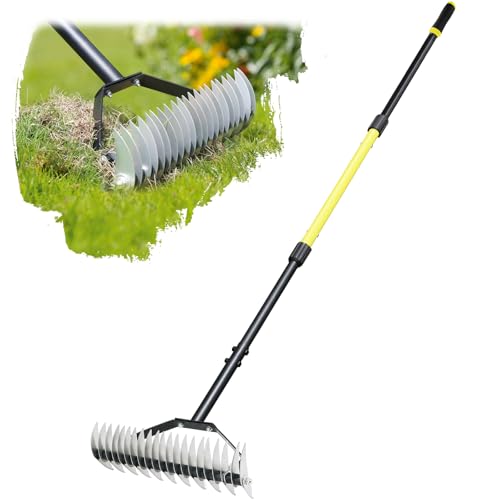
The Jardineer takes a dual-side approach. Per the roundup record, its head works on both sides, so one face is used to loosen and pull thatch while the other can smooth and level the surface afterward. That makes it a sensible pick when a repair involves both removing thatch and finishing the patch in the same session.
Its handle is 61.4 inches, a little shorter than the Bully Tools model, which can feel more manageable in a confined area such as a side yard or a strip between beds. Gardeners who want one tool that handles both the aggressive pass and the tidy-up pass, without swapping implements, are the natural audience for this design.
Specs
- Head: dual-side head per the roundup record
- Handle: 61.4-inch
- Tine count: not stated
- Head width: not stated
- Weight: not stated
MILLIONHOME 15-Inch Wide Thatch Rake

The MILLIONHOME is the wide dual-action option. Per the roundup record, it is 15 inches wide and built with a dual-action head, so it covers ground quickly on a small lawn while still offering two working actions in one head. Width is the headline here: at 15 inches, each pull clears a broad strip, which shortens the job on an open patch of turf.
A wide head does ask for a fairly even surface, since a broad set of tines needs consistent contact to pull thatch uniformly. On a flat, open lawn that is rarely a problem, and the dual-action design means the finishing pass is built in rather than left to a second tool. Handle details beyond the head design are not stated in the record.
Specs
- Head width: 15 inches
- Head style: dual-action per the roundup record
- Handle length: not stated
- Handle material: not stated
- Weight: not stated
CKLT Thatch Rake for Lawns, 18 Sharp Tempered Spring Steel Tines
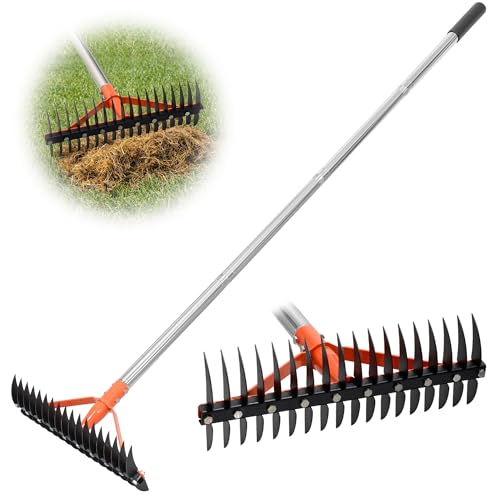
The CKLT is the spot-repair specialist of the group. Its name states 18 sharp tempered spring steel tines, and spring steel has a bit of flex in it, which helps the tines ride over uneven ground and keep biting into the thatch instead of bouncing off high spots. With 18 tines it covers less ground per pull than the 24-tine Bully Tools head, but that narrower focus is exactly what a single worn patch calls for.
This is the pick to consider if your lawn is mostly healthy and only a few areas have built up a thick thatch layer — near a downspout, along a shaded edge, or where clippings have collected. The trade-off is speed on a whole lawn, where the wider heads will finish sooner.
Specs
- Tines: 18, sharp tempered spring steel per the listing name
- Head width: not stated
- Handle length: not stated
- Handle material: not stated
- Weight: not stated
Thatch Rake with Wheels, Adjustable 37–65-Inch Handle

The final pick changes the format entirely. As carried in the roundup record, this is a thatch rake with wheels and an adjustable handle that runs from 37 to 65 inches; the brand is generic in the roundup, so it is named here exactly as recorded. The wheels help the head roll and hold a consistent working angle as you pull, which can make a longer session feel more controlled, especially on a bigger small lawn where you are making repeated passes.
The adjustable handle is the other draw: set it long for upright raking across open ground, or shorten it toward 37 inches for close work in a tight patch or for storage. If a fixed long handle feels awkward, or if two people of different heights will share the tool, this is the most flexible option in the group.
Specs
- Form: wheeled thatch rake per the roundup record
- Handle: adjustable, 37 to 65 inches
- Tine count: not stated
- Head width: not stated
- Weight: not stated
Who should skip
Skip this whole category if your lawn is large or the thatch layer is thick and widespread — a manual rake over a big area is slow, tiring work, and a powered dethatcher or a rented machine is the realistic tool. Skip it, too, if your lawn problem is not actually thatch: bare patches from shade, compaction, or grubs will not be fixed by dethatching, and pulling tines through stressed grass can make things worse. If you only need to gather leaves or spread mulch, an ordinary garden rake or leaf rake is the right tool; dethatching tines are purpose-built for pulling thatch and are the wrong shape for general cleanup. Finally, anyone who cannot manage sustained pulling and raking should look at wheeled or powered alternatives rather than a fixed manual head.
FAQ
When is the best time to dethatch a lawn?
Dethatch when the grass is actively growing so it can recover quickly afterward — typically during the main growing season for your grass type. The soil should be moist but not saturated, which lets the tines pull thatch loose without tearing out healthy roots.
How is a dethatching rake different from a regular garden rake?
A dethatching rake has short, sharp, closely spaced tines angled to dig into the thatch layer and lift it out. A garden rake has sturdier, widely spaced teeth made for soil and gravel, and a leaf rake has flexible tines for surface debris; neither is shaped to pull thatch.
How much thatch is too much?
A thin layer, around half an inch, is normal and even helpful. When the spongy layer between the soil and the green growth gets noticeably thicker than that and water starts pooling or running off instead of soaking in, dethatching is worth considering.
Can I dethatch just one patch instead of the whole lawn?
Yes — that is exactly what these manual rakes suit. Work the affected patch with short, firm pulls, rake up the loosened thatch, and leave healthy areas alone. Spot repair is gentler on the lawn than dethatching the whole yard at once.
Final verdict
For a small lawn that needs a full once-over, the Bully Tools 24-tine rake is the strongest starting point, with the MILLIONHOME close behind if you want a wide dual-action head. The Jardineer suits gardeners who want the leveling pass built into the same tool, the CKLT is the focused choice for spot repair with its spring steel tines, and the wheeled adjustable model is the pick for comfort and flexibility over longer sessions. Match the head to the patch, work when the grass is growing, and any of these five will pull thatch the way a general-purpose rake cannot.
Product and ASIN Reference
| Product | ASIN |
|---|---|
| Bully Tools 24-Tine Thatching Garden Rake, 68-Inch Fiberglass Handle | B00315770C |
| Jardineer Thatch Rake for Lawns, 61.4-Inch Handle | B0DZM2L7YC |
| MILLIONHOME 15-Inch Wide Thatch Rake | B0D8BG1JPB |
| CKLT Thatch Rake for Lawns, 18 Sharp Tempered Spring Steel Tines | B0FQNZDPY7 |
| Thatch Rake with Wheels, Adjustable 37–65-Inch Handle | B0FW9LD4QZ |
More from Amazon
Programs that pair well with the guide above. Offers and eligibility are set by Amazon and may change.
Free shipping on eligible items, Prime Video and more. Eligible new members can start with a free trial.
Start a Prime free trialA Prime membership for ages 18-24 with a trial period. Eligibility is set by Amazon.
See Prime for Young AdultsAudiobooks and podcasts to listen to on the go. Eligible new members can start with a free trial.
Try Audible freeAd-free music streaming. Eligible new subscribers can start with a free trial.
Try Music Unlimited freeAs an Amazon Associate we earn from qualifying purchases.

Write Your Review
No reviews yet. Be the first to share your experience!