

Key takeaways
- Compare five garden trellises by material, anchoring and grid size, from a heavy iron obelisk for roses to a light willow panel for one season of peas.
As an Amazon Associate we earn from qualifying purchases.
A trellis looks simple: a grid, a frame, something for tendrils to grab. The failures are simple too. A panel that held sweet peas happily in June folds flat in an August storm once beans have turned it into a green sail. A pretty lattice snaps at the soil line in its third spring, just as the clematis on it finally gets heavy. Most trellis disappointment comes from one mismatch — the support was sized for a lighter, shorter-lived plant than the one it ended up carrying.
This guide judges five garden trellises the way a plant will judge them: by the material and how it ages, by how the thing anchors to the ground or a wall, and by whether the grid spacing suits the climber you plan to grow. The list runs from a heavy iron obelisk built for a mature climbing rose down to a small bamboo ladder meant for a single pot, because those are different jobs.
Disclosure: This article contains affiliate links. If you buy through these links, we may earn a commission at no extra cost to you.
How to Choose a Garden Trellis
Start with the load, not the look
A climbing plant is weight plus wind. A mature climbing rose carries thick woody canes, dense foliage and wet blooms after rain, and it pushes against its support every time the weather turns. A panel covered in pole beans presents almost its whole surface to the wind. Before you fall for a design, ask what the plant will weigh in its third year, not its first. If a listing gives no hint of frame thickness or anchoring hardware, assume it was designed for annual vines and a season or two of use.
Material honesty: how each one ages
Wood looks at home in a garden and is easy to cut and fix, but it rots where it meets the soil. The ground-contact part of a wooden trellis fails first, often while the upper lattice still looks sound. Cedar and other durable species slow this down; thin softwood and willow do not. Expect an unfinished willow or bamboo support to be a short-lived item outdoors.
Powder-coated steel is strong for its weight and the sensible default for vegetable supports, but the coating is the protection. Every scratch from a trowel or a shifting stone exposes bare metal, and rust starts there and creeps under the coating. Plastic-coated steel tubing lasts longer in wet soil, though the plastic can split at bends and joints.
Vinyl never rots and never needs painting, which is its real appeal. Its weakness is brittleness: older vinyl cracks rather than bends, cold weather makes it less forgiving of knocks, and a broken rail is hard to repair invisibly. Solid iron sits at the other extreme — heavy, repairable and long-lived, with rust at chips in the finish as the main upkeep task.
Anchoring decides whether it stands
More trellises fall over than break. Look for ground spikes or anchors that are part of the design, and check their length: a spike of ten inches or more holds in most soils, while short decorative feet simply rest on the surface. Wall-mounted panels need fixings into brick, studs or solid fence posts, with a small gap behind the panel so stems can weave through. Freestanding A-frames spread their load across two feet and suit raised beds well. Push the support firmly once it is installed. If it rocks empty, it will not survive loaded.
Match the grid to the climber
Peas and beans climb with fine tendrils that need fine mesh or netting with small openings, roughly one to two inches, so young shoots find a hold quickly. Cucumbers do well on slightly wider mesh or an A-frame with netting. Clematis grips with leaf stalks and prefers thin rungs or wires it can wrap around. Climbing roses do not truly climb at all — their long canes must be tied in by hand, so they want an open, sturdy lattice with wide spacing you can reach through. Grapes and wisteria are in a different league of weight and should not go on any decorative panel.
The honest sizing rule
Most decorative trellises are sized for one season of annual vines — morning glory, sweet peas, a single cucumber plant — and there is nothing wrong with buying one for exactly that job. The mistake is asking the same panel to carry a perennial rose, a grape or a wisteria year after year. Buy for the plant’s mature size, and treat anything light and ornamental as a seasonal tool.
The 5 Best Garden Trellises
1. H Potter Garden Lotus Bud Trellis — the heavy iron obelisk for roses

This is the one pick on the list genuinely built for a perennial climber. The H Potter Lotus Bud is solid iron with a hand-applied charcoal brown powder finish, and at 38 pounds it weighs as much as some garden furniture. That heft is the point: a frame this heavy resists the rocking that works lighter supports loose, and the maker supplies 12-inch ground spikes that drive through the feet to pin it down.
Specs
- Model: GAR461
- Material: Solid iron, powder-coated finish
- Dimensions: 36.5 inches wide x 69.25 inches tall, plus 12-inch ground spikes
- Weight: 38 pounds
- Anchoring: Ground spikes through the feet
- Assembly: Required
- Best for: Climbing roses, clematis, honeysuckle, jasmine
Pros
- Solid iron construction with real weight behind it, suited to mature woody climbers
- Long ground spikes included as part of the design, not an afterthought
- Open decorative grid gives plenty of tying-in points for rose canes
- Tall enough at nearly six feet to show a rose at head height
Cons
- Heavy enough that the maker suggests two people for lifting and placement
- Powder coat will eventually chip, and iron rusts at every chip unless touched up
- Assembly required, and the piece is awkward to move once planted around
2. Dura-Trel Elmwood Arbor — vinyl that never rots

An arbor is a trellis you walk through, and the Elmwood earns its place here because its side panels do the same climbing work while the structure frames a path or gate. It is made in the USA from white vinyl with two-inch square posts, and it ships with four 16-inch ground anchors — longer anchors than most products in this category include, and a large part of why it stays upright under a loaded vine.
Specs
- Material: Vinyl, white
- Dimensions: 57 inches wide x 22 inches deep x 85 inches tall
- Walkthrough width: 42 inches
- Posts: 2-inch square
- Anchoring: Four 16-inch ground anchors included
- Best for: Garden entrances, paths, moderate flowering vines
Pros
- Vinyl never rots, never needs painting and washes clean
- Four long ground anchors included for a firm footing
- Sturdy square posts give the side lattices a rigid frame
- Generous height suits it to wisteria-free zones: honeysuckle, clematis, annual vines
Cons
- Vinyl grows brittle with age and cold, and a cracked rail is difficult to repair neatly
- Bright white finish shows soil splash and algae in shady spots
- A structure this size catches wind, so the anchors must go fully in, not partway
3. Trellume Cucumber Trellis A-Frame — fine mesh for the vegetable bed

For peas, beans and cucumbers, grid size matters more than brute strength, and this A-frame gets it right: plastic-coated steel pipe forms the frame and a climbing net fills the panels, giving fine tendrils something to grab every inch or two. The A-frame shape spreads the load across a raised bed and leaves the middle open for picking.
Specs
- Material: Steel pipe with plastic coating
- Dimensions: 49.4 inches x 49.4 inches
- Climbing surface: Netting panels included
- Frame style: A-frame, freestanding
- Best for: Cucumbers, peas, pole beans, morning glory
Pros
- Fine netting suits tendril climbers far better than wide lattice
- A-frame footprint is stable in a raised bed without wall fixings
- Plastic coating slows rust where the frame meets wet soil
- Folds the growing space upward, freeing bed room for other crops
Cons
- The netting is the wear item and will likely need replacing before the frame does
- Coating scratches expose steel, so expect rust spots over time
- Built for seasonal vegetables; not a support for woody perennial vines
4. LANDGARDEN Expandable Willow Trellis — the natural seasonal screen

This expandable willow panel stretches to cover a wide stretch of fence or wall, and for one season of sweet peas, nasturtiums or a light annual vine it looks better than any plastic panel. Buy it with clear eyes, though: willow is a natural, unfinished material, and outdoors it is a short-lived one. Treat it as a renewable screen you replace every season or two, ideally mounted on a fence or wall that carries the real load.
Specs
- Material: Natural willow branches, unfinished
- Size: Expands up to 36 inches x 92 inches
- Weight: About 11.8 pounds
- Anchoring: None included — must be tied or fixed to a fence, wall or posts
- Best for: Sweet peas, light annual vines, screening, balcony gardens
Pros
- Covers a wide area from a single lightweight panel
- Expandable format adjusts to the space you have
- Natural material blends into planting instead of standing out
- Easy to cut down or fold away at the end of the season
Cons
- Willow rots at soil contact and weathers fast; plan on a short outdoor life
- No anchoring hardware included and it cannot stand on its own
- Uneven natural grid gives tendrils an inconsistent hold
5. Mininfa Natural Bamboo Ladder Trellis — small support for pots
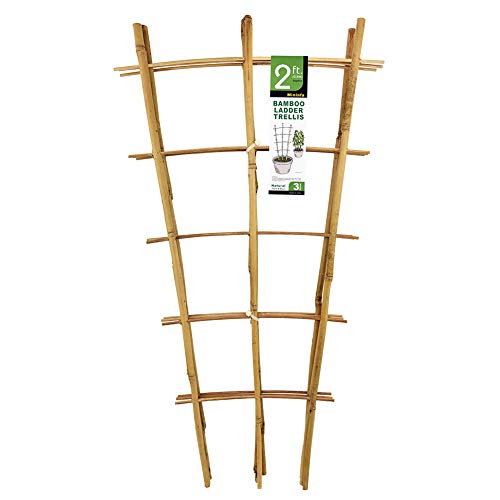
Not every climber needs a structure. This three-pack of bamboo ladder trellises stands 24 inches tall and is made for containers: a potted clematis on a patio, a jasmine by the door, or vegetables in a grow bag. The ladder fans from narrow feet that push into compost to a 12-inch top, giving a small plant a tidy frame.
Specs
- Material: Natural bamboo poles
- Height: 24 inches
- Width: 12 inches at the top, feet about 4.3 inches apart
- Pack size: 3 trellises
- Anchoring: Pushes into pot compost or soil
- Best for: Potted climbers, small vegetables, balcony containers
Pros
- Right-sized for containers where a full panel would look absurd
- Three in a pack covers several pots at once
- Very light and easy to move with the pot
- Bamboo rungs are thin enough for clematis leaf stalks to grip
Cons
- Far too small and light for in-ground perennial climbers
- Bamboo splits and greys outdoors; expect a season or two of service
- Stability depends entirely on the weight and depth of the pot
Comparison Table
| Product | Material | Size | Anchoring | Best for |
|---|---|---|---|---|
| H Potter Lotus Bud | Solid iron, powder-coated | 36.5 in wide x 69.25 in tall | 12 in ground spikes | Climbing roses and heavy perennial vines |
| Dura-Trel Elmwood Arbor | Vinyl | 57 in x 22 in x 85 in | Four 16 in ground anchors | Entrances and moderate flowering vines |
| Trellume Cucumber A-Frame | Plastic-coated steel with netting | 49.4 in x 49.4 in | Freestanding A-frame feet | Peas, beans and cucumbers in raised beds |
| LANDGARDEN Expandable Willow | Natural willow | Up to 36 in x 92 in | Fix to fence or wall (not included) | One season of light annual vines |
| Mininfa Bamboo Ladder | Natural bamboo | 24 in tall, 12 in top width | Pushes into pot compost | Potted climbers and containers |
Frequently Asked Questions
How tall should a trellis be for a climbing rose?
Plan for the rose’s mature height, which for most climbing varieties means a support at least six feet tall; canes can always be trained sideways along the top. The H Potter obelisk in this guide stands just under six feet above ground, which suits a medium climber; a vigorous rose on a wall wants a wide fan of wires or lattice instead. Whatever the height, the canes must be tied in by hand, since roses do not grip a support by themselves.
Can a garden trellis stay outside all winter?
Iron and vinyl can, and both are better left in place than wrestled in and out of storage. Powder-coated steel survives winter too, though chips in the coating rust faster through wet months. Wood, willow and bamboo suffer most: freeze and thaw cycles plus constant damp shorten their lives, so seasonal panels last longer if lifted, dried and stored under cover once the vines come down.
What grid spacing do peas and beans need?
Fine and frequent. Pea tendrils are delicate and need a hold every one to two inches, which is why netting outperforms wide lattice for legumes. Pole beans twine with their whole stem and manage slightly wider spacing, but they still climb netting more evenly than smooth poles.
How do I stop a trellis blowing over?
Anchor it before the plant loads it up. Drive spikes or anchors to their full depth, fix wall panels into solid material rather than mortar joints or thin fence boards, and site tall panels out of the wind funnel between buildings where gusts accelerate. Check the fixings again in midsummer, when the plant is at full leaf and the sail effect is strongest.
Is wood or metal better for a vegetable garden?
Coated metal, for most beds. Vegetable supports go up and come down with the seasons, get knocked by tools, and sit in watered soil — conditions that rot wood quickly and punish anything that cannot be hosed off and stored flat. Plastic-coated steel with netting handles all of that. Wood earns its place on permanent structures in the flower garden, where it stays up for years and its appearance matters more.
Conclusion
The right trellis is the one matched to the plant’s mature weight, the material’s honest lifespan and an anchor that actually holds. Choose the H Potter iron obelisk for a climbing rose you intend to keep for a decade, the Dura-Trel arbor where a path needs a frame that never rots, and the Trellume A-frame for the vegetable bed. Treat the willow panel and bamboo ladders as the seasonal, replaceable tools they are. Buy for the third-year plant, anchor before the wind tests you, and the support will disappear under healthy growth — which is exactly what a trellis is for.
More from Amazon
Programs that pair well with the guide above. Offers and eligibility are set by Amazon and may change.
Free shipping on eligible items, Prime Video and more. Eligible new members can start with a free trial.
Start a Prime free trialA Prime membership for ages 18-24 with a trial period. Eligibility is set by Amazon.
See Prime for Young AdultsAudiobooks and podcasts to listen to on the go. Eligible new members can start with a free trial.
Try Audible freeAd-free music streaming. Eligible new subscribers can start with a free trial.
Try Music Unlimited freeAs an Amazon Associate we earn from qualifying purchases.

Write Your Review
No reviews yet. Be the first to share your experience!