

Key takeaways
- Surface finish: The coating or glass top usually shows wear before the heating element fails. Do not slide cast iron across it or cut food on the surface.
- Controls: Rotary thermostats and simple switches are often easier to operate with greasy hands than small touch controls, but any control should be kept dry.
- Cleaning: Unplug the plate, let it cool, and wipe it with a damp cloth and mild detergent. Never immerse the appliance or pour water over its edges.
- Thermal shock: Do not place a cold, wet glass dish on a very hot surface. Allow chilled cookware to warm gradually where the manufacturer recommends it.
- Storage: Store flat or upright as directed, without placing heavy cookware on top. Protect the cord from sharp bends at the plug and strain-relief point.
The best electric warming plate for table use is a thermostatically controlled 120- to 180-watt plate with at least 18 by 10 inches of usable surface, evenly distributed heat, a removable or easy-wipe top, and a cord that exits from the rear or side rather than directly beneath the serving area.
That specification suits most family meals without turning the warming plate into a second cooking appliance. The right choice depends on whether you are keeping one casserole warm, serving several dishes buffet-style, or trying to minimize electricity use during a long meal.
Our top picks
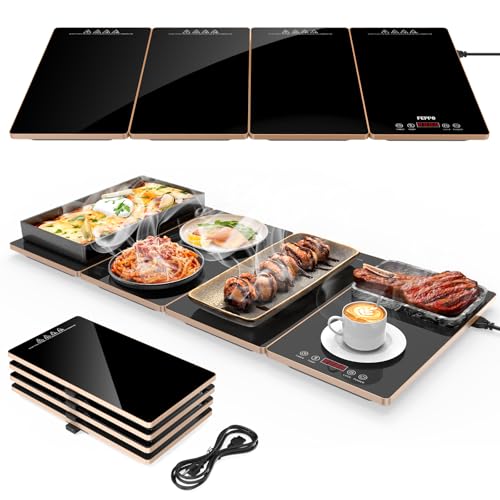


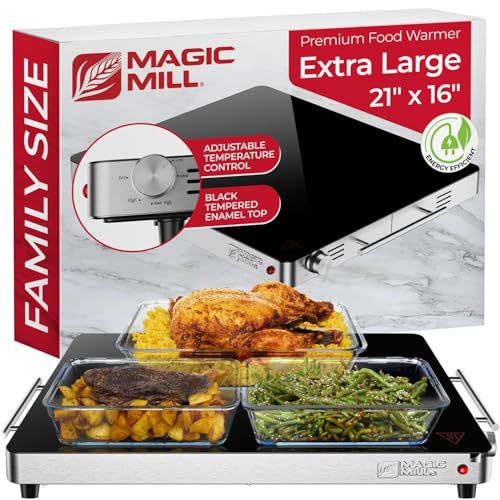
As an Amazon Associate we earn from qualifying purchases at no extra cost to you. Ratings are shown as listed on Amazon.
Quick picks by serving situation
| Situation | Best plate profile | Why it fits | Typical market range |
|---|---|---|---|
| One dish or small table | 12–15 inches, 100–120 watts, one or two heat levels | Compact, inexpensive, and adequate for a casserole or serving bowl | $35–$70 |
| Family dinner | 18–21 inches, 120–180 watts, adjustable thermostat | Balances capacity, control, and moderate energy consumption | $60–$120 |
| Buffet serving | 24–30 inches, 200–300 watts, multiple heating zones or stable full-surface heating | Accommodates several smaller dishes or two large serving pans | $90–$180 |
| Occasional holiday use | Foldable or lightweight 18–21-inch model, 120–180 watts | Easier to store than a large commercial-style unit | $50–$110 |
What matters most when choosing a warming plate
Usable surface area, not advertised dimensions
A plate’s outer measurement includes its frame, controls, handles, and sometimes a raised border. Measure the flat heated area instead. A 20-inch plate may offer only 17 or 18 inches of practical space.
For sizing, allow at least 1 inch of clearance around each item so dishes do not hang over the heated surface. A 14-inch circular plate can usually hold one large 10- to 12-inch dish. An 18 by 10-inch rectangular surface can hold two medium bowls or one casserole approximately 13 by 9 inches. A 24-inch surface is more flexible, but it also takes up substantial table space.
Wattage and temperature settings
Wattage indicates maximum electrical input, not guaranteed food temperature. A 300-watt plate heats faster and recovers more quickly when a cold dish is placed on it, but a 120-watt unit generally uses less energy once food is already hot.
For table service, adjustable temperature control is more useful than maximum wattage. Look for at least three practical settings—low, medium, and high—or a thermostat with a stated operating range. Low heat is suitable for holding already-hot food; high heat is mainly useful for preheating the surface or recovering after adding a cold serving dish.
Do not use a warming plate to bring refrigerated food safely up to serving temperature. Heat food thoroughly using an oven, stovetop, or other suitable appliance, then transfer it to the preheated plate.
Heat distribution
Uneven heating is one of the most common ownership frustrations. A plate with a single heating element may be hot in the center and noticeably cooler at the edges. This is less troublesome for a single casserole but inconvenient for several bowls.
Prefer descriptions such as full-surface heating, embedded heating elements, or independently controlled zones. A thick aluminum or tempered-glass top can help spread heat, although the element design matters more than the top material alone. If the manufacturer publishes a heat map or recommends rotating dishes, treat that as a sign that temperature variation is part of normal use.
Cookware compatibility
Flat-bottomed cookware transfers heat most effectively. Stainless-steel, ceramic, porcelain, glass, and cast-iron serving dishes are commonly suitable, but the appliance manual takes priority. A heavy cast-iron dish may warm slowly and retain heat well; thin glass may respond faster but can be more vulnerable to sudden temperature changes.
Avoid placing plastic, melamine, paper, or wooden servingware directly on a hot surface unless the manufacturer specifically permits it. Silicone feet can also soften or leave marks at high settings. Raised racks are useful when included, but they reduce heat transfer and are better for keeping a dish warm gently than for rapid warming.
Cord placement and table safety
A rear-exiting cord is usually the easiest to route behind a buffet table. A side exit can work well on a narrow counter, particularly if the outlet is beside the appliance. A cord that exits from the center or underside may force the plate to sit away from the table edge and can interfere with stacking or folding.
Look for a cord of roughly 4 to 6 feet, strain relief where it enters the housing, nonslip feet, and a visible power indicator. Keep the cord away from hot cookware and walking paths. Do not connect a warming plate to an overloaded extension cord or power strip; if an extension cord is unavoidable, use one rated for the appliance’s wattage and keep the connection dry and accessible.
Head-to-head: compact, family-size, and buffet plates
| Feature | Compact plate | Family-size plate | Buffet plate |
|---|---|---|---|
| Typical heated area | 12–15 inches | 18–21 inches | 24–30 inches |
| Typical wattage | 100–120W | 120–180W | 200–300W |
| Best for | One dish | Two to four dishes | Multiple serving vessels |
| Storage footprint | Small | Moderate | Large |
| Main compromise | Limited capacity | May still have edge-temperature variation | Higher cost, weight, and energy draw |
For most households, the family-size category is the strongest choice. It covers ordinary dinners without consuming the entire table, and its wattage is usually modest enough for occasional use. Choose compact only when storage or counter space is the overriding concern. Choose buffet size when you regularly serve several dishes at once and have a dedicated storage location.
Energy use: a practical calculation
Suppose a 150-watt plate runs for two hours. Its maximum consumption is:
0.150 kilowatts × 2 hours = 0.30 kilowatt-hours.
At an electricity rate of 20 cents per kilowatt-hour, that session costs about 6 cents. A 300-watt buffet plate used for the same time would consume 0.60 kilowatt-hours, or about 12 cents at that rate.
Actual use may be lower if a thermostat cycles the heating element off and on. The bigger energy-saving step is to preheat only briefly and place already-hot food on the plate. Leaving an empty plate on high for an hour wastes energy and adds unnecessary stress to the electronics and surface coating.
Durability and maintenance realities
- Surface finish: The coating or glass top usually shows wear before the heating element fails. Do not slide cast iron across it or cut food on the surface.
- Controls: Rotary thermostats and simple switches are often easier to operate with greasy hands than small touch controls, but any control should be kept dry.
- Cleaning: Unplug the plate, let it cool, and wipe it with a damp cloth and mild detergent. Never immerse the appliance or pour water over its edges.
- Thermal shock: Do not place a cold, wet glass dish on a very hot surface. Allow chilled cookware to warm gradually where the manufacturer recommends it.
- Storage: Store flat or upright as directed, without placing heavy cookware on top. Protect the cord from sharp bends at the plug and strain-relief point.
Buying checklist
- Measure the actual heated area and your storage space.
- Choose at least three heat settings or a usable thermostat.
- Confirm compatibility with the materials of your serving dishes.
- Check whether the surface is intended for direct contact or requires a rack.
- Prefer rear or side cord placement, nonslip feet, and an indicator light.
- Match wattage to use: about 120–180 watts for everyday serving and 200–300 watts for large buffets.
- Confirm the warranty and cleaning instructions before buying.
For energy-conscious serving, the best electric warming plate for table use is usually a family-size model with a genuinely usable 18- to 21-inch surface, 120–180 watts, adjustable low-to-medium heat, even element coverage, and a conveniently placed cord. It will handle the widest range of meals without paying the space and energy penalty of a commercial-size buffet plate.


Write Your Review
No reviews yet. Be the first to share your experience!