

Key takeaways
- Charcoal kits versus continuous digital radon detectors: what each format measures, how results are read, and the key points for choosing the right kit.
Radon is a naturally occurring gas, and a radon test kit is how you find out how much of it is present in your indoor air. Results are reported in pCi/L, and the kit you choose decides how that number reaches you: mailed back from a lab after a few days of exposure, or shown by a battery-powered monitor that keeps measuring for as long as you leave it running.
The five options below fall into two camps. The First Alert RD1 and the PRO-LAB RA100 are short-term charcoal kits that you expose, seal, and send to a lab. The Airthings 223, the Airthings Wave 2950, and the Ecosense EcoQube are continuous digital detectors that report readings themselves. Neither format is better in the abstract; they answer different questions, and the right pick depends on whether you want a single screening result or an ongoing record.
As an Amazon Associate, we earn from qualifying purchases.
Quick answer
Choose a short-term charcoal kit if you want one screening result mailed to a lab, and a continuous digital detector if you want readings you can watch over weeks and seasons. Charcoal kits are single-use and cover a few days; digital monitors run on batteries, report in pCi/L, and track short- and long-term averages without lab fees.
How to choose
Decide the format first. A charcoal kit is a passive sampler: you place it in the room, leave it for the stated exposure window, seal it, and mail it to a lab, which reports the average level over those days. A continuous detector is an electronic monitor: it sits in the room and produces readings on an ongoing basis, so you can see both short-term and long-term averages from the same device.
Match the test to the question. For a one-time screening, or a result tied to a specific few days, a charcoal kit does the job with no batteries or setup. For a home where levels may swing with weather, seasons, or ventilation changes, a continuous detector gives you a record instead of a snapshot.
Think about how results are read. Lab kits return one analysed result per test. Digital detectors report in pCi/L on the device or in an app; the EcoQube adds app trend charts, and the Wave pairs readings with humidity and temperature data. If you want to watch a graph build over time, pick a connected detector; if you want a single lab figure, pick a kit.
Check what repeat testing costs you in effort. Every charcoal test is a fresh kit plus a lab step, and lab-fee terms vary by listing, so read the fee wording on the product page before ordering. The digital detectors below state no lab fees where the listing says so, because the monitor itself does the measuring.
Count the rooms and the timing. Testing two spots at once, for example during a real-estate transaction, points to a two-detector kit like the PRO-LAB. A single detector, charcoal or digital, only ever describes the room it sits in.
Confirm the basics. Charcoal kits are for US use where the listing says so, and their exposure windows are short, so timing the test matters. Digital detectors run on batteries; check the cell type, and note that the EcoQube connects to 2.4 GHz Wi-Fi only.
First Alert Radon Gas Test Kit, RD1
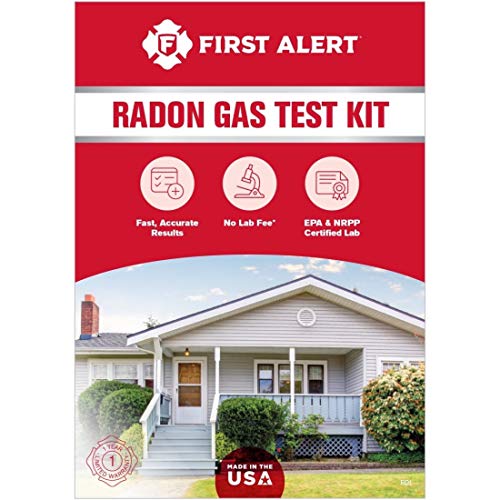
The RD1 is the classic short-term charcoal kit: a single passive sampler you expose in the room, then return by mail for lab analysis. The listing states that the lab fee is included, except for tests in New Jersey, and a return mailer is in the box, so the process is place, wait, seal, and post. The kit is listed under the EPA Radon Gas Measurement Proficiency Program and is for US use only.
One caution: the listing copy gives two different exposure windows and two different result timings, so neither figure is settled here. Follow the manual in the box for how long to expose the kit, and treat the stated turnaround as approximate. What is consistent is the format itself: one kit, one room, one lab-reported average.
Specs
– Type: Charcoal-activated short-term test kit
– Lab fee: Included, except for New Jersey tests
– Return mailer: Included
– Program listing: EPA Radon Gas Measurement Proficiency Program
– Use: US only
– Exposure window: Not stated (listing copy conflicts)
– Result timing: Not stated (listing copy conflicts)
– In the box: Charcoal test kit, manual, return mailer
PRO-LAB Radon Test Kit for Home, RA100

The PRO-LAB kit stands out for one simple reason: it contains two short-term detectors instead of one. Two detectors let you test two locations at the same time, which is the setup the listing points to for simultaneous and real-estate testing, where a single-room result is not enough. The listing states that results can arrive in as little as 48 hours and that the kit meets EPA and state requirements.
The fee wording on this listing is inconsistent: parts of the listing describe a per-detector lab fee, while other copy describes fees and postage as included. Because the listing contradicts itself, no lab-fee figure is printed here as fact. Check the fee terms on the product page before you order so the total cost of the test is clear.
Specs
– Type: Short-term radon test kit
– Detectors: 2 included
– Results: In as little as 48 hours, per the listing
– Standards: Meets EPA and state requirements, per the listing
– Lab fee: Not stated (listing fields conflict)
– Model: RA100
Airthings Corentium Home Radon Detector 223

The Corentium Home 223 is a portable continuous detector: instead of sampling once and going to a lab, it keeps measuring and reports radon levels in pCi/L itself. It runs on three AAA batteries, so it can sit in a room without a power outlet or a network connection, and it suits a household that wants to check more than one room over time by moving a single device.
Because it is a monitor rather than a mail-in kit, there is no exposure window to time and no sample to post. The trade-off is that it is a standalone unit: the listing records no app or extra sensors for this model, so readings live on the device. If you want a simple, self-contained continuous reading in pCi/L, this is the straightforward option of the three detectors here.
Specs
– Type: Continuous digital radon detector
– Reporting unit: pCi/L
– Power: Battery operated, 3 AAA
– Model / part number: 223
– UPC: 854232008019
– App: Not stated
– Extra sensors: Not stated
Airthings 2950 Wave Radon

The Wave Radon takes the continuous format and adds context around the number. Alongside radon, it carries humidity and temperature sensors, so the readings it logs through its free app show the conditions in the room at the same time. It runs on two AA batteries, which are included, and the listing states there are no lab fees, since the device itself does the measuring.
This is the pick for someone who wants to follow levels over weeks and seasons rather than check a single result, and who values the extra indoor-air data alongside the radon figure. As with any continuous monitor, what it reports is the room it sits in, so placement still matters.
Specs
– Type: Smart continuous radon detector
– Extra sensors: Humidity and temperature
– App: Free app
– Lab fees: None, per the listing
– Power: Battery operated, 2 AA included
– Model: 2950
– GTIN: 00854232008064
Ecosense EQ100 EcoQube, Digital Radon Detector
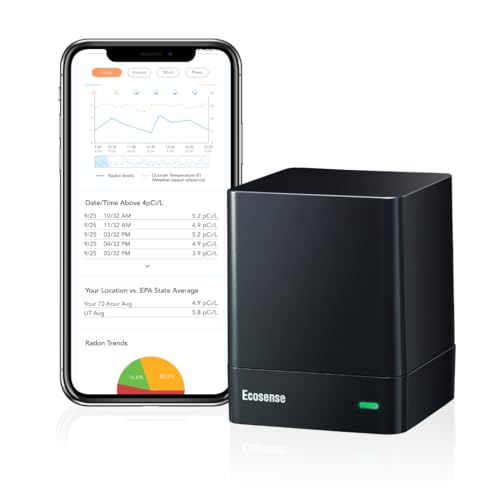
The EcoQube is a continuous detector built around a pulsed ionization chamber sensor, and it is the most connected option here: it links to an app over Wi-Fi for trend charts covering both short- and long-term monitoring. The maker states a first reading in about 10 minutes, which is a maker claim rather than a measured figure here, and lists sensitivity at 30 counts per hour per pCi/L.
One hard limit to note before buying: the EcoQube connects to 2.4 GHz Wi-Fi only, so a network that broadcasts only 5 GHz will not pair with it. If your router offers a 2.4 GHz band, the EcoQube gives you the chart-based view of how levels move over time that the standalone detectors do not.
Specs
– Type: Digital radon detector, continuous monitoring
– Sensor: Pulsed ionization chamber (ionization)
– Connectivity: Wi-Fi 2.4 GHz only
– App: Trend charts for short- and long-term monitoring
– First reading: About 10 minutes (maker claim)
– Sensitivity: 30 counts per hour per pCi/L
– Part number: EQ 100
Who should skip
Skip the charcoal kits if you want to watch levels change over time; each kit covers one room for one short window and then it is done. Skip the digital detectors if you only need a single screening result and do not want to keep a device running. Skip the PRO-LAB if the listing’s unclear fee wording bothers you and you cannot confirm the terms before ordering. Skip the EcoQube if your home network has no 2.4 GHz band. And skip the standalone 223 if an app record matters to you, since its listing states no app.
FAQ
What is the difference between a charcoal kit and a digital detector?
A charcoal kit passively absorbs a sample over a few days and is mailed to a lab, which reports one average level. A digital detector is an electronic monitor that measures continuously and reports readings in pCi/L itself, on the device or in an app, so you can follow short- and long-term averages.
How long does a short-term radon test take?
The charcoal kits here are exposed for a few days, then returned for analysis. Exact windows vary by kit, and the First Alert listing itself gives conflicting figures, so follow the instructions in the box. The PRO-LAB listing states results in as little as 48 hours once the lab receives the detectors.
Do continuous detectors charge lab fees?
There is nothing to send to a lab, so the measuring is done by the device. The Airthings Wave listing states no lab fees outright. Charcoal kits are different: their lab terms vary by listing, and the PRO-LAB listing’s fee wording conflicts with itself, so confirm the terms on the product page.
Can I test two rooms at the same time?
Yes, with the right kit. The PRO-LAB RA100 includes two detectors for simultaneous testing, which the listing points to for real-estate use. A single charcoal kit or a single digital detector only measures the one room it is placed in.
Final verdict
For a single, simple screening, the First Alert RD1 covers the basics with its lab fee and return mailer included for most buyers. For two places at once, the PRO-LAB RA100 is the only kit here with two detectors, though its fee wording needs a careful read. For ongoing readings, the Airthings 223 keeps things self-contained, the Wave 2950 adds humidity, temperature, and an app, and the EcoQube adds Wi-Fi trend charts for 2.4 GHz networks. Choose by the question you are asking: one result, or a record.
Product and ASIN Reference
| Product | ASIN |
|---|---|
| First Alert Radon Gas Test Kit, RD1 | B00002N83E |
| PRO-LAB Radon Test Kit for Home – EPA Approved Short-Term Radon Tester with 2 Detectors (model RA100) | B000BD6D20 |
| Airthings Corentium Home Radon Detector 223 Portable, USA Version, pCi/L | B00H2VOSP8 |
| Airthings 2950 Wave Radon – Smart Radon Detector with Humidity & Temperature Sensor | B07WWV7K3K |
| Ecosense EQ100 EcoQube, Digital Radon Detector | B08LLFKVX4 |
More from Amazon
Programs that pair well with the guide above. Offers and eligibility are set by Amazon and may change.
Free shipping on eligible items, Prime Video and more. Eligible new members can start with a free trial.
Start a Prime free trialA Prime membership for ages 18-24 with a trial period. Eligibility is set by Amazon.
See Prime for Young AdultsAudiobooks and podcasts to listen to on the go. Eligible new members can start with a free trial.
Try Audible freeAd-free music streaming. Eligible new subscribers can start with a free trial.
Try Music Unlimited freeAs an Amazon Associate we earn from qualifying purchases.







Write Your Review
No reviews yet. Be the first to share your experience!