

Key takeaways
- How to choose a solar attic fan: panel wattage, roof or gable mounting, thermostat controls and hybrid options compared across five solar-powered models.
A solar attic fan pulls hot air out of the attic using a photovoltaic panel instead of house wiring, so it runs when the sun is strongest, which is also when attic heat builds up most. Moving that hot, humid air out is the job the listings describe: ventilation that helps keep attic air from sitting stagnant through the summer and carrying moisture into the roof structure through the year.
Because the fan and panel are a matched system, the buying decision comes down to a handful of specifications: panel wattage, mounting style, whether a thermostat controls the fan, and whether the unit can run from an adapter when the sun is down. This guide walks through those choices using five verified models, from a 20-watt roof fan to a 50-watt hybrid unit, with every performance figure attributed to the listing that states it.
As an Amazon Associate, we earn from qualifying purchases.
Quick answer
Most buyers should start with a roof-mount fan in the 30 to 40 watt range: the iLIVING 40-watt adds a smart thermostat and hybrid-ready design, while the Remington 30 watt is the simpler roof-mount option. Choose the ECO-WORTHY if your attic suits a gable vent, the Remington 20 watt for a smaller roof section, and the OmniPV 50W for the largest stated figures.
iLIVING HYBRID Ready Smart Thermostat Solar Roof Attic Exhaust Fan, 14″, 40-Watt
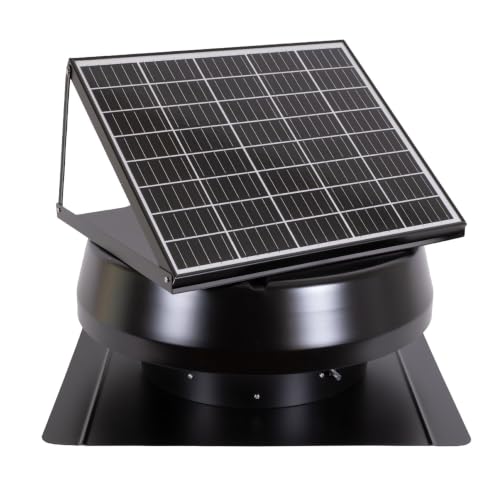
The iLIVING is the control-focused pick in this group. It is a 14-inch roof-mount solar attic exhaust fan with a 40-watt panel per the listing title, and its headline feature is smart thermostat control, so the fan responds to attic temperature rather than running purely whenever the panel sees light. The model number is ILG8SF301.
The hybrid-ready design deserves a clear explanation: per the listing copy, an AC/DC adapter kit is sold separately, and the fan as listed is solar powered. Hybrid-ready therefore means you can add the adapter later if you want the fan to keep running after sunset or on overcast days; it does not mean the adapter is in the box.
One caution on figures: retrieved information for this fan does not state its airflow and coverage consistently, so this guide treats both as not stated rather than picking a number. Judge it on its panel size, thermostat control and mounting format, and check the current product page if the airflow figure matters to your decision.
Specs:
– Mounting: roof mount, 14-inch fan
– Panel: 40 watts, per the listing title
– Controls: smart thermostat
– Power: solar as listed; hybrid-ready, adapter kit sold separately
– Airflow and coverage: not stated consistently
– Model: ILG8SF301
ECO-WORTHY Solar Power Attic Gable Roof Vent

The ECO-WORTHY is the gable-mount alternative in this line-up. Instead of cutting into the roof deck, a gable vent fits the triangular wall opening at the end of the attic, which can make it the practical choice for homes that already have a gable opening or where a roof penetration is unwelcome.
Per the listing, it uses a brushless DC motor driven by a 29-watt monocrystalline solar panel, and the listing states an airflow of 1720 CFM. That CFM figure is a manufacturer and listing figure, presented here as the seller states it; it is not a measured result, and it should not be compared directly against fans whose listings state no figure at all.
Choose the ECO-WORTHY if your attic layout suits gable mounting and you want the panel, motor type and airflow all stated in one listing. If your home has no suitable gable opening, the roof-mount models in this guide are the relevant comparison instead.
Specs:
– Mounting: gable mount attic vent
– Motor: brushless DC
– Panel: 29-watt monocrystalline
– Airflow: 1720 CFM, per the listing (manufacturer figure)
– Coverage: not stated
Remington Solar 30 Watt Roof Mount Solar Attic Fan (SF30-BLK)

The Remington 30 watt is the straightforward roof-mount option. It pairs a 30-watt panel with a black finish, model SF30-BLK, and keeps the proposition simple: a solar fan that exhausts attic air during daylight without wiring, controls or hybrid extras described in the retrieved listing information.
Airflow and coverage figures beyond the title facts are not stated in the retrieved information for this model, so this guide does not assign it a CFM number. That is worth keeping in mind when comparing across brands: a missing figure is not the same as a low figure, it simply means the listing evidence gathered here does not state one.
Pick the SF30-BLK if you want a mid-wattage roof-mount fan from an established attic fan line and do not need thermostat or hybrid features. Homeowners who want temperature-based control should look at the iLIVING above instead.
Specs:
– Mounting: roof mount
– Panel: 30 watts
– Finish: Black
– Airflow and coverage: not stated
– Model: SF30-BLK
Remington Solar 20 Watt Solar Roof Mount Attic Fan, Black (SF20-BLK)

The Remington 20 watt, model SF20-BLK, is the smaller sibling of the 30-watt model above, and the two listings should be kept strictly separate: this is a 20-watt roof-mount fan in a black finish, aimed at smaller attic sections or as a second unit paired with another fan on a larger roof.
A smaller panel generally suits a smaller ventilation job, such as a compact attic, a garage roof space or one section of a divided attic, rather than a whole large roof on its own. As with its sibling, airflow and coverage figures are not stated in the retrieved listing information, so compare it on wattage, mounting and format rather than invented numbers.
Choose the SF20-BLK if your attic is modest in size or you are adding ventilation to one part of the roof. If you are choosing between the two Remingtons for a main attic, the 30-watt model’s larger panel is the more capable starting point on the facts stated.
Specs:
– Mounting: roof mount
– Panel: 20 watts
– Finish: Black
– Airflow and coverage: not stated
– Model: SF20-BLK
OmniPV Smart Hybrid Solar Attic Exhaust Fan Pro, 50W

The OmniPV carries the largest panel in this group at 50 watts, and its listing title states the fullest set of figures: 2850 CFM of airflow, a thermostat range of 40 to 104 degrees F, and coverage up to 4,000 square feet. All three are manufacturer and listing title figures, attributed here as stated; they are claims to weigh, not measured results, and the coverage figure in particular should be read as an upper claim rather than a guarantee for any specific attic.
The listing title also describes smart hybrid operation, which places it alongside the iLIVING as one of the two control-oriented designs in this guide, but at a higher wattage. The model number is OP-SAF-50. The evidence for this fan rests on its listing title and model fields, so shoppers should confirm the full specification on the product page before ordering.
Pick the OmniPV if you have a large attic and want the biggest stated panel and figures in this group, with hybrid operation included in the design.
Specs:
– Mounting: roof mount exhaust fan
– Panel: 50 watts
– Airflow: 2850 CFM, per the listing title (manufacturer figure)
– Thermostat range: 40 to 104 degrees F, per the listing title
– Coverage: up to 4,000 square feet, per the listing title (manufacturer figure)
– Model: OP-SAF-50
How to choose
Match the mount to your house first. Roof-mount fans need a suitable roof section and a flashing installation; a gable vent like the ECO-WORTHY avoids a new roof opening where a gable vent already exists. Getting this wrong matters more than any specification.
Next, size the panel to the attic. The wattages here run from 20 to 50 watts; smaller attics and secondary spaces fit the lower end, while large attics justify the higher-wattage models. Where a listing states airflow or coverage, treat those as manufacturer figures for orientation, and where a listing states neither, do not fill the gap with numbers from another model.
Then decide on controls. A thermostat model, like the iLIVING, runs the fan based on attic temperature, while basic models run whenever the panel produces power. Hybrid designs add the option of adapter power for evenings and cloudy spells, sometimes with the adapter sold separately, as on the iLIVING, so check what is included before assuming. Finally, confirm colour, model number and what the box contains on the product page, since near-identical fans are sold in several wattages under one brand.
Who should skip
Skip a solar attic fan if your attic already has effective passive ventilation sized for the space and no heat or moisture problem to solve; adding a fan is not automatically an improvement. Skip it if your roof is heavily shaded, since a solar panel in shade cannot drive the fan when it is needed most, and a wired fan would serve better. Renters and anyone not authorised to cut into the roof or gable should also skip these, and homeowners uncomfortable with roof work should budget for professional installation rather than treating this as a casual weekend ladder job.
FAQ
Will a solar attic fan lower my energy bills?
The listings frame these fans as attic ventilation, and this guide does not promise bill savings, because savings depend on the house, the attic and the climate. What the products do, per their listings, is exhaust hot attic air using sunlight. Treat any savings figure you see in marketing as a claim, not a certainty.
What happens to a solar attic fan at night or on cloudy days?
A purely solar model slows or stops when the panel is not producing, which is normal: attic heat load is lowest then too. Hybrid designs, such as the iLIVING with its separately sold adapter kit and the OmniPV with its stated smart hybrid operation, are the route if you want the fan able to run beyond sunshine hours.
Is a bigger panel always better?
Not automatically. Panel wattage should match attic size and mounting: a 50-watt unit on a small attic is more fan than the space needs, while a 20-watt unit may under-serve a large roof. Use stated wattage, mounting and any listing airflow figures together, and remember that several models here state no airflow figure at all.
Can I install a solar attic fan myself?
Roof-mount models require cutting and sealing a roof opening, and gable models require fitting the vent into the gable wall, so the job involves roof access, flashing and weatherproofing. Confident homeowners with the right tools do take it on, but if any of that is unfamiliar, professional installation is the safer reading of what the installation involves.
Final verdict
For most homes, the iLIVING 40-watt is the most complete package here: roof mounting, a smart thermostat and a hybrid-ready design, with the honesty that its airflow figure is not stated consistently enough to print. The Remington 30 watt is the simpler roof-mount alternative, its 20-watt sibling suits smaller spaces, the ECO-WORTHY is the gable-mount route with a stated 1720 CFM listing figure, and the OmniPV 50W is the large-attic option with the biggest stated figures. Choose by mount and attic size first, treat every performance number as a listing claim, and a solar fan can be a sensible, wiring-free way to keep attic air moving.
More from Amazon
Programs that pair well with the guide above. Offers and eligibility are set by Amazon and may change.
Free shipping on eligible items, Prime Video and more. Eligible new members can start with a free trial.
Start a Prime free trialA Prime membership for ages 18-24 with a trial period. Eligibility is set by Amazon.
See Prime for Young AdultsAudiobooks and podcasts to listen to on the go. Eligible new members can start with a free trial.
Try Audible freeAd-free music streaming. Eligible new subscribers can start with a free trial.
Try Music Unlimited freeAs an Amazon Associate we earn from qualifying purchases.










Write Your Review
No reviews yet. Be the first to share your experience!