

Key takeaways
- This rain gauge buying guide for water-wise home gardens compares magnifying tubes, a glow-in-the-dark Taylor, flexible silicone and a wireless AcuRite.
Many gardens are watered on a schedule rather than on need: the timer runs or the hose comes out because it is Tuesday, whether or not it rained on Monday. That habit wastes water in wet weeks and can still leave beds short in dry ones. A rain gauge is the simplest correction. It tells you how much rain your garden actually received, so you can skip a watering session after a good soaking and add one when a passing shower delivered less than it promised.
Gauges range from a basic marked tube you read at eye level to a wireless collector that empties itself and reports to a display indoors. This buying guide compares five models across that range — two AcuRite designs, two Taylor gauges in different materials, and a La Crosse waterfall-style gauge — using only the capacities and features each listing states, so you can match a gauge to the way you garden.
As an Amazon Associate, we earn from qualifying purchases.
Quick answer
For most home gardens, the AcuRite 5-inch magnifying gauge is the straightforward pick: an acrylic tube with an easy-to-read scale and a stated 5-inch capacity. Gardeners who would rather check rainfall from indoors should look at the AcuRite wireless model with its self-emptying collector and rainfall history. The Taylor glow-in-the-dark and flexible silicone gauges suit mounted and stake positions, while the La Crosse waterfall gauge is the decorative option.
AcuRite 5-Inch Capacity Easy-to-Read Magnifying Rain Gauge, Acrylic
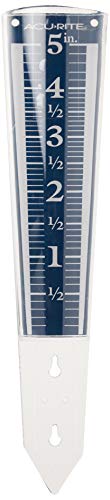
The first AcuRite is the classic manual tube gauge, refined for readability. The listing states a 5-inch capacity, acrylic construction, and a magnifying, easy-to-read scale — the scale is designed so the water column and its markings are enlarged when you look through the gauge, which helps when the gauge sits at the back of a bed rather than beside a path.
A manual gauge like this one asks for a small routine: check it after rain, note the amount, and empty it so it is ready for the next storm. In return you get a gauge with no batteries, no signal to lose, and nothing to set up beyond placing it where rain falls freely. Five inches of capacity is generous for a single storm in most regions, so overflow between checks is rarely a concern. If your main frustration with basic gauges is squinting at fine markings, the magnifying scale is the reason to choose this one. Gardeners who know they will forget to empty a tube should consider the self-emptying wireless model next instead.
AcuRite Wireless Digital Rain Gauge with Self-Emptying Collector

The second AcuRite removes the two chores of a manual gauge: walking out to read it and remembering to empty it. Per the listing, this model pairs a self-emptying outdoor collector with a wireless indoor digital display, so rainfall figures appear inside the house. The listing also states rainfall history and alerts, plus a display of the current date and time.
The self-emptying collector matters more than it might sound. A manual tube that is not emptied after a storm starts the next one part-full, and its reading quietly stops being trustworthy. A collector that tips and empties itself keeps measuring continuously, and the history feature lets you look at rainfall over days rather than a single event — useful when you are deciding whether a deep watering is due. The trade-offs are the usual ones for wireless gear: batteries to maintain and a display that needs to stay within range of the collector. If you want rainfall records without a notebook by the back door, this is the pick of the five.
Taylor Glow-In-The-Dark Mountable Rain Gauge, 6-Inch, Black and Green

Taylor’s first entry addresses a specific annoyance: reading a gauge at dawn before work, or in the evening after a late storm, when the light is poor. The listing states glow-in-the-dark markings, a mountable design, and a 6-inch capacity, the largest stated capacity among the manual gauges in this guide. It is part of Taylor’s ClearVu line and finished in black and green.
Mounting is the other half of its appeal. A gauge fixed to a fence post or railing at a set height gives consistent readings in the same conditions every time, and it stays put in wind that can topple a loosely placed tube. The glow markings and the extra inch of capacity over the AcuRite tube make this the better choice for a permanent, fixed position that you read in passing, morning and evening. If your only good mounting spot is shaded all day, bear in mind the markings charge from light; a spot with some daylight keeps the glow feature working as intended.
Taylor Flexible Silicone Rain Gauge, 7-Inch, Teal
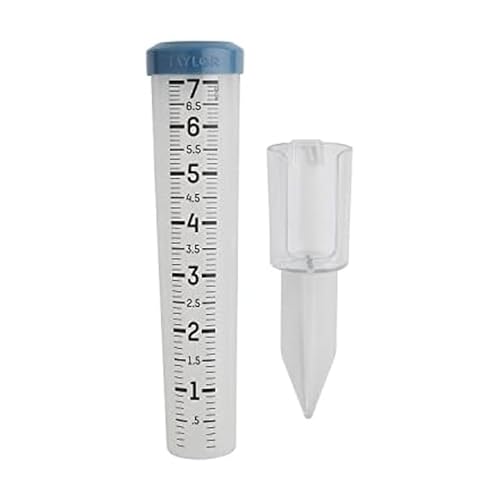
The second Taylor takes the opposite approach to durability. Instead of rigid acrylic, the listing describes a flexible silicone gauge that the maker describes as break and freeze proof — a claim worth attributing to the listing, but a plausible one for silicone, which flexes rather than cracking when water inside it freezes, and which survives being knocked off its post. The stated capacity is 7 inches, the largest in this guide.
The listing states two mounting options: post mount or ground stake. The ground stake makes this the easiest gauge here to place in the middle of a lawn or a vegetable plot, away from fences and roof lines, which is where rainfall readings are most representative. For gardeners in cold climates who have cracked a rigid gauge over winter, or anyone who wants to push a stake into the soil and be done, the silicone Taylor is the practical pick. Its flexibility also makes it a sensible choice for a gauge that will be moved around the garden across the season.
La Crosse 705-109 Waterfall Rain Gauge

The La Crosse 705-109 is the style-led option: a waterfall-style gauge from La Crosse Technology, designed to look like a garden feature rather than a measuring instrument. For gardeners who resist adding anything utilitarian-looking to a flower bed, that design-first approach may be the difference between owning a gauge and actually keeping one on display where it gets read.
One honest limitation: the retrieved listings for this model do not state its capacity, so this guide will not invent one. Buyers comparing capacities directly should note that the other four gauges here state theirs — 5, 6, and 7 inches for the manual models — while the La Crosse’s goes unstated. If a published capacity matters to you, choose one of the models that states it. If appearance matters most and you are content to read the gauge by its markings in regular checks, the waterfall design earns its place in the five.
How to choose
Capacity comes first. Manual gauges here state 5, 6, or 7 inches; any of these holds a typical storm’s rain with room to spare, but a larger capacity is forgiving if you sometimes go a few days between checks. Where a listing does not state a capacity, treat that as a genuine gap rather than assuming it matches the others.
Readability comes second, because a gauge you cannot read at a glance will not be read at all. A magnifying scale helps at a distance, glow-in-the-dark markings help in low light, and a wireless indoor display removes the trip outside entirely. Pick the readability feature that matches when and where you will actually check the gauge.
Then decide on mounting and upkeep. Mountable gauges give consistent readings from a fixed post or railing; a ground stake suits open lawn and vegetable plots; and any manual tube must be emptied after each reading. If emptying sounds like a chore you will skip, a self-emptying wireless collector is the honest choice. Finally, think about material: acrylic is rigid and clear, while the listing for the silicone Taylor describes it as break and freeze proof, which suits cold climates and exposed positions. Whatever you choose, site it in the open, away from roof drip lines and overhanging branches, so it catches the rain your beds receive.
Who should skip
Skip this category if you already run a full home weather station — you have rainfall data, and a separate gauge adds nothing. Gardeners who want rainfall pushed to a phone app should also look elsewhere, as app connectivity is not stated for any model here. And if your garden is entirely containers on a covered balcony, a rain gauge will mostly tell you what you already know: covered pots do not receive the rain the gauge records, so water them by checking the soil instead.
FAQ
How much rain does a garden actually need?
As a general rule of thumb, many vegetable and flower gardens do well with roughly an inch of water per week, from rain and watering combined. A rain gauge turns that rule into a decision: if the gauge shows close to an inch for the week, you can skip watering; if it shows a quarter inch, your beds still need the difference from the hose.
Where should I place a rain gauge?
Place it in the open, on a post, railing, or stake, away from roof overhangs, drip lines, and tree canopies, all of which distort how much rain reaches the gauge. Keep it level and somewhere you pass regularly — a gauge you walk past after a storm is one you will actually read.
Is a manual or a wireless rain gauge better?
Neither is better for everyone. A manual tube is simple, needs no batteries, and costs you a short walk and an emptying routine. A wireless model with a self-emptying collector, like the AcuRite in this guide, records rainfall continuously, keeps a history, and lets you read it indoors. Choose based on whether you will keep up with emptying a tube.
How do I keep readings accurate?
Empty a manual gauge after every reading so each storm starts from zero, and check that the gauge stays level and unobstructed as plants grow around it. Describe accuracy in terms of consistency rather than laboratory precision: a gauge read in the same spot, in the open, gives you dependable comparisons week to week, which is what watering decisions need.
Final verdict
Most gardeners should start with the AcuRite magnifying tube: a stated 5-inch capacity, an easy-to-read scale, and nothing to maintain beyond emptying it. Pick the AcuRite wireless model if you want rainfall history and readings indoors without the emptying routine. The Taylor glow-in-the-dark gauge suits a fixed mounting spot read at dawn or dusk, the Taylor silicone gauge suits cold climates and stake placement in open ground, and the La Crosse waterfall gauge suits gardeners who want the instrument to double as an ornament. Measure first, water second — that is the whole water-wise habit.
More from Amazon
Programs that pair well with the guide above. Offers and eligibility are set by Amazon and may change.
Free shipping on eligible items, Prime Video and more. Eligible new members can start with a free trial.
Start a Prime free trialA Prime membership for ages 18-24 with a trial period. Eligibility is set by Amazon.
See Prime for Young AdultsAudiobooks and podcasts to listen to on the go. Eligible new members can start with a free trial.
Try Audible freeAd-free music streaming. Eligible new subscribers can start with a free trial.
Try Music Unlimited freeAs an Amazon Associate we earn from qualifying purchases.







Write Your Review
No reviews yet. Be the first to share your experience!