

Key takeaways
- Compare analog and wireless rain gauges for home gardens by capacity, mounting, readability and freeze resistance to track watering with less guesswork.
- Top Pick: AcuRite 5-Inch Capacity Easy-to-Read Magnifying Rain Gauge
- Runner-up: Headwind EZRead 26-Inch Giant Rain Gauge
- Also consider: Taylor Silicone Rain Gauge, 7-Inch Capacity
Knowing how much rain a garden actually received changes watering decisions from guesswork into a simple routine. A storm that looks heavy from a window can leave raised beds still dry, while a steady overnight rain can soak soil deeply enough to skip irrigation for days. A rain gauge placed in an open spot in the yard gives a direct local reading, rather than a town-wide forecast or a report from a distant weather station. That local number helps protect water, avoid overwatering, and keep a useful record across a growing season.
This guide covers analog and digital options for home gardens. Analog tubes are simple, need no batteries, and are read by eye after rain ends. Wireless gauges use a self-emptying outdoor collector and send totals to an indoor display, which suits gardeners who want daily, weekly, and event totals without walking outside after every storm. The five picks below differ in capacity, mounting, readability, and freeze resistance, so the right choice depends on garden size, climate, and reading habits.
As an Amazon Associate, we earn from qualifying purchases.
Quick answer
For most home gardens, the AcuRite 5-Inch Magnifying Rain Gauge is the simplest starting point, while the Headwind EZRead suits readers who want to check rainfall from a distance. The Taylor silicone gauge adds freeze resistance, and the AcuRite wireless and Geevon wireless models add self-emptying collectors with indoor displays for ongoing totals.
AcuRite 5-Inch Capacity Easy-to-Read Magnifying Rain Gauge
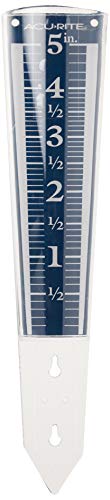
The AcuRite 00850A3 is a straightforward analog tube gauge with a 5-inch capacity, sized for single storms and for multi-day totals in moderate rainfall. The acrylic tube uses a magnifying effect through the water column, so white markings appear larger once rain collects. The listing states magnification of over 35 percent, which helps when the gauge sits a few steps away in a bed or along a path.
Mounting is by an included bracket, suited to a fence rail, post, or deck edge in an open area away from roof drip lines and tree canopy. A gauge tucked under eaves or branches will under-read, no matter how clear the markings are.
The trade-off is winter handling. Acrylic tube gauges of this type are not the freeze-resistant choice, so bringing the gauge indoors in freezing weather is the safer routine. Gardeners who want a gauge left outside all year should look at the Taylor silicone model below instead. Regular emptying after each reading keeps the next total clean.
Headwind EZRead 26-Inch Giant Rain Gauge

The Headwind EZRead takes the opposite approach to readability. At 26 inches tall, this oversized analog gauge is designed to be read from up to 50 feet away, using a high-visibility float that rises with the water level. Capacity is 5 inches of rainfall, read in larger increments than a precision cylinder gauge, which is adequate for deciding whether beds need water, even if the reading is less fine-grained.
A funnel top helps keep leaves and debris out of the measuring tube, and the included hanger supports mounting on a post or fence. The large format suits bigger yards, gardeners who check from a porch or kitchen window, and anyone who finds small tube markings hard to see. The size is also the main consideration. A 26-inch gauge needs open vertical space and a secure mount so wind does not shift it.
Freeze handling needs attention. The Amazon listing notes that this classic model is not freeze resistant and should not be left outside in freezing temperatures. Seasonal removal protects the tube and keeps readings reliable the following spring. For gardeners focused on easy distance reading during the growing season, that seasonal step is a reasonable exchange.
Taylor Silicone Rain Gauge, 7-Inch Capacity
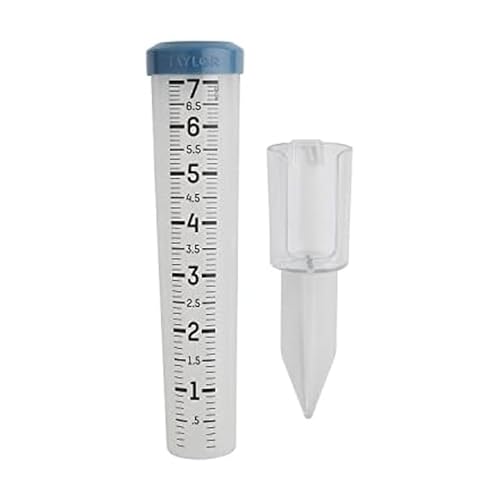
The Taylor flexible silicone rain gauge addresses the cracking problem that ends the life of many rigid plastic tubes. The listing describes the gauge as break resistant and freeze proof, with flexible silicone construction that can flex rather than split when water inside turns to ice. Capacity is 7 inches, a step up from 5-inch tubes, giving more headroom during a wet week before emptying becomes urgent.
Mounting flexibility is a strength. The gauge can be used with a post mount or pushed into the ground on a stake, so placement can move between a vegetable bed, a lawn edge, and a flower border as the season changes. Bold, easy-to-read markings suit quick morning checks before deciding on watering.
Silicone also changes cleaning. Algae and mineral film build up in any gauge left outdoors, and a flexible body is easier to scrub and rinse than a narrow rigid tube. Regular cleaning keeps the water line visible and stops debris from narrowing the opening. For cold-climate gardens, rental plots, and busy households where a gauge might be forgotten outside during an early freeze, this design offers the most forgiving analog option in this group.
AcuRite Wireless Digital Rain Gauge with Self-Emptying Collector, 00899

The AcuRite 00899 moves rainfall tracking indoors. An outdoor self-emptying collector measures rain as it falls and sends totals wirelessly to an indoor display. The display shows rainfall history, customizable alerts, and the current date and time, so daily and event totals can be checked without going outside during or after a storm. Listings describe wireless transmission up to 100 feet, with placement still affected by walls and other obstructions.
Self-emptying collection changes the routine. There is no tube to empty, no overflow loss after a gauge fills, and totals accumulate across a rain event even when nobody is home. Alerts add a prompt when rainfall reaches a set level, which can help with flood watch awareness for low garden areas and with decisions about containers that drain poorly.
Battery power is the ongoing cost. Both collector and display need batteries, and the collector should be checked periodically for leaves or debris around the funnel and tipping mechanism. Level placement on a post or flat surface away from splash from roofs keeps counts cleaner. For gardeners who want a running record with the least daily effort, this is the most complete standalone wireless pick here.
Geevon Digital Rain Gauge with Wireless Weather Display

The Geevon digital rain gauge pairs a self-emptying wireless rain collector with an indoor display that also reports indoor and outdoor temperature and humidity. That extra context suits gardeners who plan watering alongside heat and humidity, for example holding off on evening watering when humidity stays high, or checking beds sooner during a hot, dry spell after only light rain.
The backlit display is suited to a kitchen counter, potting bench, or hallway where readings get checked in the morning. Rainfall history on the display supports comparing one week with the next, which is more useful for irrigation planning than a single storm total alone. As with other tipping collector designs, the outdoor unit needs a level, open placement and occasional clearing of debris so the collector can empty freely.
Wireless range and battery changes are the practical limits. Walls, metal siding, and distance reduce signal, so testing the display location before final mounting saves frustration. Gardeners who only need rainfall may prefer the simpler AcuRite wireless model, while those who want rain plus temperature and humidity will find the Geevon layout more informative.
How to choose
Start with reading style. Analog tubes are read outside after rain, cost little to maintain, and never need batteries. Wireless gauges cost more effort at setup, then reward that effort with indoor totals, history, and alerts. Gardeners who enjoy a daily garden walk often do well with analog, while gardeners tracking several beds or an allotment often prefer wireless records.
Next, match capacity to local rain. A 5-inch tube covers most single storms, but wet regions and forgetful emptying routines favor 7-inch capacity or a self-emptying collector with no fixed limit. Precision also varies. Distance-readable gauges trade fine increments for visibility, while narrow tubes give closer readings at the cost of walking up to the gauge.
Mounting deserves a decision before ordering. Stake mounting suits soil in open beds. Post and fence mounting suit permanent spots, provided the top of the gauge sits clear of rails and foliage. Keep every gauge away from roof overhangs, sprinklers, and trees, and keep the rim level.
Finally, plan for winter. Freeze proof silicone can stay outside in cold weather within maker guidance. Acrylic and classic large-format tubes should come indoors before hard freezes. A short seasonal routine protects accuracy for years.
Who should skip
Skip a rain gauge purchase if watering is fully controlled by a smart irrigation controller with a local rain sensor already pausing cycles reliably, since a second manual record adds little. Skip analog tubes if readings will rarely be checked, because a forgotten full tube loses the next storm total. Skip wireless models if batteries and occasional collector cleaning feel like unwanted chores, or if the only display location sits beyond reliable wireless range through several walls. Gardeners in very sheltered courtyards with heavy roof runoff should first solve placement, since no gauge reads well in a distorted spot.
FAQ
How much rain means a garden can skip watering?
A common garden rule is that many established beds need about an inch of water per week from rain and irrigation combined. A gauge reading near that level across a week suggests checking soil moisture before watering, while a much smaller total suggests supplemental watering is still needed, especially for containers and new plantings.
Where should a rain gauge be placed in a yard?
Place the gauge in an open area, level, away from roofs, trees, fences that block wind-driven rain, and sprinkler spray. The top should sit above nearby plants, with clear sky overhead. A post, fence rail, or stake in the middle of the garden usually gives a more honest reading than a spot beside the house.
Do wireless rain gauges need maintenance?
Yes, light maintenance keeps wireless gauges accurate. Batteries need periodic replacement, and the outdoor collector needs occasional clearing of leaves, seeds, and insects from the funnel and tipping parts. Checking the collector at the start of the season and after major storms is usually enough for home garden use.
Can a rain gauge stay outside in winter?
That depends on construction. Flexible silicone gauges described as freeze proof are designed to handle ice expansion better than rigid tubes. Acrylic and classic large-format gauges should be emptied and brought indoors before freezing weather, since ice can crack rigid walls and distort later readings.
Final verdict
For a first gauge, the AcuRite 5-Inch Magnifying model covers the core job clearly and simply. Gardeners who read from a distance should choose the Headwind EZRead, and cold-climate gardeners should choose the Taylor silicone gauge for freeze resistance. For records without daily emptying, the AcuRite 00899 wireless gauge is the focused pick, while the Geevon adds temperature and humidity context. Any of the five, placed well and read consistently, turns watering into a measured, water-saving habit.
More from Amazon
Programs that pair well with the guide above. Offers and eligibility are set by Amazon and may change.
Free shipping on eligible items, Prime Video and more. Eligible new members can start with a free trial.
Start a Prime free trialA Prime membership for ages 18-24 with a trial period. Eligibility is set by Amazon.
See Prime for Young AdultsAudiobooks and podcasts to listen to on the go. Eligible new members can start with a free trial.
Try Audible freeAd-free music streaming. Eligible new subscribers can start with a free trial.
Try Music Unlimited freeAs an Amazon Associate we earn from qualifying purchases.







Write Your Review
No reviews yet. Be the first to share your experience!